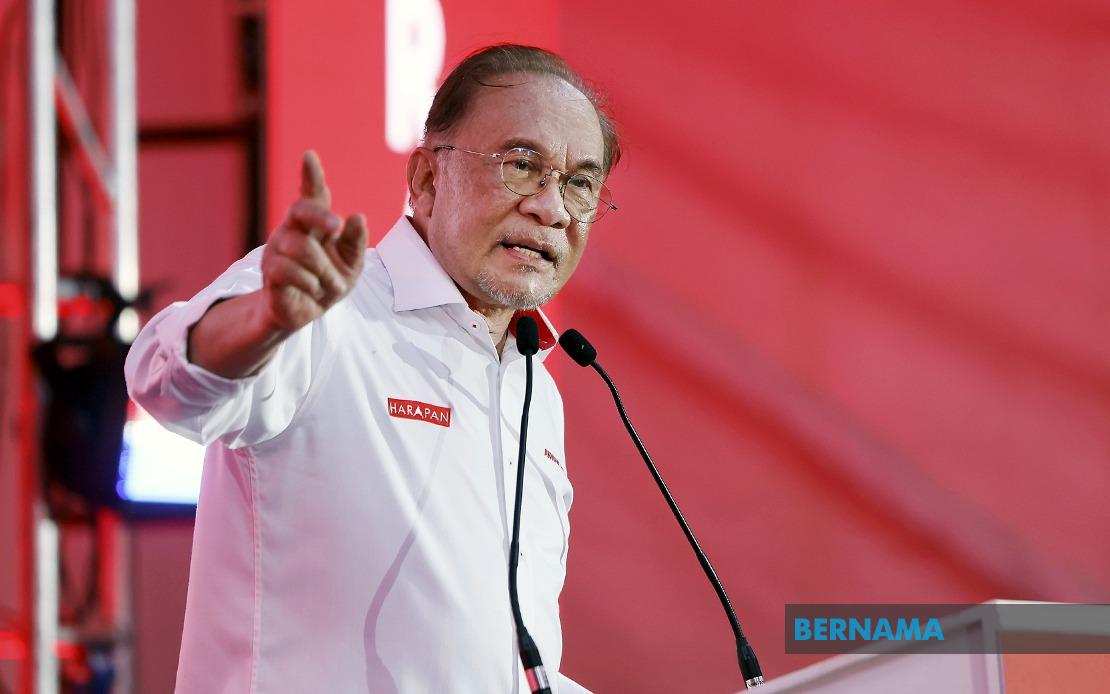
Prime Minister Datuk Seri Anwar Ibrahim has set out a clear expectation for Johor's political leaders ahead of the state election scheduled for July 11: they must demonstrate wisdom in prioritising issues, the backbone to make tough decisions, and an authentic connection to what matters to ordinary Malaysians. Speaking in Johor Bahru on July 4, the Pakatan Harapan chairman articulated a vision of governance that goes beyond the mechanics of administration to address the substantive qualities voters should demand of their representatives at the ballot box.
Anwar's appeal carries particular weight given the coalition's positioning as a reform-minded governing force since 2022. His emphasis on representatives who understand "the pulse of the people" reflects an implicit acknowledgement that electoral trust requires more than policy platforms—it demands leaders perceived as genuinely attuned to constituent concerns. In the Malaysian context, where community grievances around development priorities, service delivery and equitable resource distribution frequently shape voting behaviour, this framing addresses real voter sentiment that extends beyond urban centres and into Johor's diverse neighbourhoods and small towns.
The Pakatan Harapan machinery has committed to sustaining the people's voice in state decision-making while protecting Johor's interests, Anwar said, and driving the state toward broader development that benefits all residents. This dual messaging—defending state autonomy whilst advancing inclusive growth—reflects the coalition's attempt to balance localism with a national development narrative. For Johor specifically, which has historically alternated between different political coalitions and maintains significant economic independence through its ports, manufacturing sector and tourism, this positioning attempts to counter narratives that suggest federal-level priorities might overshadow state-level concerns.
On his first campaign day, Anwar attended seven separate community events across different areas of Johor, engaging directly with voters through meetings, public talks and grassroots engagement activities. This hands-on approach signals the coalition's intent to build momentum from the ground up, moving beyond traditional media messaging to create personal connections with voters who will decide the election. Such intensive ground-level campaigning in Malaysia's second-largest state by economy speaks to how seriously the federal government views this election outcome, particularly given its bearing on national coalition stability and Anwar's own political standing.
Packatan Harapan has fielded a complete slate of candidates across all 56 state constituencies, distributing them among coalition partners according to established power-sharing arrangements. The coalition is running 20 candidates from PKR, 19 from Amanah and 17 from DAP. This distribution reflects the delicate internal balance within Pakatan Harapan, where each partner must secure sufficient seats to maintain credibility within their own voter bases and party structures. The decision to contest every seat, rather than concentrating resources on winnable constituencies, represents a confident posture but also reveals the coalition's assessment that it has a realistic pathway to victory across diverse Johor demographics.
The broader electoral landscape shows 172 candidates competing for the 56 seats, indicating substantial multi-way contests in numerous constituencies. This fragmentation of the candidate field means that plurality voting in many areas could produce victories with relatively modest vote shares, creating scenarios where turnout and voter consolidation become critical. For Pakatan Harapan, mobilising its urban, younger and more diverse voter coalitions whilst maintaining enough appeal in rural areas will determine whether it can translate its federal government position into state-level dominance in Johor.
Anwar's specific call for elected representatives who champion multiethnic cooperation—invoking that party members and voters "work together, build this nation, raise this state"—directly addresses concerns about communal divisions in Malaysian politics. The explicit naming of Malays, Chinese and Indians working collaboratively represents a conscious effort to position Pakatan Harapan as transcending the more communal-oriented political appeals that often dominate state elections. Whether this messaging resonates with Johor voters, particularly in constituencies where economic competition between communities shapes political attitudes, will significantly influence the election outcome.
The timeline provides early voting on July 7 and main polling on July 11, compressing the campaign period into roughly a week of intensive activity. This compressed schedule advantages candidates with established ground networks and media visibility, characteristics that a federal-level coalition with sitting ministers arguably possesses relative to opposition competitors. However, short campaigns can also amplify the impact of unexpected developments or perceived missteps, making the coming days strategically consequential for all competing parties.
For Malaysian and Southeast Asian observers, the Johor election carries significance beyond state politics. It represents an early test of whether Pakatan Harapan's federal government enjoys stable support at the state level, particularly in a geographically and economically significant state. A strong coalition performance would bolster Anwar's political capital ahead of potential federal elections, whilst a weaker showing could embolden opposition narratives about waning public confidence. The state election thus functions as a proxy measurement of national political sentiment, making the campaign intensity and resource commitment entirely rational from a federal perspective.
The election also reflects ongoing competition for Johor's political identity between different visions of governance and state prioritization. Johor's history as a state with significant economic autonomy, distinct cultural characteristics and a substantial non-Malay population creates a distinctive electorate with interests not always aligned with national coalition positions. Pakatan Harapan's campaign messaging that emphasises simultaneous attention to state interests and national unity represents an attempt to navigate this complexity, claiming that supporting the coalition serves both community and broader Malaysian interests.

