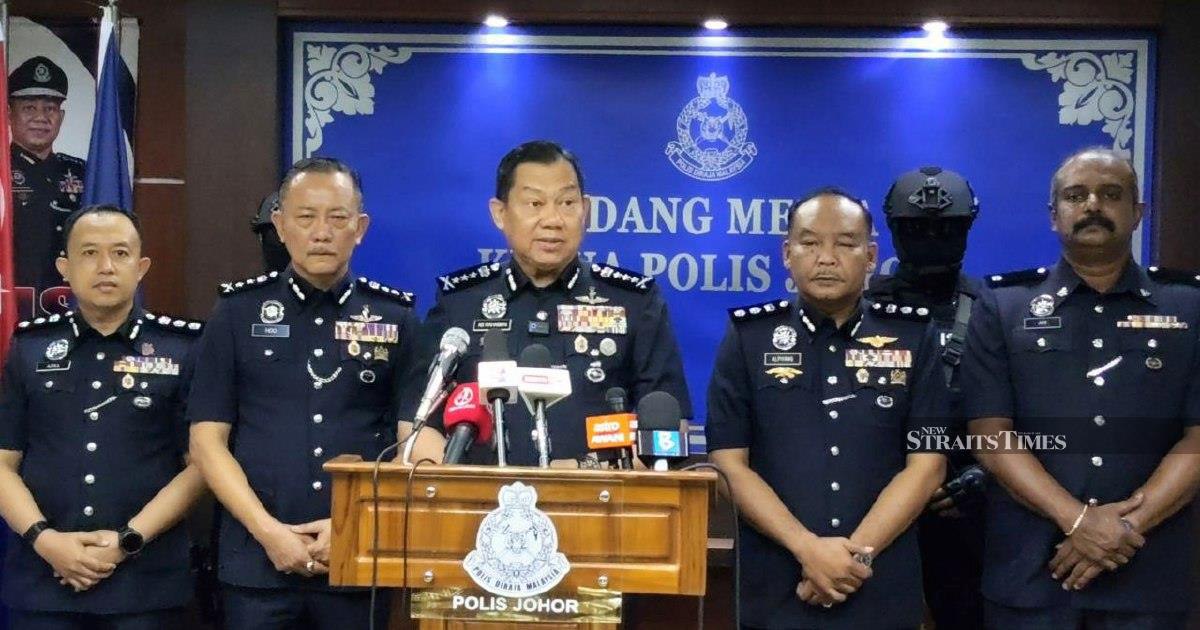
The Johor Baru police department executed a series of coordinated raids on Saturday that resulted in one of the region's more substantial drug seizures this year. Officers apprehended eight individuals suspected of operating an organized methamphetamine distribution circuit, with the operation yielding 60.78kg of the illegal substance with an estimated street value of RM3.04 million. The breakthrough follows weeks of intelligence gathering by federal narcotics units working in tandem with state police teams, representing a significant blow to trafficking operations in southern Peninsular Malaysia.
Among those taken into custody was a school dropout barely into his teenage years, who had been recruited to serve as a transporter within the distribution network. The youth's involvement underscores a troubling trend across the region whereby traffickers increasingly exploit minors and young adults as couriers, exploiting their lower visibility in law enforcement operations and their reduced legal culpability. The use of youthful operatives allows criminal syndicates to maintain distance from direct possession charges while still moving product through populated areas. This particular case demonstrates how vulnerable young people, often facing economic hardship or social disconnection after leaving formal education, become susceptible to recruitment by organized crime groups.
The remaining seven suspects are believed to have held more senior roles within the trafficking hierarchy. Preliminary investigations suggest their operation was neither isolated nor small-scale, but rather a component of a larger distribution network spanning multiple states. The methodical nature of the Saturday raids indicates police had mapped out the organizational structure and likely supply chain before making arrests, suggesting the seizure may represent only a portion of the total drugs in circulation within the network at the time of intervention.
Methamphetamine trafficking remains a persistent challenge throughout Malaysia and Southeast Asia broadly, with the stimulant maintaining strong demand among recreational drug users and presenting particular dangers when cut with fentanyl or other opioids. The region sits at the intersection of major global trafficking routes, with precursor chemicals flowing from international sources and finished products destined for markets across East and Southeast Asia. Unlike heroin, which has faced declining usage patterns in certain demographics, methamphetamine consumption continues expanding, particularly among urban populations and younger age groups. The drug's relatively low cost compared to other stimulants makes it increasingly accessible across socioeconomic strata.
The RM3.04 million valuation assigned to the haul represents the wholesale or distributor-level pricing rather than street-level retail values. At retail prices in urban markets, the same quantity would command substantially higher monetary value, potentially exceeding RM8 million or more depending on purity and local market conditions. This pricing differential underscores the profit margins involved in drug trafficking and explains the persistent appeal to criminal enterprises willing to accept the risks associated with production and distribution networks.
Johor Baru, as Malaysia's southern gateway and a major transit point between the peninsula and Singapore, has long featured prominently in narcotics enforcement operations. The state's geography, port facilities, and road infrastructure make it an attractive node for trafficking operations moving goods between markets. Police in the region have intensified operations in recent years, though traffickers continuously adapt their methodologies in response to enforcement pressure. Arrests and seizures, while strategically significant, remain cyclical rather than providing permanent disruption to supply chains capable of rapid reconstitution.
The involvement of a teenage transporter raises questions about recruitment and coercion patterns within trafficking networks. Investigations typically reveal whether such individuals entered the arrangement voluntarily due to financial necessity, were coerced through debt bondage or family connections, or suffered exploitation by criminal handlers. The distinction carries implications for how prosecutors approach charges and how courts assess culpability when minors appear in trafficking cases. Malaysia's drug laws permit severe penalties for trafficking offenses, with sentences potentially exceeding two decades imprisonment for quantities of this magnitude, though youthful offenders sometimes receive reduced sentences on grounds of age and culpability assessment.
The eight-person network likely operated with specific functional divisions—manufacturing or supply coordination, bulk distribution, territorial sales management, and lower-level street-level dealing through retail points. The inclusion of a school dropout suggests police may have broken the operation at multiple levels rather than concentrating arrests solely on senior operatives. Such comprehensive arrests prove more disruptive to network functionality than targeting leadership alone, as even replacement of senior members proves easier than rapidly reconstituting mid-level logistics and street-level sales infrastructure simultaneously.
Broader implications for the region remain concerning. Methamphetamine production capacity throughout Southeast Asia continues expanding, with clandestine laboratories operating across porous border regions where enforcement capabilities remain limited. The availability of precursor chemicals through both licit and illicit international supply channels ensures continued production regardless of individual enforcement operations. As long as demand persists—driven by pricing accessibility and the stimulant's pharmacological properties—supply-side enforcement alone cannot address the challenge comprehensively. Public health approaches emphasizing rehabilitation, community intervention, and demand reduction remain underdeveloped compared to criminal justice responses.
Meanwhile, Johor police have indicated that investigations remain ongoing regarding the broader network's operations, potential international connections, and sources of supply. Authorities typically interrogate suspects extensively to map upstream suppliers and downstream retail distribution networks. Information derived from such investigations often feeds into intelligence platforms shared with regional counterparts through Association of Southeast Asian Nations law enforcement channels and bilateral arrangements with countries including Thailand, Indonesia, and Singapore. The August seizure and arrests will contribute data points to larger strategic pictures of trafficking organization and methodology that law enforcement agencies continuously compile.

