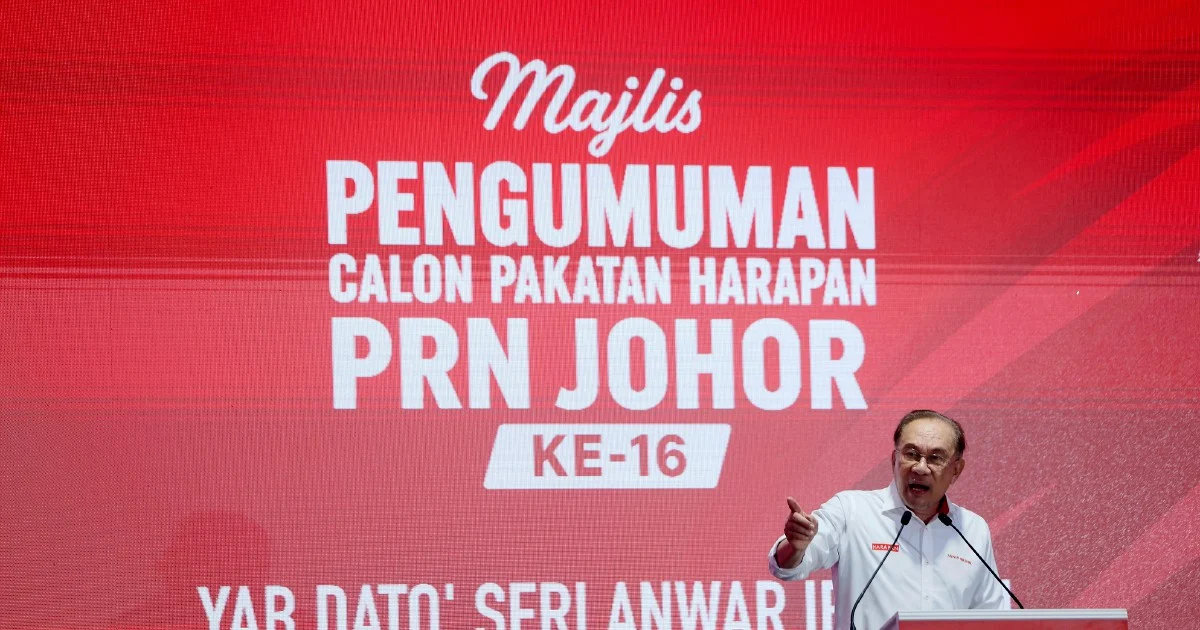
Prime Minister Datuk Seri Anwar Ibrahim has disclosed that the federal government has directed substantially more resources to Johor than the state has contributed to national coffers over the past three years, underscoring the administration's investment strategy in the peninsular state. Speaking at an event in Tangkak, the Prime Minister indicated that whilst Johor generated RM14 billion in revenue for federal coffers, the government has returned RM16 billion in the form of development allocations and financial support to the state.
This disclosure emerges as a demonstration of federal commitment to balanced regional development and fiscal redistribution across Malaysia's diverse economic zones. The figures suggest a deliberate policy to channel investment into Johor's infrastructure, services, and economic initiatives beyond what the state's tax base alone would ordinarily justify. Such allocations typically encompass infrastructure projects, education and healthcare facilities, social welfare programmes, and economic development initiatives that fall under federal jurisdiction or require centralised funding mechanisms.
Johor's position as one of Malaysia's most economically significant states makes these figures particularly noteworthy. The state generates substantial revenue through port operations, manufacturing, tourism, and the growing digital economy centred in Iskandar Puteri. The fact that federal returns exceed state contributions reflects a broader national fiscal philosophy wherein wealthier states effectively cross-subsidise development in regions requiring intensive infrastructure investment or facing economic restructuring challenges.
For Malaysian readers and investors, these figures carry implications for understanding how federal allocations are distributed and the underlying rationale guiding spending decisions. Johor's net recipient status, despite its economic productivity, indicates that the federal government weights factors beyond simple revenue generation when determining allocations. Regional development priorities, demographic needs, strategic infrastructure gaps, and inter-state equity considerations all influence funding decisions that exceed simple revenue-matching formulas.
The three-year period covered by Anwar Ibrahim's statement likely encompasses the financial years following the formation of the current administration. During this timeframe, Malaysia has navigated economic recovery post-pandemic, inflation pressures, and shifts in fiscal priorities toward green energy transition and digital infrastructure. Johor has received substantial investments aligned with these national agendas, particularly surrounding the hydrogen economy development and technology park expansions in the Iskandar region.
From a Southeast Asian perspective, Malaysia's approach to federal fiscal transfers offers comparative insights into how developed regional economies manage centre-state resource distribution. Unlike some neighbours where fiscal centralisation creates persistent regional grievances, Malaysia's framework explicitly permits allocations exceeding strict revenue contributions, acknowledging that balanced development requires strategic over-investment in strategic zones. This methodology aims to prevent widening inter-state inequality whilst maintaining economic efficiency.
The announcement carries political significance as well. Tangkak, located in the Muar district, represents a constituency where federal support becomes locally visible through completed projects and ongoing development. The Prime Minister's choice to highlight federal investment in this setting demonstrates how resource allocation announcements serve dual purposes—communicating fiscal responsibility to the broader electorate whilst reassuring specific constituencies of their status within national development priorities.
Johor's business community and investors have vested interest in understanding these federal commitment levels. The RM16 billion allocation over three years translates to approximately RM5.3 billion annually, a substantial resource base for state-level infrastructure development, public service expansion, and business environment improvements. These funds support the ecosystem within which private enterprise operates, from port efficiency to digital connectivity to workforce training programmes that enhance human capital.
The revenue contribution figures also warrant contextual analysis. Johor's RM14 billion contribution across three years averages RM4.67 billion yearly—a proportion that reflects both the state's economic output and the structure of Malaysia's tax system. Direct income taxes, corporate taxes, and indirect levies collected within Johor flow to federal revenue, with only designated state taxes retained for state budgets. The gap between what Johor contributes and receives thus illustrates the federal redistribution mechanism in operation.
Looking forward, these fiscal dynamics become increasingly relevant as Malaysia pursues economic diversification and positioning within regional supply chains. Johor's role as a gateway to ASEAN and its proximity to Singapore make continued federal investment strategically valuable beyond pure domestic considerations. Infrastructure quality and public service provision in the state influence broader regional competitiveness and bilateral economic relations with neighbours.
The Prime Minister's willingness to publicly detail these figures suggests confidence in both the federal budget's sustainability and the government's record on fulfilling allocation commitments. Transparency regarding fiscal flows between federal and state levels helps build institutional trust and allows stakeholders to assess whether stated priorities translate into actual spending patterns. Investors, planners, and policymakers benefit from understanding how federal resources genuinely flow through the system.
As Malaysia continues navigating macroeconomic challenges including inflation management and fiscal consolidation pressures, such allocations to developed states like Johor require ongoing justification and performance accountability. The implicit contract is that federal investments generate returns through economic growth, improved service delivery, and social development that justify the allocation differential. Monitoring whether Johor's economic trajectory and competitiveness justify continued above-revenue allocations will inform future federal budgeting decisions and centre-state fiscal relationships.

