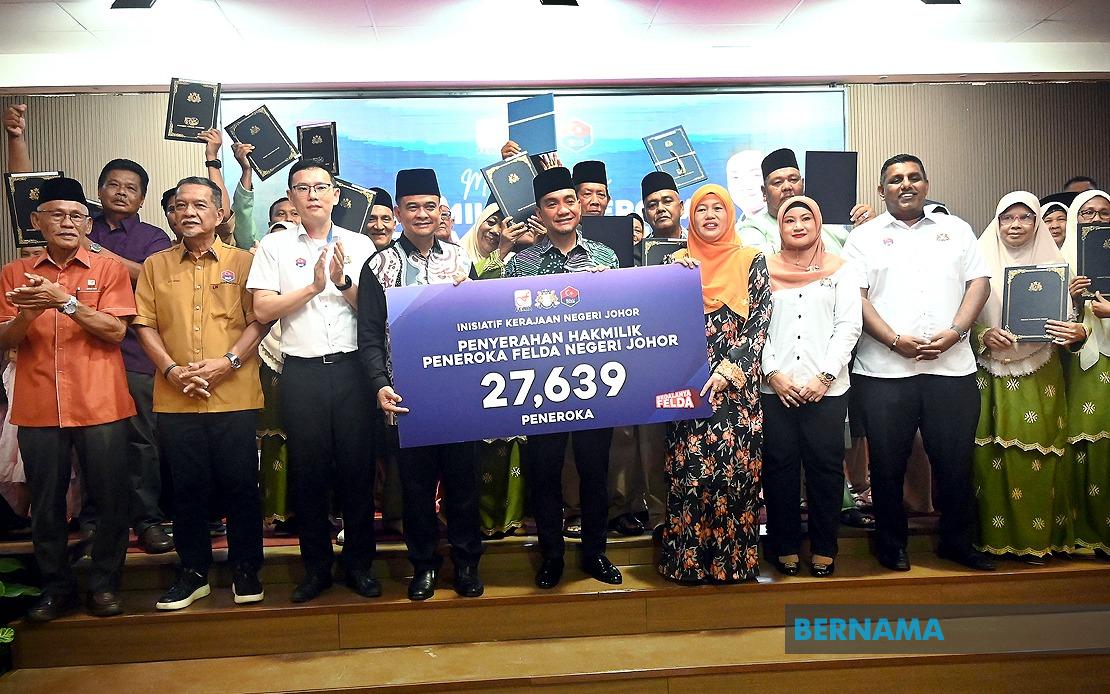
Johor has virtually eliminated a decades-old bureaucratic hurdle that has plagued Federal Land Development Authority (FELDA) settlers, with the state government announcing the resolution of 99.99 per cent of outstanding land title applications. Menteri Besar Datuk Onn Hafiz Ghazi disclosed the achievement at a ceremonial gathering in Kluang on June 23, where 210 settlers formally received their long-awaited land title documentation—a symbolic culmination of an extensive administrative overhaul that has taken years to complete.
The numbers tell a compelling story of institutional progress. From an initial backlog of 27,642 pending applications, the state administration has successfully processed and approved 27,639 cases, leaving just three applications still in the pipeline. This near-total clearance represents far more than a statistical victory; it addresses a fundamental insecurity that has constrained the economic opportunities and financial stability of thousands of families who have invested their livelihoods in FELDA schemes across southern Peninsular Malaysia.
The three districts of Kluang, Kota Tinggi, and Mersing have been particular focal points of this resolution effort, collectively accounting for 210 of the most recent title transfers. These three areas encompass some of the oldest and most established FELDA settlements in Johor, where settlers have often operated on plantations and residential plots for decades without formal documentary proof of ownership. The lack of clear titles has historically prevented many from accessing credit facilities, mortgaging their properties, or passing assets securely to the next generation.
Menteri Besar Onn Hafiz positioned the initiative within a broader rural development framework, underscoring that the resolution of land disputes forms a critical pillar of the Johor government's strategy to enhance welfare and prosperity in agricultural communities. His remarks signal a shift in how state administrations approach rural governance—not as a peripheral concern but as integral to inclusive economic development. By removing the institutional fog surrounding property ownership, settlers gain the clarity necessary to make investment and business decisions with confidence.
The historical context of this achievement cannot be overstated. FELDA settlers have historically faced structural disadvantages in Malaysia's property and credit systems. Many were allocated plots with provisional or conditional tenure that remained technically unresolved for generations. This ambiguity created a two-tier system where FELDA residents lacked the documentary security that urban and non-FELDA rural dwellers took for granted. Banks and financial institutions were reluctant to lend against uncertain titles, effectively locking settlers into subsistence-level economics despite owning valuable agricultural land.
The Johor government's commitment to treating FELDA settlements as a priority signals recognition that agricultural communities require deliberate policy attention. Without such interventions, the structural disadvantages embedded in older settlement schemes perpetuate rural poverty and limit intergenerational wealth accumulation. By systematically regularising titles, the state removes a critical bottleneck that has constrained rural financial inclusion across the region.
Johor Agriculture, Agro-based Industry and Rural Development Committee chairman Datuk Zahari Sarip's presence at the ceremony underscores the cross-departmental nature of this initiative. Title resolution touches multiple government functions—land administration, agriculture, revenue collection, and rural development—requiring coordination that has evidently been strengthened in recent years. This institutional alignment is itself noteworthy, as rural policy initiatives often suffer from siloed bureaucratic structures.
For Malaysian settlers specifically, the implications extend beyond Johor. FELDA operates settlements across multiple states, and Johor's administrative progress may serve as a template for neighbouring jurisdictions grappling with similar title backlogs. Selangor, Pahang, and other states with significant FELDA populations may face pressure to accelerate their own regularisation efforts, particularly if Johor's success becomes politically visible.
The near-complete resolution also has implications for land administration modernisation. The scale of this project—processing and verifying 27,000-plus land claims—requires robust documentation systems, skilled personnel, and sustained financial commitment. Johor's achievement suggests that Malaysian state governments possess the technical capacity to tackle historical land administration problems, provided political will and budgetary resources align. This is relevant as several other states grapple with their own title verification challenges.
Economically, the impact on FELDA communities could be substantial. With secure titles in hand, settlers can now approach financial institutions for loans to modernise farming equipment, diversify into higher-value crops, or establish agro-processing enterprises. The titles also create tradeable assets, enabling younger-generation family members to leverage inherited or purchased plots as collateral for entrepreneurial ventures. Over time, this could redirect capital flows into FELDA areas, reversing decades of relative capital scarcity.
The remaining three unresolved applications warrant attention despite the overwhelmingly positive headline figures. These outliers may involve disputed claims, missing documentation, or complex ownership situations that resist straightforward resolution. The Johor government will need to develop tailored approaches for these residual cases to genuinely claim complete closure.
Looking forward, maintaining this achievement requires ongoing institutional discipline. Land administration systems can deteriorate if follow-up processes are neglected—title holders must receive clear guidance on registration procedures, inheritance mechanisms, and dispute resolution channels. The state government's statement that FELDA settlements will continue receiving attention suggests awareness that this milestone is a foundation rather than an endpoint.
For Southeast Asian observers, Johor's accomplishment illustrates how targeted administrative reform can address long-standing rural grievances. The region contains numerous older settlement schemes across various countries where similar title uncertainties persist. The Johor model—combining political commitment with systematic administrative processing—offers a replicable approach to unlocking trapped value in rural communities and strengthening the economic security of agricultural populations who form the demographic foundation of Southeast Asian societies.

