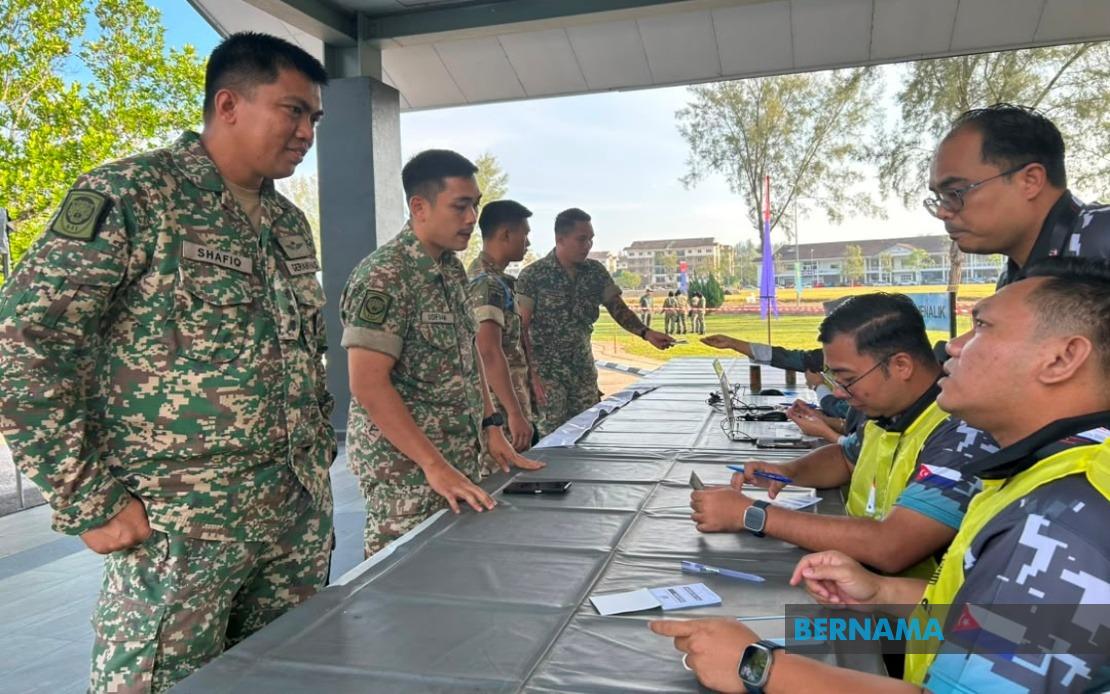
The 16th Johor state election is gathering momentum as early voting surged past the halfway point on July 7, signalling robust participation from the security establishment ahead of Saturday's general poll. By 11 am, the Election Commission confirmed that 56.32 per cent of registered early voters—representing 11,605 of the 20,607 eligible personnel—had already cast their ballots across 64 designated polling centres that opened at 8 am.
The early voting phase exclusively accommodates members of the security forces and their spouses, a framework designed to accommodate personnel who may be deployed or on duty during the main polling day. This group forms a critical institutional bloc within the broader electorate, and their enthusiastic participation on July 7 reflected confidence in the electoral process. The Royal Malaysia Police and General Operations Force contingent demonstrated particularly strong engagement, with 6,852 of their 12,063 registered personnel and spouses completing their votes. Meanwhile, the Malaysian Armed Forces maintained comparable momentum, with 4,753 of 8,544 eligible military personnel and dependents voting by mid-morning.
The bifurcated voting process introduced operational complexity to electoral management, yet the Election Commission executed proceedings smoothly across multiple venues. Polling centres operated on a staggered closure schedule, with doors closing progressively between noon and 6 pm depending on local conditions and remaining voter numbers. This staged approach prevented congestion while accommodating the working schedules of security personnel and their families, many of whom had obligations beyond the voting exercise.
The Johor election represents one of the nation's significant electoral contests, with 172 candidates contending for 56 state assembly seats. The competition intensity underscores Johor's strategic importance within Malaysia's political landscape—the state has historically served as a bellwether for broader electoral trends and a significant power base for various coalitions. The outcome will substantially influence the state government's composition and policy direction for the coming term.
Saturday's general polling will determine the ultimate distribution of these 56 seats among competing candidates and parties. The electorate encompasses approximately 2.7 million registered voters across the state, making this one of Malaysia's more substantial sub-national elections by raw numbers. The sheer voter population underscores the logistical complexity involved in administering the election while maintaining security and procedural integrity throughout the voting process.
Early voting participation patterns often foreshadow overall turnout levels and engagement patterns. The robust 56% figure among security personnel by mid-morning suggested that established voters were treating the election seriously and exercising their franchise without significant hesitation. This baseline enthusiasm could potentially indicate broader willingness among the general populace to participate in Saturday's main election, though such projections require caution given the distinct demographics and motivations of the security contingent.
The security forces' prioritized early voting window reflects Malaysia's electoral framework, which recognises that military and police personnel may face deployment or duty constraints on main polling days. This accommodation has become institutionalised across Malaysian elections at various levels, ensuring that those in uniform maintain meaningful representation despite professional obligations. The healthy participation among these voters on July 7 demonstrated that the mechanism functions effectively in practice.
For Malaysian political observers and regional analysts monitoring Johor's trajectory, the 16th state election carries significance extending beyond local governance. Johor's electoral outcome could influence negotiations within ruling coalitions, reshape factional dynamics within competing parties, and potentially affect strategic calculations ahead of federal-level politics. The state's geographic proximity to Singapore and its economic importance as a manufacturing and logistics hub add another dimension to the contest's strategic weight.
The Election Commission's transparent real-time reporting of voting figures, disseminated through social media platforms, reflected contemporary approaches to electoral transparency. Such public communication allows citizens and stakeholders to monitor the process, build confidence in institutional credibility, and track engagement patterns as they develop. The ready availability of voting statistics contributed to an informed public discourse surrounding the election.
As Saturday's main polling day approaches, the early voting performance establishes baseline metrics for assessing overall election-day turnout and engagement. The substantial participation among security personnel and their families on July 7 provided the Election Commission with operational data regarding logistical capacity, voter flow management, and procedural execution. These insights would inform final preparations and staffing arrangements for the anticipated voter traffic on Saturday across hundreds of polling stations throughout Johor.

