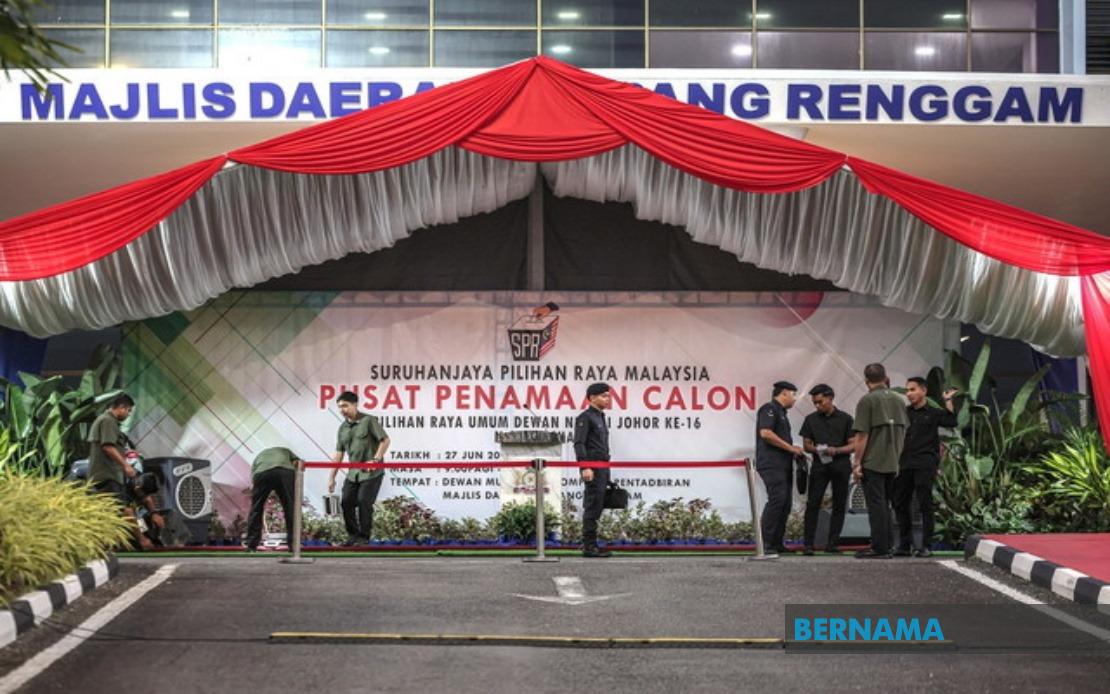
The nomination process for the 16th Johor State Election got underway across all 56 centres simultaneously at 9 o'clock this morning, marking the formal launch of candidate registrations for the crucial state poll. The compressed timeline gives aspirants just sixty minutes until 10am to lodge their nomination papers with returning officers at their designated centres, after which the eligibility verification phase commences before the campaign trail officially begins.
The procedural flexibility allows candidates, their proposers, and seconders to present nomination documents in various combinations—whether together as a trio, in pairs, or individually—providing some latitude in how submission requirements are fulfilled. This approach accommodates candidates whose official proposers and seconders may be unable to physically attend the centres due to prior commitments or logistical constraints common in geographically dispersed constituencies.
Once all nomination papers have been screened and eligible candidates verified, the Election Commission has established a fourteen-day campaign window that will extend through to 11.59pm on July 10. This period represents the critical phase when political parties can publicly mobilise resources, canvas voter support, and articulate their platforms across the state's various constituencies. The compressed campaign schedule compared to national elections reflects the compressed election cycle for state assemblies.
The electoral stakes are substantial, with the Election Commission registering 2,727,926 eligible voters across Johor. This figure comprises 2,703,175 ordinary registered voters, augmented by 12,041 military personnel and their spouses, and 12,710 police personnel and their spouses. These additional voter categories, while numerically modest, represent important constituencies that parties must engage strategically, particularly given military and police communities' traditionally distinct political alignments and priorities.
Party enthusiasm was evident even before the official start time, with supporters from various political organisations converging on nomination centres from as early as 6.30am to demonstrate backing for their preferred candidates. The gathering crowds, whilst largely peaceful, underscored the competitive intensity surrounding these state elections and the grassroots mobilisation that Malaysian political parties invest in nomination day proceedings. This public show of strength often carries symbolic weight, signalling organisational capacity and popular enthusiasm to media observers and rival parties.
Weather presented a complicating factor for the morning's proceedings, with the Malaysian Meteorological Department forecasting scattered rainfall across several districts including Johor Bahru, Muar, Batu Pahat, Kota Tinggi, Pontian, Tangkak, and Kulai. Conversely, Segamat, Kluang, and Mersing were expected to experience clear conditions. The meteorological department's afternoon forecast proved more concerning, with thunderstorm warnings issued for multiple districts including Johor Bahru, Segamat, Kluang, and Kota Tinggi, potentially disrupting nomination centre operations or candidate movements between locations.
Security arrangements reflected the importance attached to maintaining electoral integrity throughout the nomination phase. Police forces augmented by personnel from the People's Volunteer Corps maintained comprehensive security cordons around all nomination centres, implementing strict traffic management protocols and vigilant monitoring to prevent any incidents that might compromise the process or provoke inter-party confrontations. These precautions, whilst routine for Malaysian elections, remain essential given occasional tensions that emerge during competitive nomination periods.
The electoral calendar progresses swiftly from this point forward. The Election Commission has designated July 7 for early voting, allowing military and police personnel, along with other eligible voters with valid reasons, to cast ballots before the main polling date. The principal polling day is scheduled for July 11, barely two weeks after nominations close, compressing the entire pre-election period into a remarkably brief timeframe that tests party machinery and voter awareness simultaneously.
For regional observers and stakeholders across Southeast Asia, the Johor election carries implications extending beyond state boundaries. As Malaysia's most economically developed state and a strategic gateway to Singapore, Johor's political complexion influences not only national Malaysian politics but also regional economic and diplomatic dynamics. The election results will offer important indicators regarding voter sentiment across crucial urban and rural constituencies, potentially foreshadowing patterns relevant to future federal elections and regional power configurations in the years ahead.

