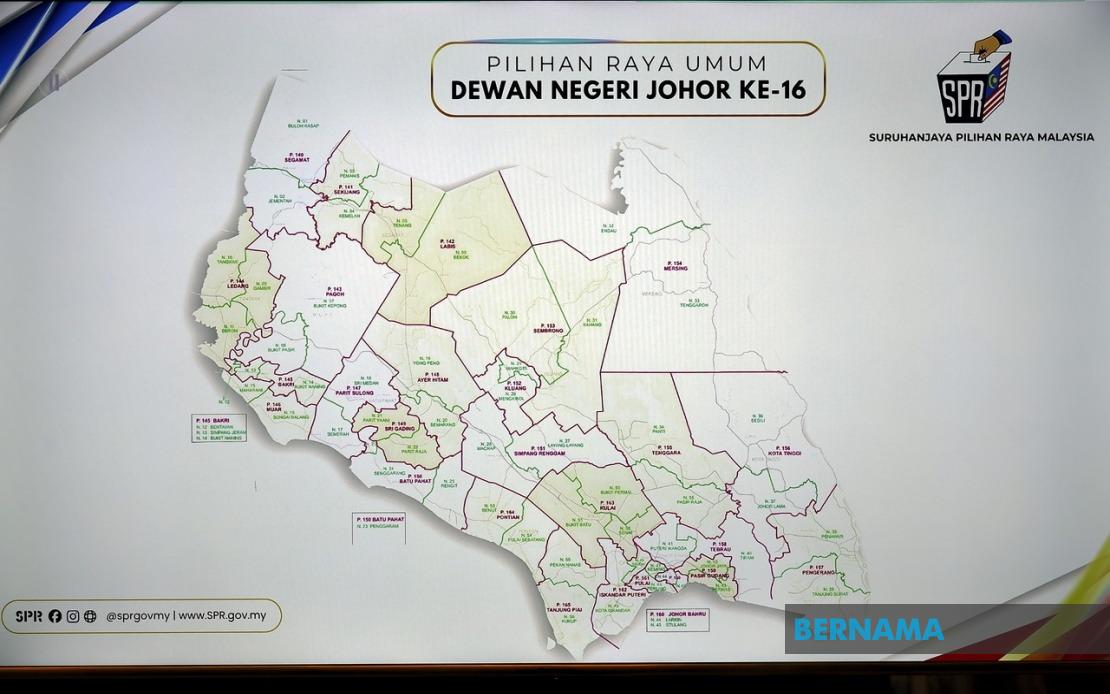
The 16th Johor state election enters its critical nomination phase tomorrow, marking the official launch of what is shaping up to be a significant political contest in Malaysia's second-largest state. The process begins early, with candidates required to register between 9 am and 10 am at designated nomination centres throughout Johor, followed by a screening phase before returning officers announce the final slate of contenders. Voters will ultimately cast their ballots on July 11, with early voting opportunities available on July 7. The Election Commission has confirmed that 2,727,926 registered voters are eligible to participate, comprising over 2.7 million ordinary citizens along with 12,041 military personnel and their spouses, and 12,710 police officers and their spouses.
The political landscape reveals a highly competitive three-way contest that diverges significantly from Johor's recent electoral history. Pakatan Harapan has committed to fielding candidates in all 56 seats, distributing its slate across Parti Keadilan Rakyat with 20 nominees, Parti Amanah Negara with 19, and the Democratic Action Party with 17. This represents an ambitious strategy aimed at capitalising on any dissatisfaction with the incumbent administration and making substantial gains across traditionally contested and opposition-leaning constituencies. Barisan Nasional is matching this comprehensive approach with a full slate of 56 candidates, anchored by UMNO's 36 nominees, the Malaysian Chinese Association's 16 contenders, and the Malaysian Indian Congress contributing four candidates.
Perikatan Nasional, the newer alliance comprising the Pan-Malaysian Islamic Party, Bersatu, and the Malaysian Indian People's Party, has adopted a more selective strategy, contesting 32 of the 56 available seats through PAS's 11 candidates, Bersatu's 16 nominees, and MIPP's five representatives. This calibrated approach suggests the coalition is targeting specific constituencies where it believes it can generate competitive challenges while consolidating its influence in particular regions. Beyond these three main contenders, several smaller parties are making election bids, including the Malaysian United Democratic Alliance aiming for four seats, the Socialist Party of Malaysia fielding a single candidate, and Parti Bersama Malaysia making its state election debut with 15 nominees.
The context for this election reflects shifting political dynamics in Johor, a state that has historically been a BN stronghold. In the 2022 state election, BN secured 40 seats, providing it with a commanding majority and control of the state government. However, PH managed to capture 12 seats, PN took three, and MUDA achieved one seat, indicating growing electoral competitiveness and voter interest in alternatives. The two years separating that election from tomorrow's nomination day have likely witnessed considerable political realignment, particularly as PH and PN have pursued different strategic partnerships at the federal level and various state governments have shifted coalitional arrangements.
The Election Commission is emphasising procedural compliance to ensure the election process runs smoothly. Prospective candidates are being instructed to verify their nomination forms in advance at either the relevant Returning Officer's Office or the State Election Office to minimise complications on nomination day itself. Equally important are deposit payments, which candidates must settle promptly while retaining receipts as documentary proof when submitting their nomination papers. These administrative preparations, while seeming routine, can determine whether candidates successfully register or face disqualification due to technical non-compliance.
Anti-corruption oversight represents another significant dimension of the election framework. The Malaysian Anti-Corruption Commission has issued explicit guidance reminding all candidates and political parties to maintain strict compliance with the MACC Act 2009 and the Election Offences Act 1954 as amended in 2012. The enforcement commitment extends beyond mere warnings, as the MACC has established five dedicated 24-hour operations rooms strategically positioned in Tampoi, Batu Pahat, Kluang, Segamat, and Mersing. These facilities provide direct channels for the public to report suspected corruption or abuse of power, creating a monitoring infrastructure intended to deter illicit conduct and respond rapidly to complaints throughout the election period.
This election assumes broader significance within Malaysia's political landscape, as Johor remains economically important and politically influential. The state's 2,727,926 voters represent a considerable bloc within the national electoral system, and outcomes in Johor often signal broader political trends affecting federal-level politics. A significant shift in Johor's composition—whether BN reinforces dominance, PH makes meaningful gains, or PN establishes a meaningful presence—could influence confidence levels among investors, civil society observers, and political strategists assessing Malaysia's democratic health and political trajectory.
The dissolution of the Johor State Legislative Assembly on June 1 formally triggered the electoral cycle, necessitating the completion of all election processes within a constitutionally prescribed timeframe. The compressed schedule between nomination day tomorrow and polling day on July 11 allows approximately two weeks for campaigning, candidate visibility, and public deliberation. This timeframe is considerably shorter than some previous state elections and may advantage candidates and parties with established ground infrastructure, media resources, and voter recognition compared to newcomers or smaller outfits attempting to build awareness from scratch.
For Malaysian voters and political observers in Johor and beyond, tomorrow represents a pivotal moment when the abstract political competition transforms into concrete candidacies. The nomination process determines not merely who competes but also reveals which parties are confident enough to contest broadly and which are adopting narrower strategies. The diversity of party participation, ranging from the three major coalitions to smaller entities like PSM and Bersama, reflects Malaysia's multi-party system, though the ultimate contest will likely pivot on how voters evaluate BN's governance record, PH's policy alternatives, and PN's positioning. As Johor enters what promises to be a competitive and closely watched state election, the nomination process tomorrow will crystallise the political choices available to voters and establish the framework for Malaysia's most significant state-level electoral contest since the 2023 federal election.

