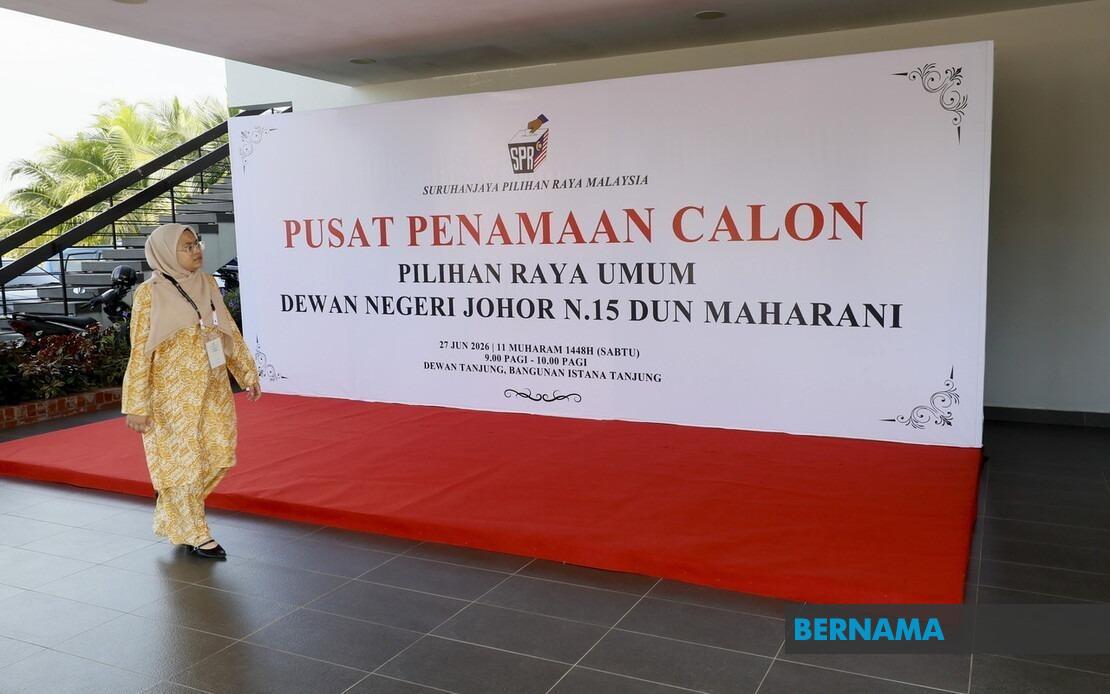
The 16th Johor State Election entered its critical opening phase today as nomination centres across all 56 constituencies opened their doors to receive candidacy applications. Beginning at 9 am, the Returning Officers stationed at these 56 nomination centres (PPC) will process applications for precisely one hour, closing submissions at 10 am sharp. This compressed timeframe underscores the Election Commission's tight operational schedule for Malaysia's southern jewel, one of the nation's most politically contested states.
Demand for nomination forms has been robust, with 593 forms sold as of yesterday morning, signalling broad interest from political parties and independent aspirants in contesting the 56 seats. By the time nomination centres opened today, 133 prospective candidates had already paid their election deposits and formally confirmed their intention to stand. This figure provides early indication of the competitiveness expected across constituencies, though final numbers will become clearer once the Election Commission announces the list of eligible candidates following today's deadline.
The electoral landscape reflects Malaysia's fractured political terrain, with five distinct coalitions and independent groupings mobilising candidates. Pakatan Harapan contests all 56 seats through its three component parties, with PKR fielding 20 candidates, Amanah 19, and DAP 17. This unified front represents the opposition's effort to consolidate anti-BN sentiment. Barisan Nasional, which holds 40 of the outgoing assembly's seats, counters with candidates from UMNO (36), MCA (16), and MIC (four), attempting to retain its traditional dominance in Johor.
Perikatan Nasional's fragmented fielding strategy reveals internal tensions within the coalition. PAS will contest only 11 seats while Bersatu, despite being the senior partner nationally, contests 16 constituencies. The inclusion of MIPP in five seats and Pejuang in one reflects PN's attempt to shore up support among Indian voters and appeal to Malay-Muslim nationalists respectively. This patchwork approach, compared to BN's more concentrated UMNO presence, suggests vulnerability in PN's Johor machinery.
New entrants and smaller parties add complexity to the contest. MUDA's participation in four seats represents the youth-oriented movement's persistence in state-level politics following its federal breakthrough. Parti Sosialis Malaysia fields one candidate, maintaining its symbolic presence in Malaysian electoral politics. Most notably, Parti Bersama Malaysia (Bersama) makes its electoral debut contesting 15 seats, suggesting backing from significant financial and organisational resources to field such a wide slate.
Johor's electoral roll encompasses 2,727,926 registered voters, comprising the vast majority of 2,703,175 ordinary civilian voters alongside 12,041 military personnel and their spouses and 12,710 police personnel and their spouses. The military and police voter categories have historically demonstrated distinct voting patterns and loyalty considerations, potentially influencing outcomes in constituencies where security forces are concentrated. This electorate has grown from previous elections, reflecting both demographic expansion and improved voter registration efforts.
The campaign period, commencing immediately following today's candidate announcement, extends exactly 14 days until 11.59 pm on July 10. This relatively short window compresses political messaging and ground operations, potentially advantaging well-resourced parties with established machinery. Early voting takes place on July 7, allowing military and police voters and others with qualifying reasons to cast ballots before the main election day on July 11. The condensed timeline suggests the Election Commission prioritised rapid resolution of the political uncertainty created by the June 1 dissolution.
Logistical preparations have been extensive to manage the nomination day operations and subsequent campaign. The Election Commission has issued explicit reminders about compliance with the Election Offences Act 1954, particularly concerning restrictions on loudspeaker use from vehicles and musical instruments during campaign activities. These regulations, designed to minimise public disruption, are particularly crucial in urban areas where multiple nomination centres operate in close proximity. Non-compliance carries criminal penalties that have deterred major infractions in past elections.
Weather conditions present a secondary operational consideration for today's proceedings. The Malaysian Meteorological Department forecasts morning rainfall across several Johor districts with afternoon thunderstorms expected, potentially affecting candidate rallies and supporter gatherings around nomination centres. Nevertheless, such weather is typical for the season and rarely disrupts nomination proceedings, which occur indoors at designated centres.
Security deployment reflects the political sensitivity surrounding Johor elections. The Royal Malaysia Police has deployed 4,832 personnel across the state to maintain order, manage traffic, and monitor compliance with electoral regulations. Road closures and diversions affecting 19 major highways near nomination centres are expected throughout today, requiring commuters and campaign organisers to adjust routes. This significant security presence indicates official concern about potential electoral violence or civil disturbance, though Johor elections have generally remained peaceful in recent cycles.
The outgoing assembly composition provides baseline expectation for this election's result. Barisan Nasional's commanding 40-seat majority gave it uncontested governance from the 2018 election, with Pakatan Harapan holding 12 seats, Perikatan Nasional three, and MUDA one. However, intervening by-elections, party defections, and shifts in voter sentiment may have altered the underlying political balance. Today's nomination day creates the formal opportunity for voters to evaluate candidates and parties across the full spectrum of choice available.
For Malaysia's wider political narrative, the Johor election carries outsized significance. As the nation's second-largest state by population and a BN stronghold for decades, outcomes here influence national coalition calculations and regional power dynamics within both Pakatan Harapan and Perikatan Nasional. A BN collapse in Johor would signal fundamental realignment in Malaysian politics, whereas BN consolidation would suggest the opposition's struggles persist despite federal-level electoral gains in recent years. The next fortnight will test these competing narratives on the ground.

