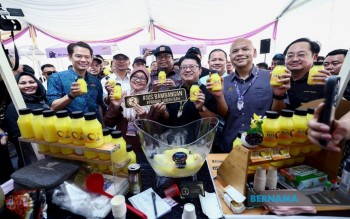
Sabah is set to become a focal point for Malaysia's national campaign to promote homegrown products internationally, with the selection of the state as a venue for the JOM MALAYSIA Festival 2026 marking a significant vote of confidence in its economic potential. The National "Let's Buy Malaysian Products" Movement (JOM MALAYSIA) represents far more than a conventional trade fair or consumer promotion, according to state leadership. Rather, it functions as an integrated economic instrument designed to weave together entrepreneurs, government agencies, private sector participants, financial institutions, and buyers into a cohesive network capable of sustaining long-term commercial growth.
Sabah Chief Minister Datuk Seri Hajiji Noor outlined how the JOM MALAYSIA framework directly supports the objectives of the Sabah Maju Jaya (SMJ) 2.0 development agenda, which itself prioritises sustainable growth underpinned by local business expansion and competitive advantage. The alignment between these two initiatives creates what officials describe as a comprehensive value chain—beginning with entrepreneurial capacity-building, progressing through product refinement and innovation, and culminating in access to both regional and global distribution networks. This "local to global" trajectory has become central to how Sabah frames its economic future within the broader Malaysian context, particularly as competition for investment and trade opportunities intensifies across Southeast Asia.
Recent performance metrics suggest Sabah's entrepreneurial base possesses genuine export potential. Throughout 2025, some 124 small and medium-sized enterprises from the state participated in eighteen international trade exhibitions, generating RM95.9 million in pipeline sales—a remarkable 37.12 percent jump from RM60.4 million the year prior. These figures indicate not merely marginal improvements but substantive growth in commercial capacity and market readiness. The consistency of this upward trajectory demonstrates that Sabah's products are finding receptive audiences beyond Malaysia's borders, though systematic infrastructure and targeted promotion remain necessary to translate opportunity into sustained revenue streams.
To reinforce this momentum, the Sabah government has deployed several targeted assistance programmes designed to prepare enterprises for international competition. The SME-UP Assistance Programme, operating under the SMJ 2.0 umbrella with a RM15 million budget, aims to cultivate 600 micro, small, and medium-sized entities across sectors. Complementing this is the Sabah Ready-to-Eat Programme, which addresses a critical gap in Malaysia's food export sector by offering commercialisation support, including development grants, access to retort processing equipment, and halal certification assistance—capabilities increasingly demanded by overseas retailers and food service operators.
Food products represent a particularly promising avenue for Sabah's export ambitions, given the state's agricultural heritage and the global premium now attached to authentic, regionally-distinctive food items. The halal certification component carries particular significance for markets across the Middle East, North Africa, and increasingly Southeast Asian nations themselves, where halal credentials serve as both regulatory requirement and competitive advantage. By bundling technical support with certification pathways, the state government addresses a common bottleneck that prevents promising food entrepreneurs from reaching international shelves.
The designation of Sabah as a JOM MALAYSIA festival host reflects federal recognition of the state's economic weight within East Malaysia's development trajectory. Such recognition carries symbolic importance—signalling to private investors and multilateral development institutions that Sabah occupies a prominent position in Malaysia's economic priorities. For a state historically overshadowed in national economic narratives by peninsular concerns, this visibility matters considerably in attracting capital, technical expertise, and international partnership arrangements.
Tourism emerges as a complementary engine for product promotion, with Sabah recording 3.79 million visitor arrivals and generating RM8.74 billion in tourism revenue during the previous year. These visitors represent captive audiences for local goods, from handicrafts and agricultural products to food items and cultural merchandise. The upcoming Visit Sabah Year 2027, paired with the broader Visit Malaysia Year 2026 initiative, creates an expanded promotional calendar that Chief Minister Hajiji Noor believes should be leveraged to position JOM MALAYSIA activations across multiple strategic tourism destinations throughout the state. This approach transforms tourism infrastructure into a distribution and marketing platform for entrepreneurial Sabah.
The broader policy context deserves scrutiny, however. Sabah's economic development has historically struggled with infrastructure gaps, limited access to capital for small enterprises, and geographic disadvantages in reaching peninsular and international markets. Whilst programmes like SME-UP and the Ready-to-Eat initiative address supply-side constraints, demand-side challenges persist. Malaysian consumers, let alone international buyers, often lack awareness of Sabah-origin products, and establishing brand recognition requires sustained investment in marketing that individual SMEs can rarely afford independently. The JOM MALAYSIA platform potentially solves this through collective brand leverage—presenting Sabah products under an officially-endorsed national banner that carries government backing and quality assurances.
For Malaysian readers across all states, Sabah's development holds broader implications. The success of the "local to global" model in East Malaysia may provide replicable lessons for SME development elsewhere, particularly in less-urbanised regions. Additionally, as Malaysia seeks to deepen regional trade integration through mechanisms like the Regional Comprehensive Economic Partnership (RCEP), the capacity of subnational economies like Sabah to participate in global value chains becomes increasingly material to national competitiveness.
The proposed expansion of JOM MALAYSIA programming across Sabah in conjunction with Visit Sabah Year 2027 suggests the state government recognises that single, time-bound festival events generate insufficient momentum for sustainable market access. Distributed activations across multiple locations and extended timeframes create repeated touchpoints with international buyers and visitors, increasing the likelihood that early awareness converts to actual orders. This reflects more sophisticated thinking about trade promotion than traditional trade fair models.
Ultimately, the JOM MALAYSIA initiative exemplifies how coordinated policy—linking trade promotion, SME development, tourism infrastructure, and regional branding—can address the multi-faceted challenges facing subnational exporters in developing economies. Sabah's selection as a festival venue provides tangible validation of this strategy, though translating the initiative's structural framework into measurable improvements in export volumes and entrepreneurial sustainability will require consistent implementation and adaptive management as market conditions evolve throughout 2026 and beyond.

