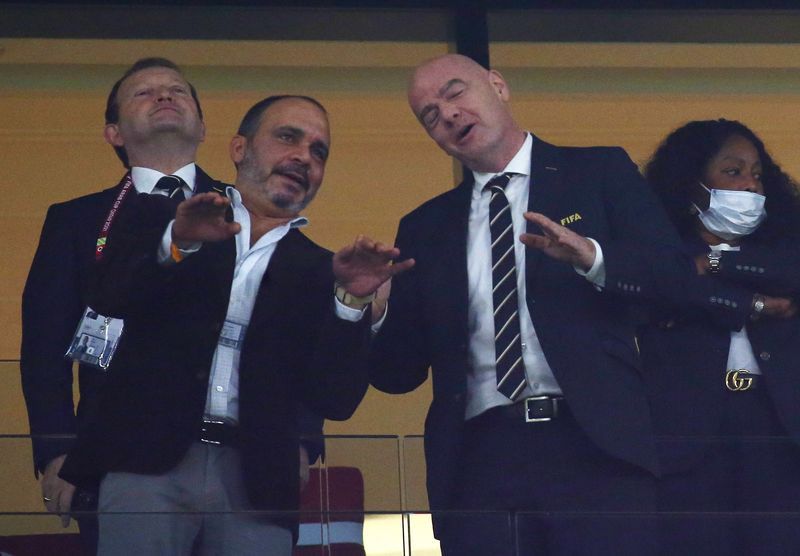
The president of the Jordan Football Association has escalated tensions with FIFA's leadership, publicly accusing FIFA President Gianni Infantino of employing coercive tactics by allegedly conditioning organisational support on a personal endorsement. Ali bin Hussein's scathing statement on Tuesday marks a rare direct confrontation between a national federation leader and the world soccer governing body's chief, coming at a moment when Infantino already faces mounting criticism from within the global football hierarchy.
According to bin Hussein, FIFA officials used verbal communication channels during the World Cup to suggest that endorsing Infantino would facilitate assistance for Jordan's football association across multiple operational challenges. This alleged quid pro quo arrangement, the Jordanian official contends, violates fundamental ethical principles that his nation's football body holds paramount. Bin Hussein's public rejection of such pressure signals that smaller football associations are increasingly willing to challenge FIFA's institutional practices directly, rather than accepting hierarchical pressure quietly.
The timing of bin Hussein's accusations is noteworthy, arriving as Infantino grapples with significant resistance from confederations and national associations over his now-abandoned proposal to monetise World Cup commercial rights. The FIFA president had proposed selling a minority stake in the organisation's commercial operations, a move designed to generate billions of dollars for global sports development initiatives. However, soccer governing bodies across continents swiftly rejected this controversial privatisation scheme following a rigid September 19 deadline that Infantino had imposed.
Infantino's position within FIFA has weakened considerably following this rejection. Both Mattias Grafstrom, FIFA's Secretary General, and renowned football administrator Arsene Wenger publicly distanced themselves from the World Cup stake sale proposal, signalling fractures within the organisation's executive leadership. Bin Hussein explicitly referenced these internal divisions, indicating that leadership concerns extend beyond commercial disagreements to fundamental governance and ethical questions.
Jordan's grievances, while specific to a smaller football nation, illuminate systemic issues within FIFA's operational framework. The association faces mounting financial pressures despite limited resources, with fans encountering prohibitively expensive ticket pricing while simultaneously being denied World Cup participation visas. These combined barriers effectively limit Jordan's domestic support base from engaging with international tournaments, creating a situation where the nation bears costs without corresponding revenue or grassroots benefits.
A particularly contentious issue involves taxation arrangements that disproportionately affect participating nations differently. Jordan faced significant U.S. government tax obligations through FIFA for its World Cup 2026 participation, a burden that teams based in Canada and Mexico—the other co-hosts—did not encounter. Bin Hussein characterised this arrangement as fundamentally unfair, noting that revenue intended for player compensation and staff support flows instead to tax authorities. This geographic disparity in tax treatment raises questions about FIFA's responsibilities to create equitable conditions across participating nations, regardless of host country location.
The delayed disbursement of prize money compounds these financial strains substantially. Jordan qualified for the World Cup for the first time in its history but exited during the group stage. Additionally, the nation's team reached the Arab Cup final in Qatar, a FIFA-organised tournament, yet has awaited compensation since December without receiving contracted payments. Bin Hussein emphasised the contradiction inherent in FIFA's situation: the organisation operates with substantial financial reserves in the billions of dollars while smaller associations struggle to compensate players adequately for tournament participation.
Bin Hussein's statement reflects a broader frustration among representatives of smaller football nations regarding resource disparities within FIFA's ecosystem. While the organisation claims its development initiatives benefit global soccer, the allocation mechanisms appear to advantage established confederations with greater political leverage. Jordan's minimal budget constraints mean that external costs imposed by FIFA participation—whether through taxation, visa complications, or delayed payments—represent genuinely significant financial burdens affecting player welfare and federation sustainability.
The accusation of "blackmail" carries substantial weight in diplomatic and institutional contexts. By employing this language publicly, bin Hussein signals that he views FIFA's alleged conditional assistance arrangements as falling outside acceptable governance norms. This framing converts what might otherwise be dismissed as routine political disagreement into a question of institutional integrity and ethical standards. The willingness to make such accusations suggests that frustration among federation leaders has reached a threshold where reputational concerns may outweigh diplomatic caution.
FIFA's response to these allegations remains pending. The organisation has been contacted for comment through formal channels, though its communications strategies typically involve delayed, carefully constructed statements. However, the convergence of bin Hussein's allegations with Infantino's existing difficulties suggests that the FIFA president's capacity to weather institutional criticism may be diminishing. Multiple high-profile disputes simultaneously—involving commercial proposals, internal leadership fractures, and allegations of coercive practices—create cumulative pressure that complicates Infantino's strategic position.
For Malaysia and Southeast Asian nations with comparable football development status, bin Hussein's public stance carries instructive implications. The willingness to challenge FIFA directly on matters affecting smaller associations demonstrates that federation leaders need not accept institutional pressures passively. Malaysian football's own funding challenges and complicated relationship with FIFA governance structures may benefit from understanding how other nations navigate similar terrain. The broader lesson extends to regional football confederations: collective action and transparency regarding institutional concerns can effectively counter hierarchical pressure from global governing bodies.

