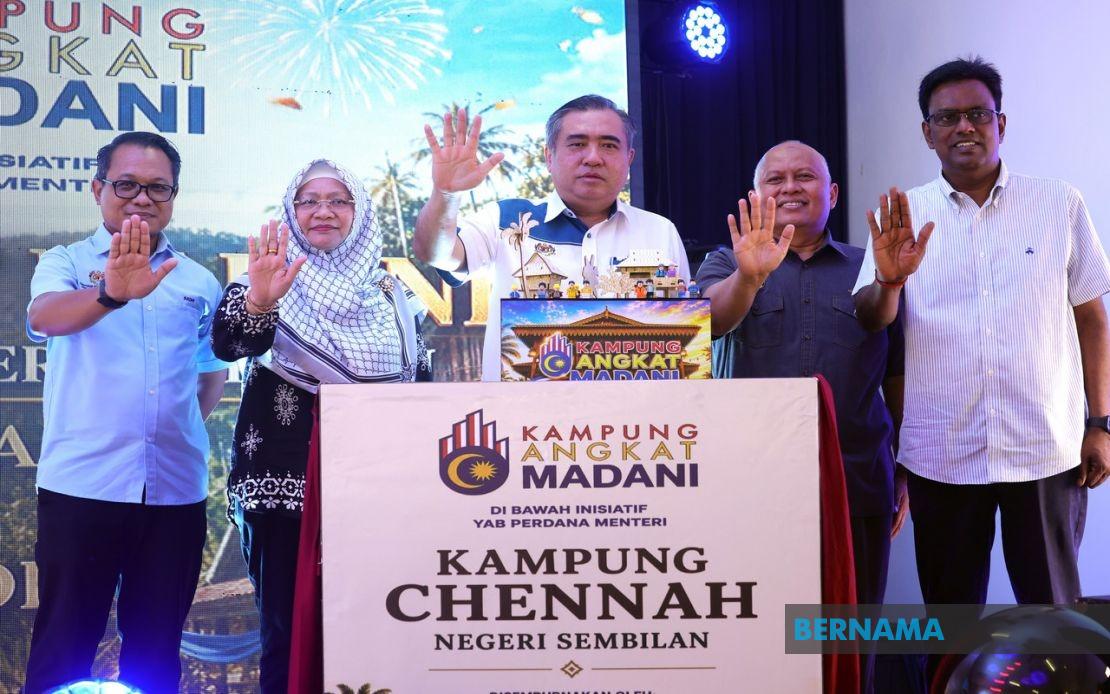
Transport Minister Anthony Loke Siew Fook has moved to dispel any perception that the Kampung Angkat MADANI village development programme is being deployed strategically around ongoing state elections, asserting instead that it represents a structured national rollout that commenced over two years ago and follows a predetermined schedule.
Speaking in Jelebu after launching a series of infrastructure improvements in Kampung Chennah, Loke explained that the initiative unfolds gradually across different phases to ensure remote rural settlements receive systematic assistance in addressing infrastructure deficits and broader socio-economic challenges. The minister's clarification addresses potential criticism that such high-visibility development projects implemented during election periods could be construed as government electioneering—a sensitive issue in Malaysia's political landscape where the delineation between legitimate governance and campaign activity remains contentious.
Loke referenced his own previous work on the scheme, noting that he had already overseen similar village enhancement exercises last year, including interventions in an Orang Asli settlement at Lenggeng. The breadth of coverage achieved through multiple government agencies and departments, he stressed, reflects comprehensive planning rather than ad-hoc implementation. The decision to execute Kampung Chennah's projects in July, according to the minister, followed existing schedules rather than election-driven timing considerations.
The underlying rationale for Kampung Angkat MADANI centres on systematic needs identification in villages situated at considerable distance from urban centres, enabling policymakers to design targeted development initiatives addressing local requirements. This diagnostic approach contrasts with generalist assistance programmes and theoretically allows scarce resources to concentrate on settlements with the most pressing infrastructure and service delivery gaps. For rural Malaysian communities often neglected in development priorities, such targeted attention holds genuine significance in closing the urban-rural development divide.
Loke underscored government compliance with established electoral protocols that prohibit ministerial participation in official government events within polling constituencies during designated campaign periods. While ministers retain their substantive responsibilities, they must abstain from attending or launching government programmes in affected constituencies throughout the formal campaign window. This framework, Loke noted, emanates from Prime Minister-level directives establishing heightened administrative standards regarding the separation of official duties from electoral activity.
The minister acknowledged that he personally will refrain from participating in official government programme launches within constituencies during the campaign phase, a self-imposed constraint designed to reinforce the boundaries between governance and politics. This represents an aspect of the broader administrative culture shift that leadership has promoted, reflecting evolving Malaysian political conventions regarding ministerial conduct during elections.
Kampung Chennah itself earned selection for the 2024 iteration of Kampung Angkat MADANI specifically because of its geographical remoteness and demonstrated deficiencies in fundamental amenities and infrastructure provision. The government has committed RM500,000 toward five distinct projects in the settlement, encompassing library facility renovation, futsal court refurbishment, and enhanced drainage infrastructure surrounding the mosque. These interventions directly serve community interests by addressing identifiable service gaps rather than pursuing abstract or tangential development objectives.
Implementation timelines for the Kampung Chennah projects span two to three months, with Loke pledging ministerial oversight to maintain execution momentum and prevent timeline slippage. This commitment to monitoring reflects the challenges that often plague rural development initiatives in Malaysia, where implementation delays and quality inconsistencies frequently undermine project efficacy and local stakeholder confidence.
Beyond immediate infrastructure considerations, Loke articulated a broader philosophical framing of ministerial responsibilities that extends transportation policy beyond conventional port, airport, railway and public transport regulatory functions. The Transport Ministry's engagement in village-level community development, he argued, demonstrates that contemporary governance encompasses social responsibility dimensions and population welfare considerations. This conceptualisation represents an attempt to position infrastructure and transport portfolios within holistic development frameworks rather than as purely technical-administrative domains.
For Southeast Asian policymakers grappling with persistent rural-urban divides and infrastructure disparities, the Kampung Angkat MADANI model offers a structured approach to systematic village assessment and targeted improvement implementation. Malaysia's experience implementing such programmes amid intense electoral competition illustrates broader regional tensions between development imperatives and political cycles, with governments across the region frequently navigating similar pressures to deliver tangible rural improvements while maintaining electoral propriety boundaries.
The controversy surrounding programme timing reflects deeper Malaysian political sensitivities about government resource deployment during elections, an issue that resonates across Southeast Asia where critics frequently allege that infrastructure announcements and project launches constitute implicit campaign activity benefiting incumbent administrations. Loke's emphasis on pre-nomination timing and adherence to established protocols attempts to position Kampung Angkat MADANI within legitimate governance frameworks rather than as electoral strategy, though such distinctions remain contested in competitive political environments where constituencies scrutinise all government activity through electoral lenses.

