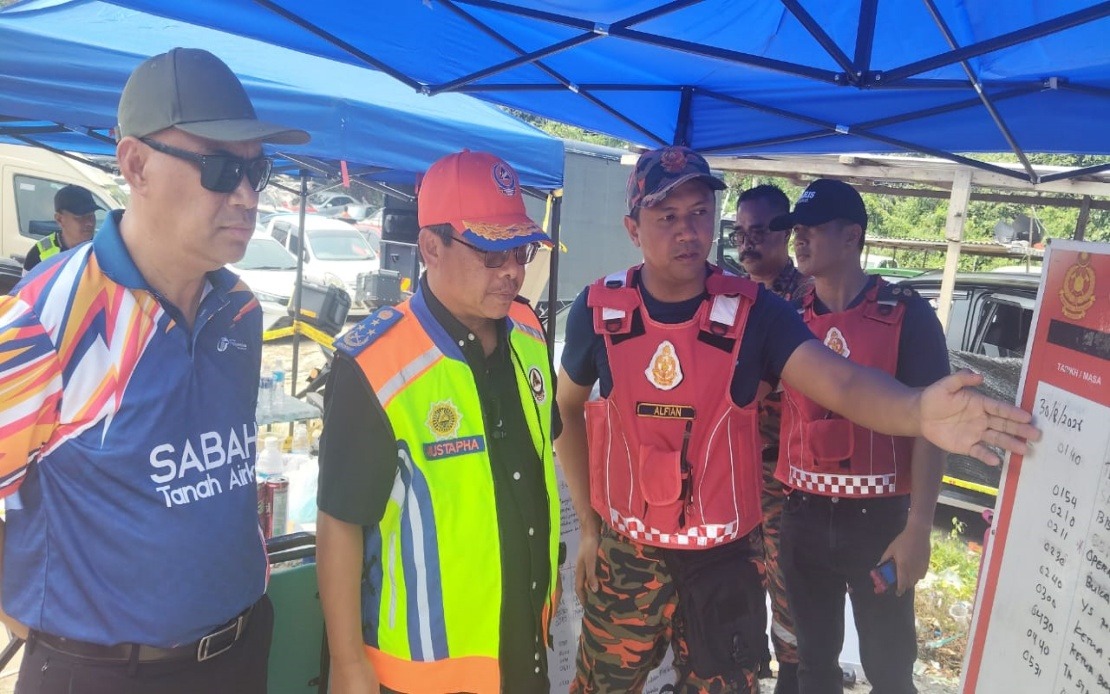
A catastrophic fire swept through Kampung Lok Buta in Kota Kinabalu early today, leaving three young children dead and forcing more than 200 families from their homes. The blaze, which ignited at 1.40 am, destroyed more than 200 residential structures in the densely populated village, making it one of the most significant fire disasters to strike the Sabah capital in recent memory. The three victims—four-year-old Nana Abdullah, her six-year-old brother Mohd Asrul Abdullah, and their eight-year-old cousin Nurfarahdilah Mohd Tajihah—perished in the flames, casting a tragic shadow over the emergency response efforts now underway.
In response to the scale of the disaster, authorities have established two temporary relief centres at Dewan Kampung Likas and Dewan Damai to coordinate shelter and assistance for the displaced residents. These facilities serve as crucial hubs for victim registration, donation collection, and overall disaster management coordination. The Kota Kinabalu City Hall (DBKK) has formally declared the affected area a disaster zone, activating protocols that unlock accelerated funding and resource allocation for recovery operations. Datuk Mustapha Sakmud, the Minister in the Prime Minister's Department responsible for Sabah and Sarawak affairs, visited the scene personally to assess the situation and oversee the establishment of relief infrastructure.
The immediate humanitarian priority centres on identifying and supporting students displaced by the fire. Mustapha recognised that educational continuity is essential for affected children and has committed to liaising with the Ministry of Education to ensure uninterrupted access to schooling. Students from primary and secondary schools, as well as those enrolled in higher education and Technical and Vocational Education and Training (TVET) institutions, will receive tailored assistance packages to minimise disruption to their academic progress. This proactive approach reflects growing awareness among Malaysian policymakers that natural disasters and large-scale emergencies can perpetuate educational inequality if vulnerable groups are not explicitly supported.
Mustapha, who represents Sepanggar in Parliament, emphasised that recovery must extend beyond immediate humanitarian relief to address systemic vulnerabilities exposed by the fire. He has requested DBKK and relevant agencies to convene urgent meetings to design comprehensive assistance frameworks for affected families. These discussions will address housing reconstruction, livelihood restoration, and psychosocial support for traumatised survivors, particularly children who witnessed the disaster. The engagement of multiple government tiers signals recognition that fires of this magnitude require coordinated, multi-agency responses rather than siloed departmental efforts.
Escalation of the matter to the highest levels of government underscores the seriousness with which federal leadership views the Kampung Lok Buta disaster. Mustapha indicated that the Malaysia Agreement 1963 (MA63) Implementation Action Council—a high-level forum attending to Sabah and Sarawak governance matters—would receive a comprehensive briefing on the fire's aftermath. This council, expected to convene with Prime Minister Datuk Seri Anwar Ibrahim and Sabah Chief Minister Datuk Seri Hajiji Noor in attendance, will consider strategic recovery initiatives and resource commitments necessary to rebuild the community. Such elevation of a local disaster to the national policy agenda reflects the fire's significance as both a humanitarian emergency and a governance challenge.
Datuk Seri Dr Sabin Samitah, the DBKK mayor and District Disaster Management Committee chairman, has assumed operational leadership of relief and recovery coordination. This dual mandate positions the city authority as the focal point for inter-agency cooperation, volunteer mobilisation, and community liaison. The involvement of the District Disaster Management Committee ensures that response efforts integrate disaster risk reduction principles and that lessons learned from this incident inform future preparedness planning. Sabah's vulnerability to fires—driven by factors including informal settlement density, inadequate building codes in some areas, and seasonal dry weather patterns—necessitates institutional learning mechanisms to reduce recurrence risk.
Immediate financial assistance to bereaved families has been pledged by Mustapha, though specific amounts were not disclosed in initial statements. Beyond immediate condolences, the families of Nana Abdullah, Mohd Asrul Abdullah, and Nurfarahdilah Mohd Tajihah will require ongoing support including funeral assistance, guardianship arrangements where applicable, and bereavement counselling. The loss of three children represents not only personal tragedy but a profound loss to the Kampung Lok Buta community, and culturally appropriate memorialisation and support will be important components of collective healing.
The Kampung Lok Buta fire raises broader questions about fire safety standards and informal settlement governance in Malaysian cities. Sabah's rapid urbanisation has produced sprawling kampungs where traditional housing clusters with high population density and limited emergency infrastructure are vulnerable to conflagration. Building code enforcement, fire hydrant placement, emergency evacuation planning, and community fire safety education remain inadequately resourced in many periurban settlements across Malaysia. The federal government's response to this disaster presents an opportunity to advance fire safety standards and settlement planning regulations that would reduce future risk across similar communities nationwide.
International experience demonstrates that post-disaster recovery trajectories depend critically on how quickly housing reconstruction begins and whether affected communities participate meaningfully in designing replacement housing and livelihood support. Malaysia's disaster management frameworks have evolved significantly in recent years, incorporating lessons from major incidents including the 2013 Lahad Datu conflict and various flood events. The Kampung Lok Buta response will test the maturity of these systems and provide evidence about whether inter-agency coordination, community participation mechanisms, and financial recovery support operate as designed when large-scale displacement occurs in urban contexts.
Social cohesion and community trust hinge on whether recovery is perceived as equitable and timely. The establishment of relief centres, high-level government engagement, and public commitment to student support represent immediate confidence-building measures. However, sustained government presence during the recovery phase—spanning weeks and months as families rebuild—will determine whether the community emerges stronger and more resilient. Southeast Asian cities hosting substantial informal settlements must grapple with this tension: rapid urbanisation creates housing affordability benefits for migrants and rural-urban migrants, yet concentrates risk. Kampung Lok Buta exemplifies both the vulnerabilities and the human resilience characteristic of Malaysia's dynamic urban frontiers.

