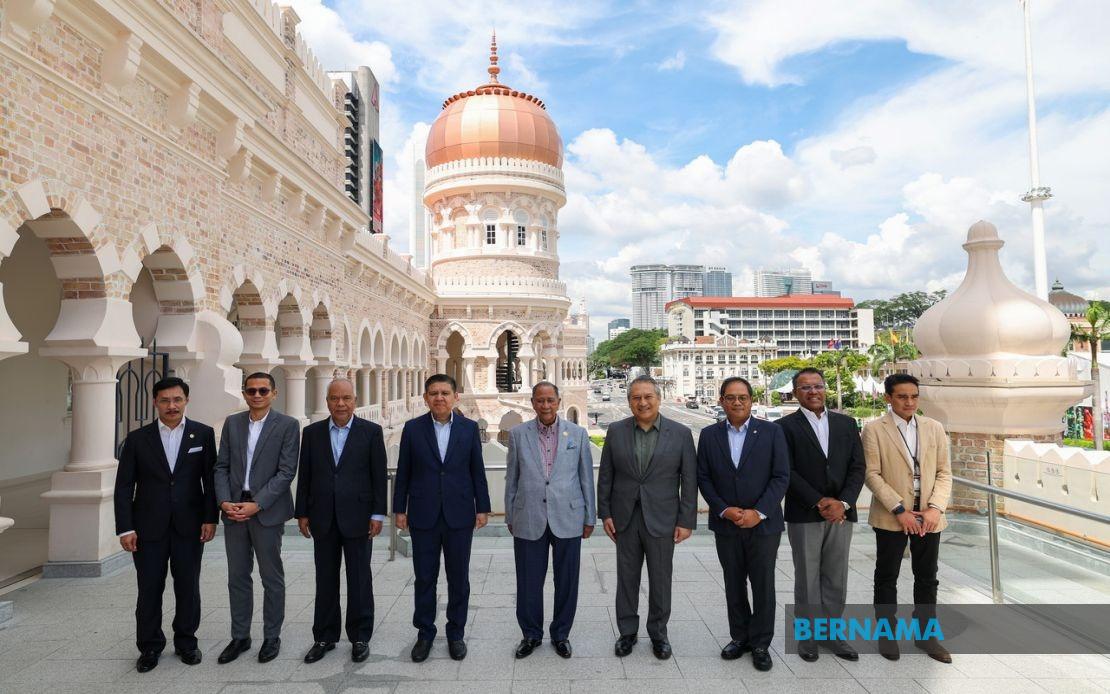
The Sultan of Kedah, Al Aminul Karim Sultan Sallehuddin Sultan Badlishah, made a significant visit to the Sultan Abdul Samad Building in Kuala Lumpur on June 24, reaffirming royal patronage of the nation's heritage conservation efforts. His tour of the meticulously restored colonial-era structure came at a moment of particular importance, as the landmark continues to establish itself as a public destination following its reopening to the general public earlier this year. The visit, lasting nearly three hours, encompassed a comprehensive examination of the building's newly refurbished spaces and represented tangible recognition of the institutional commitment to preserving Malaysia's architectural and historical legacy.
Greeted upon arrival by Khazanah Nasional's managing director, Datuk Amirul Feisal Wan Zahir, the Sultan was guided through the facility by senior management and curatorial staff. The delegation accompanying the royal visitor reflected the significance of the occasion, with Khazanah Nasional's chief corporate officer and general legal adviser Datuk Mohamed Nasri Sallehuddin, along with the head of real assets Selvendran Katheerayson, all in attendance. This constellation of senior officials underscored the central importance that Khazanah Nasional, Malaysia's sovereign wealth fund managing significant national assets, places on the building's restoration and public activation.
The Sultan's itinerary encompassed the primary exhibition spaces that form the cornerstone of the building's transformation into a cultural and educational facility. The Confluence Hall, a new gallery installation, provided historical context tracing Kuala Lumpur's origins and urban evolution. Staff from Think City, the urban renewal enterprise operating exhibitions within the space, briefed the royal visitor on the curatorial approach and interpretive frameworks guiding the displays. This educational component reflects a strategic decision to position the building not merely as an architectural artifact to be preserved, but as an active platform for public understanding of the city's historical trajectory and urban development patterns.
The tour continued into the Visionary Hall, where contemporary multimedia installations and architectural scale models illustrate Kuala Lumpur's trajectory as a modern metropolis. The integration of digital technologies and three-dimensional representations offers visitors an accessible method of grasping the complex urban planning decisions and infrastructure investments that have shaped the capital. The Sultan's subsequent visit to the historic balcony above the Porte Cochere provided both symbolic and literal elevation—the vantage point from which Malaysia's independence celebrations and major national ceremonies have historically been observed, making it a site of considerable constitutional and ceremonial weight.
A notable inclusion in the itinerary was the School of Hard Knocks, a social enterprise operated by Royal Selangor that provides vocational training and employment opportunities. This integration within the Sultan Abdul Samad Building reflects a broader contemporary approach to heritage sites, transforming them into engines of social benefit and community development rather than mere repositories of historical artifacts. The Sultan's engagement with this initiative signals royal support for combining cultural preservation with tangible socioeconomic interventions that benefit Malaysian society.
The Sultan Abdul Samad Building's journey to this moment of royal visitation encompasses a restoration process of substantial scope and significance. The building's Phase One conservation concluded in January 2024, following eleven months of intensive work undertaken through the Khazanah Heritage Fund initiative. His Majesty Sultan Ibrahim, King of Malaysia, formally inaugurated the completion of these restoration works, conferring additional ceremonial weight on the project. The structure's original designation as the Secretariat Building established it as the functional heart of colonial administration, subsequently transitioning to become symbolically and historically central to Malaysia's independence narrative.
Statistics documenting the building's public reception since reopening provide quantifiable evidence of its successful repositioning as a destination for locals and tourists alike. Since February 2, when the building opened to the general public, approximately two hundred thousand visitors have passed through its doors. This visitor volume, accumulated over merely four months, demonstrates substantial public interest and validates the institutional investment in making the space accessible and engaging. For a heritage site in the Malaysian context, such figures represent successful cultural programming and community outreach.
Khazanah Nasional's managing director articulated the broader philosophical framework underpinning the restoration initiative, emphasizing that conservation extends beyond structural preservation to encompassing the active interpretation and transmission of historical knowledge. The building's restoration represents not a static act of architectural conservation but rather a dynamic commitment to ensuring that the physical structure serves as a medium for understanding Malaysia's development trajectory, Selangor's regional significance, and Kuala Lumpur's emergence as a major metropolitan center. This interpretive approach transforms heritage preservation from an archival exercise into an instrument for civic engagement and historical consciousness.
The Sultan of Kedah's visit carries implications extending beyond ceremonial recognition. As a member of the Conference of Rulers, the constitutional body providing institutional oversight to Malaysia's system of constitutional monarchy, the Sultan's engagement with major national heritage sites reinforces the royal institution's connection to the nation's historical narrative and contemporary preservation agenda. Such visits, when undertaken by regional monarchs, strengthen the symbolic unity between various state sultanates and the broader national project of cultural stewardship.
The restoration effort also reflects international best practices in heritage conservation adapted to the Malaysian institutional context. The employment of professional conservation expertise, the integration of contemporary interpretation methods with historical authenticity, and the commitment to public accessibility demonstrate that heritage preservation in Malaysia operates according to standards comparable to global museums and cultural institutions. This raises the building's significance beyond its domestic historical importance to position it within transnational conversations about how postcolonial nations engage with colonial architectural legacies and urban heritage.
Looking forward, the Sultan Abdul Samad Building's trajectory from administrative center to heritage destination represents a microcosm of how Malaysia manages its colonial past while constructing contemporary meanings around national identity. The regular engagement of royal patrons, the steady accumulation of visitors, and the integration of diverse programming—from historical exhibitions to social enterprises—suggests that the building has successfully navigated the complex challenge of remaining historically authentic while remaining culturally and economically vital. The Sultan of Kedah's visit thus marks not a culmination of the restoration project but rather a validation of its successful transition into a new chapter of national significance.

