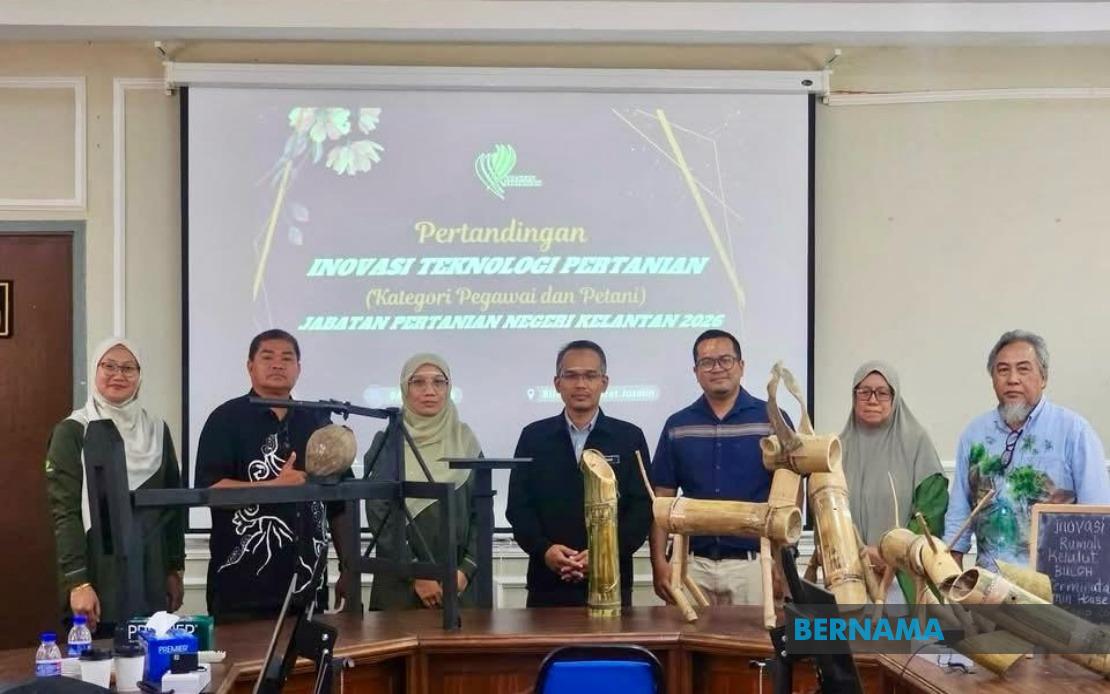
A mechanical innovation emerging from Kelantan's agricultural sector has earned recognition that could reshape how tropical fruits are processed across Malaysia. Plantation entrepreneur Che Adnan Che Kadir, 56, recently received a four-star rating for his coconut dehusking device at the Kelantan Department of Agriculture's 2026 Agricultural Technology Innovation Competition, an achievement that has opened unexpected pathways for the technology's evolution. The judging panel, impressed by the device's engineering and practical application, has suggested that the invention could be adapted beyond coconuts to address processing challenges facing other high-value crops.
The prospect of expanding the device's capabilities to durian processing particularly intrigued the adjudicators, who recognised an urgent need in the industry. Durian handling presents distinctive challenges that have long frustrated commercial producers and smallholder farmers alike. The fruit's thick, spiky exterior demands considerable skill to penetrate safely, and improper cutting techniques risk damaging the valuable flesh within or causing injury to workers. By proposing durian as a primary target for technological adaptation, the judging panel has identified a genuine pain point in Malaysia's most prestigious and economically significant fruit sector, one that affects everything from farm-level efficiency to export competitiveness.
Che Adnan's reaction to the judges' suggestion revealed the unexpected trajectory of grassroots innovation in Malaysian agriculture. He initially developed the device in 2024 to solve a practical problem on his own six-hectare holding in Kampung Chetok, Pasir Mas, motivated by the tedium and physical toll of traditional hand dehusking. The portable machine, weighing just 3.5 kilogrammes, dramatically accelerates the process—reducing the time to remove a coconut husk from between two to three minutes using conventional methods down to approximately one minute, with skilled operators achieving results in forty to forty-five seconds. What began as a personal solution to farm labour challenges has now attracted institutional attention and validation, positioning Che Adnan as a potential contributor to broader agricultural modernisation.
The support extended by the Kelantan Department of Agriculture proved essential to Che Adnan's entry into the competition framework. The state-level assessment involved rigorous evaluation by a multidisciplinary judging panel that included representatives from the Kelantan Department of Agriculture itself, the Malaysian Agricultural Research and Development Institute (MARDI), and Malaysia's polytechnic sector. This diverse expertise ensured that the device was evaluated not merely for mechanical function but also for scalability, safety, market relevance, and alignment with national agricultural development priorities. The recognition Che Adnan received—including selection for the farmer category award—now positions him as a candidate to represent Kelantan at the national innovation platform during National Innovation Week in Putrajaya at the end of September.
Progression from state to national competition, however, demands significant refinement work. Che Adnan has acknowledged that the judges' recommendations include structural and functional improvements necessary before the device can be considered for wider deployment. The inventor recognises that adapting technology proven effective for coconut dehusking to durian processing will require understanding the biomechanical differences between the two fruits, testing performance across multiple durian varieties, and ensuring worker safety within a modified operational framework. These are not trivial engineering challenges, and successful adaptation will demand technical expertise that extends beyond his original farm-based development process.
The financial dimension of scaling innovation remains a critical constraint in Malaysia's agricultural technology ecosystem. Che Adnan has articulated a clear path forward: securing an innovation grant would enable the design refinement, prototype testing, and production capacity analysis necessary to bring an adapted product to market. The RM10,000 national innovation prize accompanying potential national-level success would constitute seed funding for these objectives. However, truly commercialising the technology for industry-wide deployment likely requires substantially larger investment in manufacturing setup, regulatory compliance, quality assurance protocols, and market distribution infrastructure—resources that individual innovators rarely possess.
The durian sector represents an exceptionally promising application domain for such innovation. Malaysia's durian industry generates billions of ringgit annually and has become increasingly export-focused, particularly toward China and other Asian markets. Processing efficiency directly impacts farm profitability and supply chain competitiveness. A mechanised dehusking solution could reduce labour costs, improve food safety through consistent handling standards, increase processing throughput, and potentially enable smaller producers to compete more effectively in commercial markets. The fruit's cultural significance and economic weight mean that innovations addressing its processing have amplified market potential compared to less prominent crops.
Beyond durians, Che Adnan mentioned that areca nuts also featured among the judges' suggestions for technological adaptation. The breadth of potential applications underscores a fundamental characteristic of well-designed agricultural machinery—that success in one domain often hints at broader utility. A device succeeding with coconut husks, durian shells, and potentially areca nut processing demonstrates underlying mechanical principles applicable across the tropical agriculture portfolio. This modularity and transferability enhance the invention's strategic value to the national agricultural modernisation agenda.
The institutional framework surrounding Che Adnan's innovation reveals how Malaysia's agricultural development system attempts to identify and nurture grassroots technological solutions. The competition structure itself—state-level qualifying rounds leading to national exposure—creates pathways for farm-based innovators to access formal recognition, expert feedback, and potential funding mechanisms. MARDI's involvement ensures that innovations are assessed against research-grounded standards, while polytechnic participation anchors evaluations in practical manufacturing and scalability considerations. For Malaysian farmers and agro-entrepreneurs, this ecosystem theoretically democratises innovation development and reduces the barriers that traditionally isolated agricultural improvements within corporate research facilities.
Che Adnan's expression of motivation despite his initial modest expectations captures an important dynamic in innovation adoption. He developed his device to address immediate personal challenges, with no anticipation that a localised farm solution would attract state and national institutional attention. This trajectory—from necessity-driven invention to potential commercialisation—illustrates how agricultural modernisation sometimes emerges bottom-up rather than through top-down research programmes. His willingness to adapt the original design based on expert recommendations and institutional guidance suggests a collaborative rather than proprietary mindset, which facilitates knowledge transfer and sector-wide improvement.
Looking forward, Che Adnan's progression through the national innovation competition will provide insights into Malaysia's capacity to nurture, scale, and commercialise agricultural technologies developed outside traditional corporate or research institution channels. Success would validate investment in state-level agricultural innovation competitions and demonstrate that practical farm-based solutions deserve institutional support comparable to laboratory-derived innovations. Conversely, if the device struggles to secure commercialisation pathways despite national recognition, it would highlight systemic gaps between innovation recognition and market realisation—a persistent challenge in translating promising agricultural technologies into farmer-accessible commercial products.

