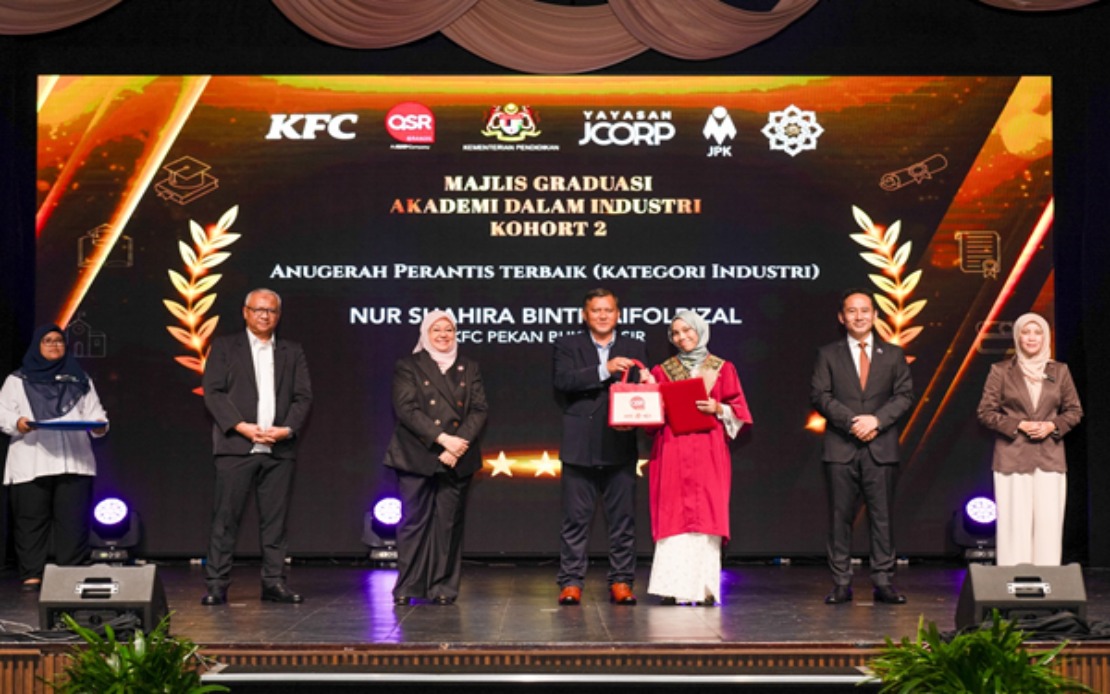
A strategic partnership between QSR Brands—operating KFC Malaysia—and Yayasan JCorp has successfully produced its second cohort of 37 vocational graduates through the Applied Dual Intake (ADI) programme, marking a significant milestone in bridging Malaysia's skills gap and developing young talent for the fast-food service industry. The initiative, which combines formal education with practical workplace training, represents a growing model of industry-education collaboration that policymakers and business leaders increasingly advocate as essential to building a competitive national workforce.
The ADI programme stands out as a deliberate effort to give students more than certificates; participants undergo intensive training in actual restaurant environments where they learn food preparation, customer service, operational management, and workplace safety standards. This hands-on approach ensures graduates possess immediately deployable competencies rather than purely theoretical knowledge. The second cohort underwent their entire training module at KFC restaurants across Johor Bahru, working within the vocational curriculum framework for Fast Food Preparation and Service established by Malaysia's education authorities.
Zulkernai Fauzi, director of the Ministry of Education's Technical and Vocational Education and Training (TVET) division, framed the ADI programme as a benchmark for how Malaysia should evolve its vocational education system. His remarks underscore a broader policy shift recognizing that Malaysia's economic competitiveness depends on producing skilled workers aligned with industry demands. The current cohort's achievement—building on the inaugural intake of 23 students who completed training in March 2025—brings the total number of graduates trained by KFC Malaysia through this channel to 60 since the programme's inception in June 2023.
The Cohort 2 graduates demonstrated exceptional academic performance, achieving a perfect 100 per cent pass rate across Vocational Stream Subjects (MPAK), the Malaysian Skills Certificate at both Level 2 and Level 3, while 95 per cent successfully passed the Sijil Pelajaran Malaysia (SPM) examination. Each graduate received five distinct qualifications: the Vocational SPM (SPMV), two levels of the Malaysian Skills Certificate, a Programme Completion Certificate, and a Certificate of Appreciation from QSR Brands. This multi-credential approach reflects international best practices in recognizing diverse competencies acquired through blended learning pathways.
Rozaini Mohd Sani, chairman of Yayasan JCorp, emphasized that participation in the ADI programme provides young Malaysians regardless of socioeconomic background access to structured career pathways and confidence-building experiences. His statement reflects Yayasan JCorp's broader mandate as a foundation committed to social mobility and skills development across Johor and nationally. The collaboration demonstrates how corporate social responsibility initiatives, when strategically designed, can address workforce shortages while simultaneously opening doors for youth who might otherwise lack mentorship or industry exposure.
Dr Sharifah Musainah Syed Alwi, chief human resources officer at QSR Brands (M) Holdings Bhd, reframed the programme's success not merely in terms of certification metrics but as evidence of genuine skill acquisition in operational contexts. Her perspective highlights a critical gap in Malaysian education: the distinction between obtaining a credential and demonstrating applied capability. By insisting on real-world mastery of restaurant operations, the ADI model addresses employer frustrations about graduate readiness—a persistent challenge in Southeast Asia's labour markets where qualification inflation often masks genuine skill deficits.
The ADI programme itself emerged in June 2023 from a tripartite collaboration involving KFC Malaysia, the Department of Skills Development (under the Ministry of Human Resources), and the Ministry of Education. This institutional architecture matters significantly; it signals sustained government commitment to vocational pathways alongside academic tracks, and demonstrates willingness by major corporations to invest capital and management capacity in talent pipeline development. For Malaysia, which faces demographic challenges and heightened regional competition for skilled labour from Singapore, Thailand, and Vietnam, such initiatives become strategically important.
The graduation ceremony for Cohort 2 also recognised outstanding individual performance through awards including the Best Apprentice Award (Industry Category), Best Apprentice Award (SPM Category), and Best Apprenticeship Documentation Award. These distinctions motivate continued excellence and provide incentive structures encouraging trainees to excel across different competency domains. Recognition mechanisms matter psychologically and professionally, particularly for young Malaysians transitioning from education into the workforce and building professional identities.
For Malaysian policymakers observing this model, several implications merit consideration. First, the ADI programme demonstrates that vocational education need not be a second-tier pathway if structured with industry rigour and clear credentials. Second, the model shows that scaling is possible: moving from 23 graduates in the initial cohort to 37 in the second, with intentions to expand further, indicates business case viability. Third, the programme's success in achieving high pass rates across multiple certification standards suggests that blended learning—combining classroom instruction with apprenticeship—may be more effective than purely classroom-based vocational training for many students.
Beyond the immediate context of fast-food service, the ADI programme offers a template potentially applicable across Malaysia's hospitality, retail, manufacturing, and construction sectors. These industries consistently report difficulty recruiting and retaining workers with appropriate foundational skills and work ethic. If QSR Brands' success with KFC can be replicated by other major employers and industry associations, Malaysia could substantially expand its pool of job-ready young workers while reducing youth unemployment and underemployment—both perennial challenges in the Malaysian labour market.
The collaboration between QSR Brands and Yayasan JCorp also illustrates how multinational corporations operating in Malaysia can embed themselves within local development ecosystems rather than merely extracting labour. This approach builds social license, develops supply-chain resilience through local skill development, and contributes to national capability-building. As Malaysia competes regionally and globally for foreign direct investment, demonstrating corporate citizenship through workforce development programmes strengthens the nation's overall attractiveness as a business destination.
Looking forward, the momentum established by two successful cohorts positions the ADI programme as a potential model for replication and expansion. Government support, evidenced by TVET director Zulkernai Fauzi's public endorsement of further expansion, suggests policy alignment with scaling ambitions. However, success at scale will require sustained commitment from participating employers, adequate Ministry of Education resourcing, and demonstrated pathways ensuring graduates secure meaningful employment that leverages their newly acquired qualifications—a crucial factor determining programme reputation and applicant quality in subsequent cohorts.

