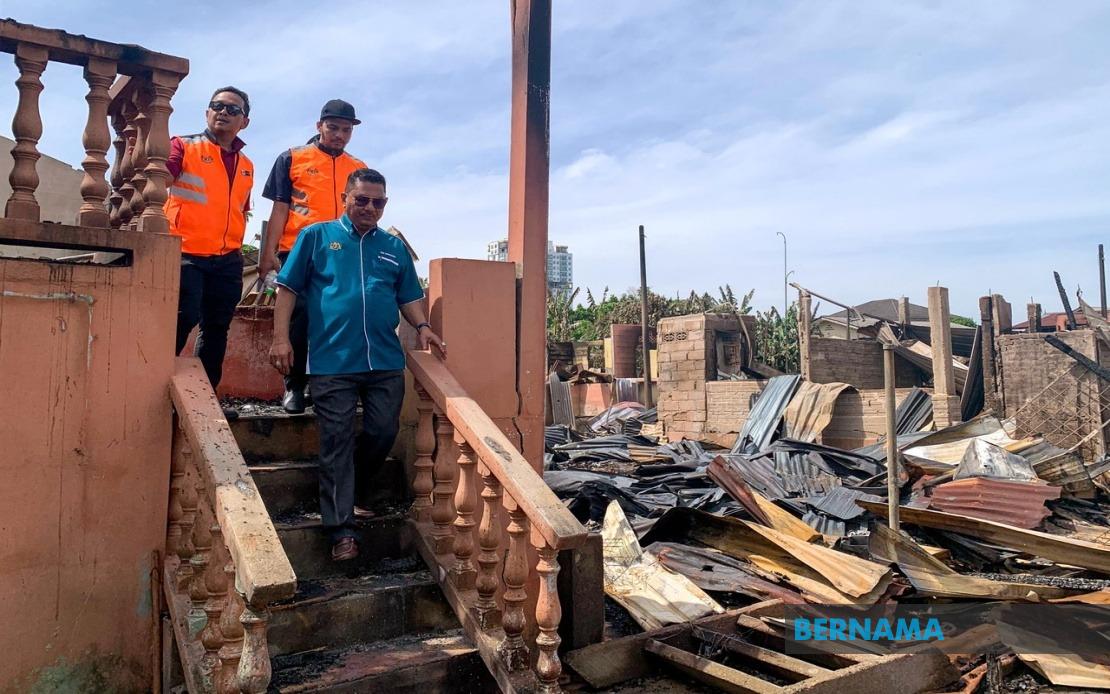
Kelantan's Fire and Rescue Department has concluded that carelessness sparked the devastating blaze that consumed 27 residences in Kampung Gok Kapur on June 8, with the fire investigation forensic unit pinpointing the ignition source to a gas lighter applied directly to a pile of papers inside a residential kitchen. The incident, which rendered 110 residents homeless, stands as a stark reminder of the dangers posed by indoor burning activities in densely populated settlements where homes are built in close proximity to one another.
Kelantan JBPM director Farhan Sufyan Borhan detailed the circumstances of the fire's origin during an interview in Kota Bharu, explaining that physical evidence and witness statements converged on a consistent narrative. The initial flame from the lighter caught the papers, which then ignited nearby combustible items stored in and around the kitchen area. The fire's rapid progression from this single point of ignition to engulfing the entire first house, and subsequently jumping to adjoining properties, demonstrates how quickly domestic conflagrations can escalate in Malaysian village settings where wooden structures predominate and building spacing remains minimal.
The department's technical investigation revealed that the burning activity was not an accident but rather a deliberate act carried out without proper safety precautions or consideration for the surrounding environment. The individual responsible had chosen to dispose of waste papers by direct flame combustion in an indoor kitchen space, a method fundamentally incompatible with fire safety standards and residential proximity norms. This classification as negligence rather than accidental fire carries implications for potential legal proceedings, as the investigation report will now be forwarded to police authorities and other relevant agencies for further determination of culpability and appropriate enforcement action.
The human toll extended beyond property loss. The 110 villagers displaced by the flames faced immediate hardship, with families relocated to a temporary shelter established at Mukim Banggol Mosque while authorities coordinated relief and reconstruction efforts. Fortunately, despite the scale of destruction across 27 residential structures, no fatalities were recorded in the incident, a fortunate outcome that underscores both the evacuation response capabilities mobilised by emergency services and the speed with which residents managed to flee their burning homes.
This incident reflects a broader vulnerability in Malaysian residential communities where traditional burning methods for waste disposal remain prevalent despite regulatory prohibitions and modern alternatives. In rural and semi-urban areas particularly, open-flame waste burning persists as an inexpensive disposal method, often motivated by limited access to municipal waste collection services or general unfamiliarity with fire codes. The Gok Kapur fire serves as a cautionary case study of how this culturally entrenched practice can catastrophically interact with residential density and structural materials common in Malaysian villages.
The Fire and Rescue Department has seized upon the incident as an educational moment, issuing public advisories against the use of open flame sources within or adjacent to residential zones. Officials emphasise that burning activities—whether for waste disposal, ritualistic purposes, or other reasons—must occur only in designated outdoor areas located at safe distances from inhabited structures and stored flammable materials. The advisory explicitly targets communities in Kelantan and across the region where such practices may persist.
From a broader Southeast Asian perspective, the Kampung Gok Kapur fire reflects fire safety challenges common across the region's developing areas. Rapid rural-to-urban migration, informal housing settlements, and inadequate municipal services create conditions where residents adopt hazardous waste management techniques. Kelantan, with its significant rural population and reliance on agricultural and small-scale economic activities, faces particular vulnerability to domestic fire incidents rooted in unsafe traditional practices. The state has experienced multiple serious fire incidents in recent years, suggesting systemic gaps in fire prevention education and enforcement.
The investigative methodology employed by the Fire and Rescue Department's forensic unit demonstrates Malaysia's commitment to scientific evidence-based fire investigation. By integrating physical evidence analysis with eyewitness testimony, investigators established a clear causal chain from the initial lighter application through the fire's propagation pattern. This approach enables authorities to distinguish between accidental and negligent fires, facilitating appropriate legal responses while also identifying preventive lessons for public communication campaigns.
Looking forward, the transfer of the investigation report to police establishes a pathway toward potential prosecution of the individual responsible for the negligent burning activity. Depending on the severity of charges and applicable legislation, penalties could range from fines to imprisonment. Beyond individual accountability, however, the incident highlights the need for community-level interventions including targeted fire safety education programs in rural settlements, accessible waste management infrastructure, and enforcement of regulations governing open-flame activities near residential areas.
The Kelantan JBPM's advisory to the public carries particular weight given the department's direct investigation of this consequence-laden incident. When an authoritative government agency explicitly warns against a practice and can point to a specific case involving 27 destroyed homes and over a hundred displaced residents, the message gains practical resonance beyond abstract safety recommendations. Residents throughout Kelantan and neighbouring states should heed the warning that convenience and cost-savings in waste disposal cannot justify risks that threaten entire communities.

