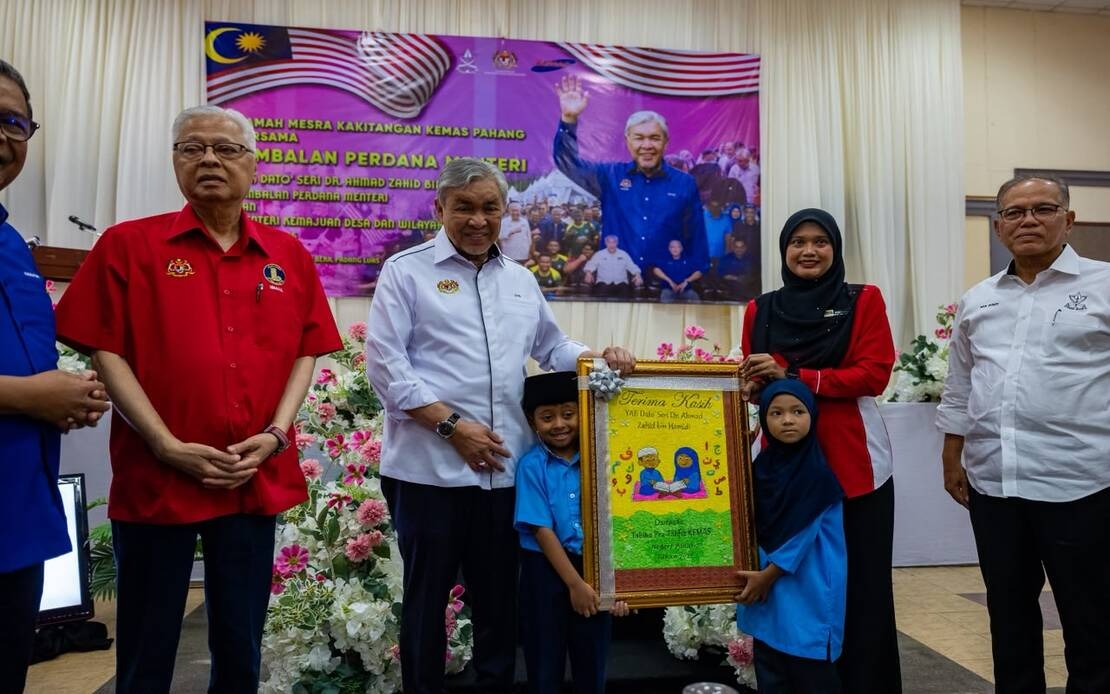
The Rural and Regional Development Ministry (KKDW) has outlined an ambitious agenda to reshape early childhood education delivery through its Community Development Department (KEMAS), seeking to balance technological innovation with values-based learning as schools adjust to lower starting ages. Deputy Prime Minister Datuk Seri Dr Ahmad Zahid Hamidi revealed the strategic direction while attending a community engagement programme in Bera, Pahang, underscoring how recent changes to enrol children at age six rather than seven have amplified the role played by KEMAS kindergartens and childcare centres in foundational learning.
The modernisation drive represents a significant pivot for an institution that has accumulated six decades of grassroots service. Ahmad Zahid framed the initiative not as abandonment of KEMAS's traditional community-centric mission, but rather as necessary evolution to ensure relevance in an increasingly digitised world. He emphasised that technological advancement must remain tethered to core principles of moral and religious formation, avoiding the trap of adopting technology for its own sake whilst neglecting spiritual and ethical development of young learners.
Immediate implementation plans centre on expanding Smart Class infrastructure and smartboard deployment across KEMAS kindergartens. This technological infrastructure forms part of a broader government push to democratise access to digital learning tools beyond urban and affluent areas, extending capability to rural and regional communities where KEMAS operates most intensively. The proposal reflects recognition that early exposure to technology—when paired with quality pedagogy—can enhance learning outcomes and prepare children for a labour market increasingly dominated by digital competencies.
Parallel to technological enhancement, KEMAS intends to deepen religious education through a structured Quranic memorisation programme commencing next year. The curriculum expansion moves beyond Juzuk 30, the commonly memorised final section of the Quran, to incorporate complete surahs including Yasin, Al-Waqiah, Al-Mulk and As-Sajdah. This represents a deliberate pedagogical choice to ground early learning in Islamic teachings whilst maintaining KEMAS's secular operational framework that serves all Malaysian communities. Ahmad Zahid underscored a critical prerequisite: KEMAS educators themselves must achieve proficiency in these memorisation techniques before instructing children, ensuring programmes are delivered with rigour rather than superficial implementation.
For Malaysian policymakers and educators, the dual-track approach addresses a persistent tension in Southeast Asian education systems. Governments across the region grapple with balancing secular skill development with cultural and religious preservation as societies modernise. By embedding religious instruction within a technology-enhanced learning environment, KEMAS potentially demonstrates a model that other departments and institutions might adapt. However, success hinges on quality teacher training and adequate resourcing—concerns that Ahmad Zahid obliquely acknowledged by calling for enhanced coordination between federal authorities, state governments, and elected representatives.
The initiative also reflects budgetary realities and intergovernmental dynamics within Malaysia's education ecosystem. Ahmad Zahid specifically commended the Pahang state government for securing land titles, allocating grants for facilities, and funding renovation projects. This acknowledgment signals that advancement of early childhood infrastructure depends on vertical alignment between federal aspirations and state capacity. Pahang's demonstrated commitment—evident through Menteri Besar Datuk Seri Wan Rosdy Wan Ismail's presence at the event—suggests willing state-level partnership, yet national rollout may encounter resistance in less developed or politically divided states lacking equivalent resources.
Statistically, KEMAS institutions have served approximately 8.4 million children since establishment, positioning the department as a significant player in Malaysia's early education landscape. This scale underscores both the opportunity and challenge inherent in systemic reform. Transforming pedagogical approaches, upgrading physical infrastructure, and retraining tens of thousands of educators across hundreds of facilities represents an undertaking of considerable complexity and expense. The ministry's framing of this as necessary evolution rather than optional enhancement suggests commitment to sustained investment, yet budget allocation and timeline remain undisclosed.
The emphasis on political stability and cross-level government cooperation carries particular resonance in Malaysia's current governance context. Ahmad Zahid's assertion that stability and willingness to embrace reform are prerequisite to educational advancement implies that partisan divisions or bureaucratic resistance could impede implementation. For KEMAS, which operates primarily in rural and underserved communities, delays or uneven rollout could exacerbate existing disparities between children in well-resourced urban areas and those in peripheral regions.
Regional implications warrant consideration. Across Southeast Asia, governments face similar pressures to internationalise curricula and adopt technology-driven learning whilst preserving cultural identity and religious values. Malaysia's KEMAS model—if successfully executed—could inform policy approaches in neighbouring countries confronting analogous tensions. Conversely, implementation challenges might deter regional emulation and highlight the difficulty of achieving balanced reform in resource-constrained environments.
The proposal to expand religious memorisation specifically targets young children whose cognitive development and neural plasticity make this period optimal for language and memory acquisition. Neuroscientific evidence supports early exposure to linguistic patterns, whether in multiple languages or sacred texts. By structuring memorisation within a formal curriculum rather than leaving it to informal family transmission, KEMAS aims to ensure equitable access to religious education regardless of socioeconomic background—a democratising impulse consistent with the department's community development mandate.
Looking ahead, success will require sustained attention to educator training, curriculum coherence, and equitable resource distribution. Ahmad Zahid's vision of KEMAS as an institution that preserves legacy whilst embracing transformation offers an aspirational framework, yet operationalising this balance demands rigorous planning and accountability mechanisms. The presence of former Prime Minister Datuk Seri Ismail Sabri Yaakob at the Bera event suggests cross-party recognition of early education's importance, potentially facilitating political consensus necessary for long-term funding and support across electoral cycles.

