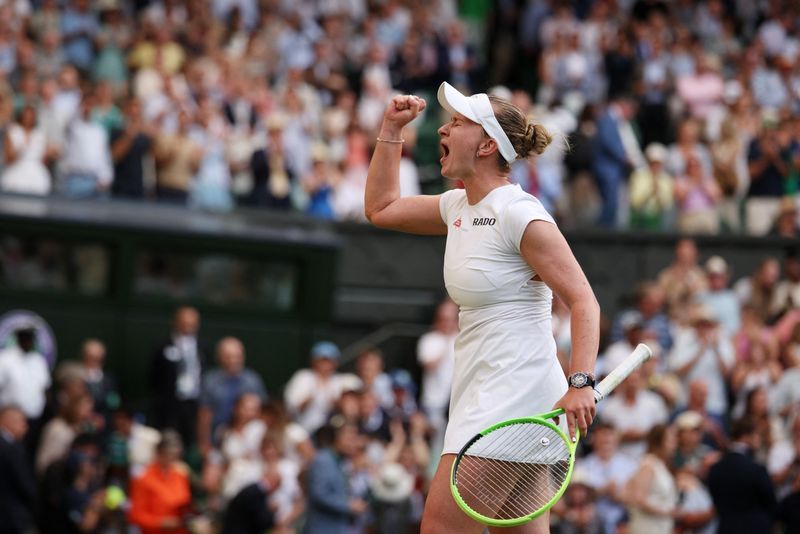
Barbora Krejcikova mounted an impressive recovery from a set down to overcome fifth seed Mirra Andreeva 4-6 7-5 6-4 in the second round at Wimbledon on Wednesday, consolidating her status as a formidable force on grass despite early wobbles against the rising Russian talent. The Czech veteran's tactical adjustment in the latter stages proved decisive as she navigated a contest that tested her composure against an opponent still riding the momentum from her maiden Grand Slam triumph at Roland Garros just weeks earlier.
Krejcikova's opening gambit suggested she would dispatch the 19-year-old Russian with relative ease, racing to a 3-0 lead as she imposed her will on Centre Court with aggressive baseline play and precise court positioning. However, the momentum evaporated as quickly as it had materialised, allowing Andreeva to find her rhythm and claw her way back into the encounter. By the time the first set concluded, Andreeva had seized the initiative, leaving Krejcikova facing an uphill battle against an opponent buoyed by confidence and the knowledge that she belonged among tennis's elite after claiming the French Open crown.
The significance of this match extends beyond the immediate result, given that Krejcikova herself claims the 2024 Wimbledon championship among her prestigious collection alongside her French Open title. Her ability to recalibrate her game during the second set demonstrated the match intelligence that has defined her career across singles and doubles disciplines. Rather than abandoning her initial game plan, Krejcikova recalibrated her serving patterns and court coverage, gradually wrestling control from Andreeva and forcing the decider that would ultimately prove decisive.
Andreeva's frustration mounted visibly as the third set unfolded, with Krejcikova's unwavering determination and experience proving increasingly difficult to breach. The young Russian saved six match points in a dramatic finale, showcasing the resilience that has already become her trademark despite her tender age, yet she lacked the finishing touch required to close out the opportunity. Krejcikova's persistence across those final moments illustrated why she remains a dangerous proposition on tennis's grandest stages, particularly on the surface where she has tasted the highest honours.
In the post-match interview, Krejcikova reflected on the intensity of the battle and the respect she holds for her opponent's growing prowess. She emphasised that this represented their fifth meeting, with each encounter proving to be a genuine test rather than a forgone conclusion. The Czech acknowledged Andreeva's exceptional trajectory, recognising that the teenager possesses all the ingredients necessary to sustain success at the highest level for many years to come. Krejcikova's willingness to credit her opponent's abilities speaks to the professional atmosphere that increasingly characterises women's tennis, where rivalries can coexist with genuine admiration.
Krejcikova expressed genuine satisfaction at her ability to execute under pressure on what she described as the finest tennis court in the world. Centre Court at the All England Club carries immense symbolic weight in tennis culture, and performing successfully there against a talented opponent reinforced her credentials as more than merely a doubles specialist or occasional singles contender. Her triumph demonstrated that she remains fully capable of sustaining excellence across entire tournaments, a crucial requirement for anyone harbouring ambitions of multiple Grand Slam titles.
The path forward presents a notably different challenge, as Krejcikova will now face fellow Czech Nikola Bartunkova in the third round. Intra-national matchups at this stage carry particular intensity, given the familiarity between players from the same federation and coaching ecosystem. The encounter also presents a narrative opportunity, with both competing for the prestige of representing their nation's tennis interests at a Grand Slam.
For Andreeva, the loss represents a sobering reminder that success at one Grand Slam does not guarantee progression through subsequent majors, particularly when facing experienced opponents who have navigated the pressures of these events repeatedly. While her French Open victory cemented her status as a force to reckon with, her inability to close out opportunities against Krejcikova illustrates the marginal differences that separate winners from runners-up at the sport's highest level. Her immediate reaction, throwing her racket in frustration, underscored the emotional toll of such narrow defeats.
The encounter holds broader significance for Southeast Asian tennis enthusiasts and observers, as it exemplifies the increasingly competitive landscape of women's professional tennis where breakthrough players can immediately challenge established champions. Andreeva's emergence adds another layer of unpredictability to major tournaments, creating opportunities for exciting matches that were previously more predictable. The resurgence of Central European tennis, through players like both Krejcikova and Andreeva, continues to enrich the sport's competitive environment and challenge the traditional hierarchies that have long defined professional tennis.

