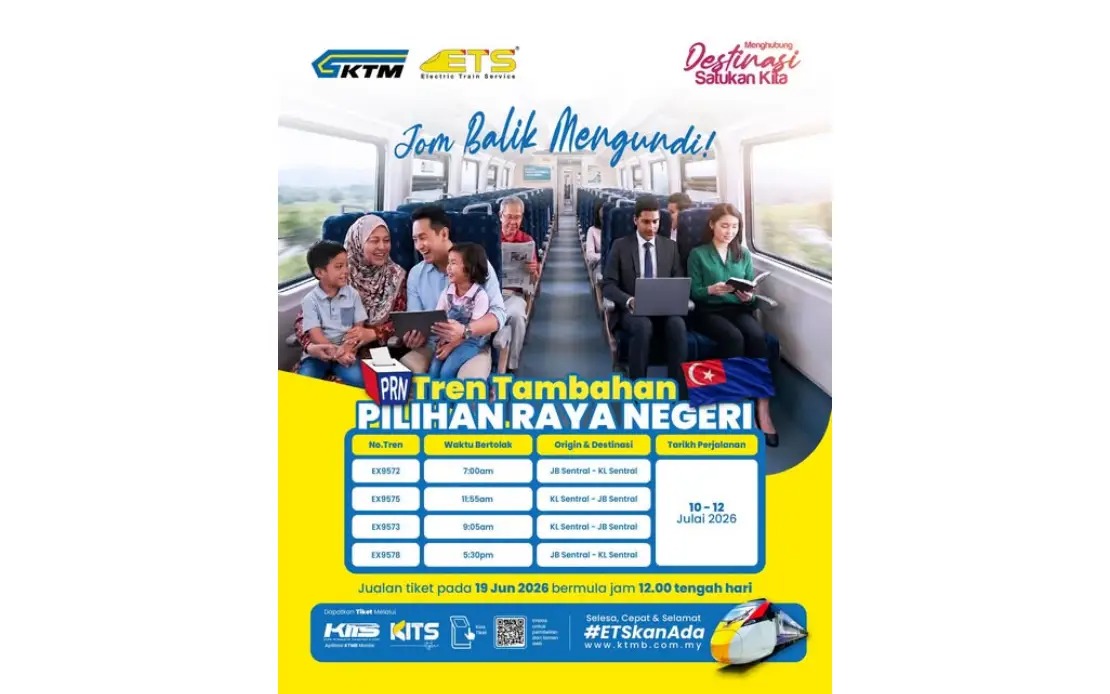
Keretapi Tanah Melayu Berhad (KTMB), the national rail operator, has announced a significant expansion of Express Train Service (ETS) capacity on southern routes to facilitate voter participation in the upcoming Johor state election. The decision underscores the railway operator's commitment to enabling democratic participation while managing transportation demands during a major electoral event. The additional train services will operate during the critical travel window between July 10 and 12, with July 11 designated as polling day by the Election Commission following the dissolution of the State Legislative Assembly on June 1.
Ticket sales commenced at noon on June 19, with KTMB offering multiple purchasing channels to maximise accessibility for travellers. Passengers can buy tickets through the KTMB Mobile application, the KITS Style app, the official online portal at online.ktmb.com.my, or through traditional ticket kiosks operated by KTMB across its network. This multi-channel approach reflects growing consumer expectations for digital convenience while maintaining support for those preferring in-person transactions, a consideration particularly relevant in Malaysia's diverse demographic landscape.
The expanded service capacity addresses a predictable surge in passenger demand as registered voters from across the peninsula make their way to Johor to cast ballots in their constituencies. During state election cycles, Malaysian transport networks routinely experience elevated pressure as diaspora communities and those who have relocated for work return home to exercise their voting rights. The Johor election, being one of Malaysia's largest state polls by population and electoral significance, typically triggers substantial inter-state migration patterns in the days preceding the vote.
KTMB's proactive approach mirrors similar contingency planning measures adopted during previous major electoral events in Malaysia. By announcing the service expansion well in advance and opening ticket sales early, the rail operator provides voters with certainty regarding travel arrangements, potentially reducing last-minute scrambling for seats and associated congestion. This forward planning is particularly crucial for the ETS network, which has become the preferred option for many Malaysian travellers seeking a balance between speed, cost-effectiveness, and comfort on medium to long-distance routes.
The decision also carries broader implications for Malaysia's transport ecosystem. The willingness of state-linked operators like KTMB to adjust capacity dynamically demonstrates how infrastructure can be mobilised to support civic participation. For voters residing in Klang Valley, Selangor, Kuala Lumpur, and other northern population centres, the availability of direct ETS services to Johor eliminates the need to rely on alternative modes such as buses or private vehicles, reducing overall traffic congestion on federal roads during what is typically a busy period.
From a regional perspective, Malaysia's expansion of rail services for electoral purposes may offer instructive lessons for other Southeast Asian democracies grappling with similar challenges of managing voter mobility during elections. Countries with geographically dispersed populations and significant intra-national migration increasingly recognise that facilitating transportation access is integral to ensuring democratic representation, not merely a convenience measure. The ETS network's evolution reflects Malaysia's broader infrastructure maturation and the integration of modern digital ticketing systems into public services.
The Johor state election carries particular weight in Malaysia's political landscape, influencing broader coalition dynamics at the federal level. Historically, voter turnout and participation rates in major state elections have served as barometers for political sentiment. Enhanced transportation options can marginally influence overall participation rates, particularly among voters in neighbouring states for whom travel costs and logistical hurdles might otherwise discourage attendance. By reducing friction in the voting process, KTMB's initiative indirectly supports more robust democratic participation.
The announcement also highlights the logistical sophistication required to operate a modern railway network serving 33 million people across a geographically complex country. Beyond the three-day voting window, KTMB must balance the addition of extra services with its existing commercial schedules, ensuring that non-electoral passengers are not disadvantaged while accommodating the temporary surge. This operational juggling act demands careful resource management, staff scheduling, and coordination with station facilities and maintenance crews.
For voters planning to utilise the expanded services, awareness of booking procedures and ticket availability will be crucial. The early announcement and multiple booking channels demonstrate KTMB's recognition that diverse passenger segments require different engagement mechanisms. Young, digitally-native voters might favour app-based bookings, while older voters or those less comfortable with technology may prefer purchasing at physical kiosks. The coexistence of these options reflects inclusive service design principles increasingly expected of Malaysian public utilities.
The timing of ticket sales opening—at noon on June 19, just over three weeks before polling day—provides a reasonable window for planning while avoiding excessive early rush demand. This scheduling reflects operational experience accumulated from previous electoral events and represents a calculated effort to distribute booking load across available systems and staff. Early experience with this booking period will likely inform KTMB's approach to future electoral transport planning.
Ultimately, KTMB's decision represents a small but meaningful example of how state institutions can adapt to facilitate democratic processes. While supplementary train services alone cannot guarantee high voter turnout, they remove a concrete barrier to participation for those choosing to vote in person in their home constituencies. As Malaysia continues strengthening its democratic institutions and infrastructure, such proactive accommodation of electoral participation patterns reinforces the principle that voting access should be enabled rather than hindered.

