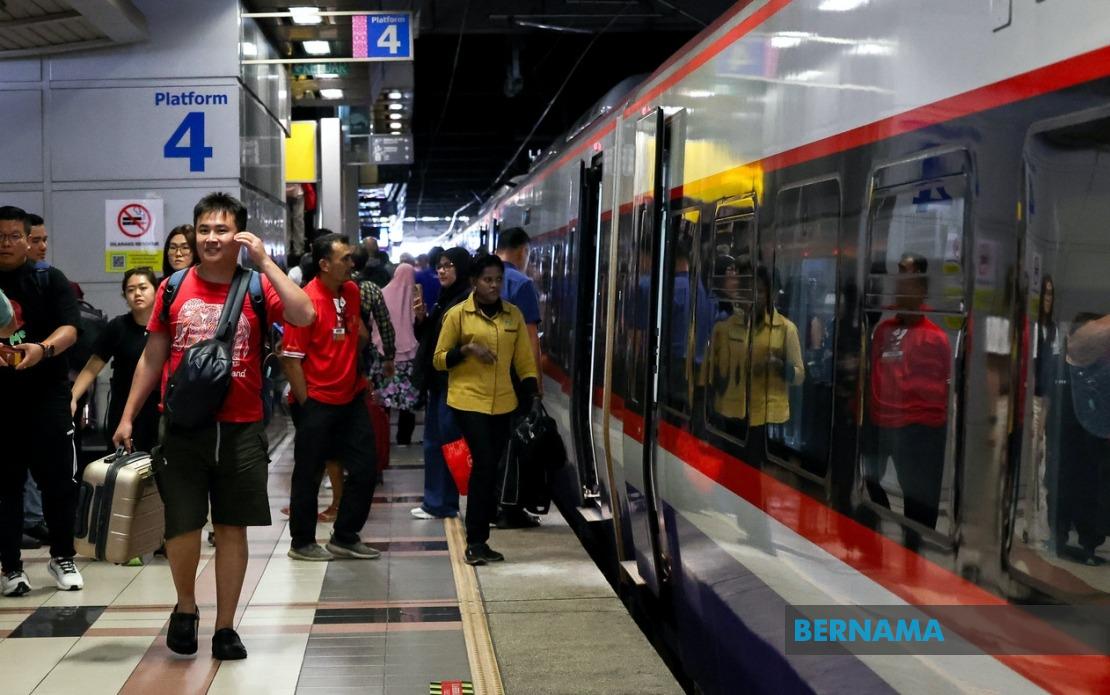
Keretapi Tanah Melayu Berhad (KTMB) is mobilising additional train capacity to manage anticipated passenger volumes during the Johor state election this weekend, releasing 7,464 extra seats across its Electric Train Service network in the southern corridor. The expanded service reflects the railway operator's response to strong public demand, particularly from voters travelling to their home constituencies to cast ballots.
The additional capacity deployment centres on two critical routes that connect Malaysia's economic heartland with Johor: the KL Sentral-JB Sentral-KL Sentral corridor and the JB Sentral-Gemas-JB Sentral line. KTMB is introducing four extra train services on each route, bringing daily capacity to 2,488 seats across the three-day operation window from July 10 to 12. This measured expansion allows the rail operator to distribute passenger flows across multiple departure times rather than creating bottlenecks during peak periods.
The decision to expand capacity again comes after KTMB's initial supplementary ticket release on June 19 sold out entirely, demonstrating the scale of inter-state voter migration during election periods. Rail transport plays a significant role in this phenomenon, as ETS services offer a reliable, relatively affordable alternative to driving, particularly for voters in the Klang Valley who need to reach Johor constituencies. The near-complete sell-out of the previous batch indicated that KTMB had underestimated demand, prompting the current second-phase expansion.
To incentivise passengers to choose rail over road transport, KTMB is offering a 20 per cent discount on all additional ETS train services during the three-day operation period. This promotional pricing strategy serves multiple objectives: it reduces congestion on federal highways during a period when road traffic is expected to surge, it makes rail travel more competitive against fuel and toll costs for family groups, and it demonstrates public sector responsiveness to voter mobility needs during elections. The discount represents a material cost consideration for families travelling together.
Ticket sales arrangements reflect KTMB's efforts to manage both distribution and passenger flow. Sales for the JB Sentral-Gemas-JB Sentral route opened at 3.00 pm on the announcement day, while the KL Sentral-JB Sentral-KL Sentral route sales commence the following morning at 9.00 am. This staggered approach allows the operator to monitor demand patterns and adjust resources accordingly. KTMB is actively encouraging cashless, advance purchases through its KITS Style mobile application, its official website, and self-service kiosks at selected stations, reducing congestion at ticket counters and enabling better demand forecasting.
For Malaysian readers and voters, the availability of discounted ETS tickets addresses a genuine logistical challenge during state elections. Johor, with its large population distributed across multiple constituencies and significant commuter populations in other states, typically experiences substantial return migration during polling periods. Workers and students based in Selangor and Kuala Lumpur who maintain voter registration in Johor face costs and time commitments when returning home to vote. Improved rail capacity with promotional fares removes some of these barriers.
From a broader policy perspective, KTMB's expansion illustrates how electoral cycles can drive demand for public transport infrastructure. Malaysian transport planners increasingly recognise that election periods stress road networks disproportionately, and rail capacity becomes valuable for managing this predictable surge. However, the repeated sell-out of supplementary tickets also highlights structural limitations in regular ETS capacity, suggesting that even without election-driven demand, the KL-Johor corridor may be operating near theoretical maximum passenger throughput during peak periods.
Operational protocols announced by KTMB address the reality of managing large passenger volumes. The requirement for passengers to arrive 30 minutes before departure, with platform entrance closure five minutes before departure, reflects standard procedures but becomes more critical when capacity utilisation approaches maximum levels. These timing requirements are particularly relevant for voters unfamiliar with ETS operations or travelling during unfamiliar hours to accommodate their election day schedules.
The railway operator is providing multiple support channels for passenger enquiries, including the KTMB Call Centre at 03-9779 1200 and official social media platforms. This redundancy in communication channels acknowledges that voters and passengers may have questions during the booking process or need last-minute clarifications about timing and procedures. Clear, accessible information pathways reduce anxiety about rail travel among passengers who might otherwise default to private vehicles.
For Southeast Asian observers, Malaysia's approach to election-period transport management demonstrates how middle-income nations manage electoral logistics through public infrastructure adaptation. While some democracies address voter travel through polling station accessibility improvements or early voting windows, Malaysia's approach emphasises expanding the capacity of existing transport networks. This reflects both the geographic distribution of Malaysia's population and the continued importance of rail as a viable transport mode in the Kuala Lumpur-Johor corridor.
The three-day operation window is carefully calibrated to the election schedule, with services running July 10-12 to capture both pre-election travel (voters arriving to campaign or settle their affairs) and post-election return migration. This timing reflects experience gained from previous state elections and indicates that KTMB has developed reasonably accurate models of when voter movement peaks relative to polling day.
Looking ahead, the repeat cycle of sold-out supplementary tickets followed by expanded releases suggests KTMB may need to consider permanent capacity increases on the southern ETS corridor rather than relying on temporary election-period expansions. Whether this translates to additional rolling stock procurement or operational restructuring remains a question for transport planners, but the consistent demand signal is clear. For voters and the travel-dependent public, the immediate benefit is clear: expanded options at reduced cost during an important civic occasion.

