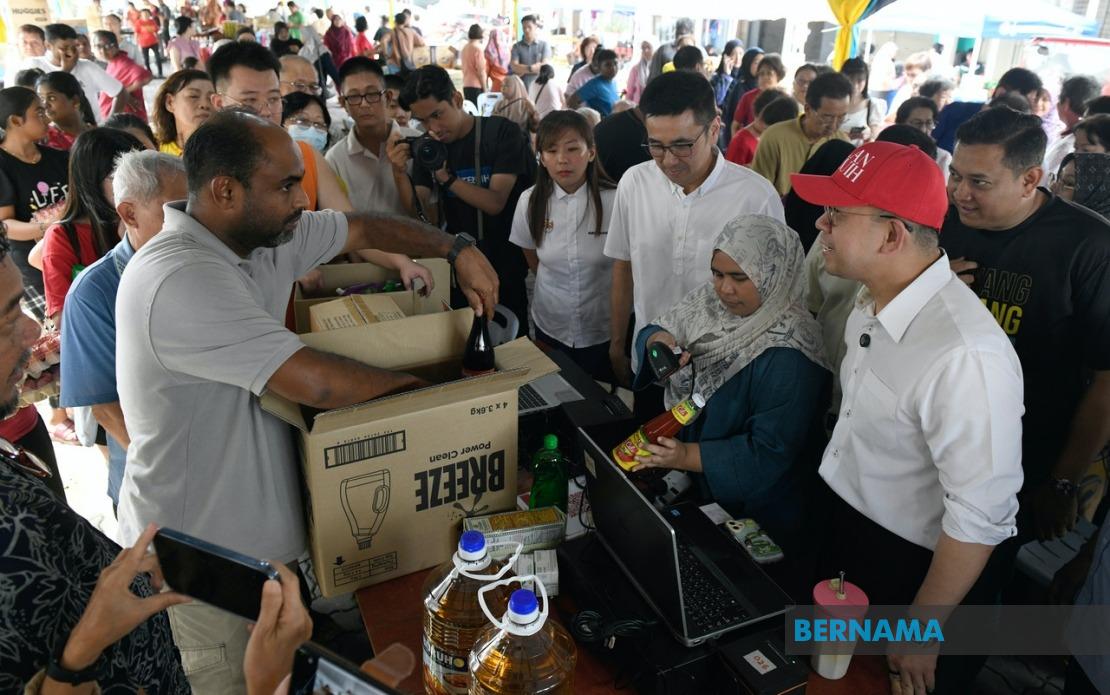
The Malaysian government is doubling down on its commitment to uplift local entrepreneurs and small enterprises through targeted programmes administered by the Ministry of Entrepreneur and Cooperatives Development (KUSKOP), with officials citing impressive growth trajectories in the nation's retail and wholesale trade landscape. Minister Steven Sim Chee Keong outlined the ministry's forward trajectory at an event in Nibong Tebal, emphasising that sustained grassroots engagement represents a cornerstone of broader economic empowerment strategies designed to ensure widespread prosperity across the business community.
Recent economic data underscores the vitality of Malaysia's distribution and retail sectors. According to statistics released by the Department of Statistics Malaysia (DOSM), the wholesale and retail trade segment achieved sales valued at nearly RM175 billion during April 2026, reflecting a year-on-year expansion of 15.3 per cent. This performance demonstrates the sector's resilience and expanding consumer appetite, factors that ministry officials view as creating unprecedented opportunities for smaller operators seeking to strengthen their market positions and diversify revenue streams.
Simplifying pathways into retail and wholesale distribution has emerged as a strategic priority for policymakers grappling with questions about equitable economic participation. Minister Sim articulated a vision wherein both governmental support mechanisms and private sector dynamism converge to drive down operational costs, stabilise commodity pricing, and enhance wage levels across the economy. The Jualan MADANI KUSKOP (JMK) programme, which Sim inaugurated in the Jawi constituency at Taman Bukit Panchor, represents a tangible manifestation of this philosophy, designed specifically to connect cooperatives and MSMEs with expanded commercial opportunities.
The global economic environment presents both headwinds and context for evaluating Malaysia's domestic trajectory. International tariff disputes, escalating trade tensions, and geopolitical volatility have introduced pronounced uncertainty into worldwide commerce. Despite Malaysia's exposure to these external shocks—owing to its integration within global supply networks and reliance on international markets—government officials maintain that coordinated domestic interventions have successfully insulated the local economy from more severe disruption. This resilience reflects the cumulative effect of deliberate policy choices prioritising economic stability and business confidence.
For Malaysia's MSME ecosystem, sector growth creates tangible commercial expansion possibilities. Smaller enterprises increasingly possess the capacity to penetrate new consumer markets, establish relationships with previously untapped customer segments, and cement their integration within broader economic networks characterised by increasingly sophisticated production and distribution frameworks. These developments carry particular significance for entrepreneurs operating in retail and wholesale domains, where volume dynamics and supply chain efficiency determine competitive advantage. The proliferation of opportunities within expanding sectors simultaneously reduces barriers confronting small operators attempting to scale operations and formalise previously informal business arrangements.
Minister Sim, who represents the Bukit Mertajam parliamentary constituency, stressed that governmental economic stewardship must ultimately culminate in tangible benefits reaching ordinary entrepreneurs rather than remaining concentrated within larger corporate structures. This perspective aligns with broader policy frameworks emphasising inclusive growth and equitable distribution of prosperity, recognising that thriving micro and small enterprises constitute essential elements within Malaysia's economic architecture. The minister highlighted that local entrepreneurs function as fundamental catalysts driving national economic dynamism, justifying sustained policy attention and resource allocation.
The ministry's programmatic emphasis on cooperative development reflects recognition that collective action frequently enables smaller operators to achieve economies of scale otherwise inaccessible to isolated enterprises. Through cooperative structures, individual traders can coordinate procurement, pool resources, negotiate improved terms with suppliers, and leverage shared infrastructure, thereby enhancing overall competitiveness and operational efficiency. This institutional approach addresses structural handicaps confronting small businesses whilst preserving entrepreneurial autonomy and preserving ownership within local communities.
Sector-specific growth in wholesale and retail trade simultaneously reflects broader consumer confidence developments and disposable income expansion across Malaysian households. As employment remains relatively secure and wage growth materialises in pockets of the economy, household purchasing power extends, driving increased retail transactions. This benign demand environment creates windows of opportunity for small retailers and wholesalers to expand inventory, diversify product offerings, and capture market share from larger competitors potentially constrained by operational inflexibility or slower response times to emerging consumer preferences.
The intersection of KUSKOP initiatives with private sector dynamics suggests that governmental support alone remains insufficient for sustaining competitive small enterprises. Rather, comprehensive development requires simultaneous attention to workforce capabilities, technological adoption, financial access, and market intelligence. By positioning KUSKOP as a facilitator connecting small businesses with relevant resources and opportunities, rather than merely providing financial transfers, the ministry adopts a more sophisticated approach recognising that sustainable entrepreneurship requires holistic ecosystems supporting continuous improvement and adaptation.
Looking ahead, the ministry's emphasis on retail and wholesale sector development signals confidence that these traditional commercial domains retain significant growth potential despite digital transformation reshaping consumer behaviour. Physical retail networks serving regional and local markets remain economically significant, particularly in contexts where e-commerce infrastructure remains incomplete or consumer preferences favour direct personal transactions. This reality creates sustained opportunities for small traders willing to innovate within established formats, combining traditional retail practices with modern customer service standards and product curation approaches.

