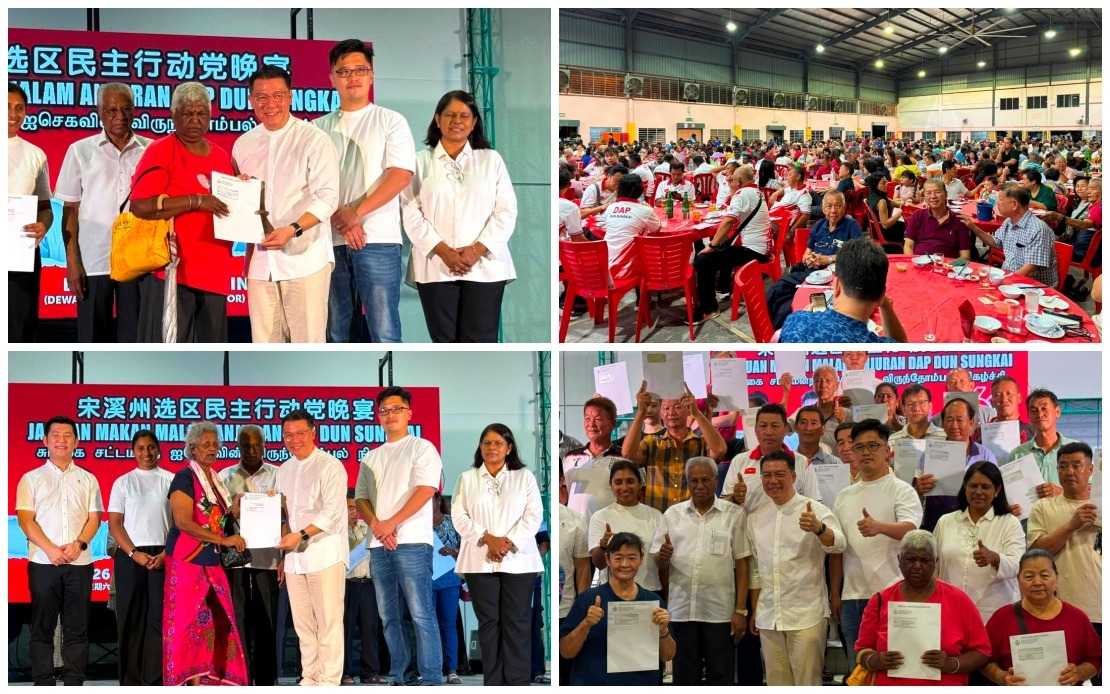
A protracted housing crisis affecting 120 squatter families in the Sungkai and Kuala Bikam areas of Perak has finally reached resolution, with Housing and Local Government Minister Nga Kor Ming presenting formal land grants to the recipients at a DAP Sungkai divisional dinner. The settlement concludes what had become a defining challenge for residents who had lived in precarious conditions for over 40 years, marking a significant milestone in land rights recognition for one of Malaysia's historically marginalised communities.
The formal distribution of these land grants represents far more than administrative paperwork; it signals a tangible shift in security and stability for families who have endured decades of uncertainty regarding their residential status and future prospects. For many recipients, the grants promise generational change—the ability to own their homes legally, access formal credit systems, secure property inheritance for descendants, and participate more fully in Malaysia's economic and social structures. The symbolic weight of this moment cannot be understated in a country where land ownership remains deeply intertwined with citizenship, dignity, and opportunity.
Nga emphasised during the ceremony that the resolution embodied the MADANI Government's core philosophy of inclusive development that transcends racial and socioeconomic boundaries. The minister framed the outcome as evidence that the current administration prioritises tangible welfare improvements over political rhetoric, positioning land security as a fundamental human need rather than a partisan issue. This framing carries particular resonance given Malaysia's history of communal tensions around resource distribution and land allocation—a sensitive terrain where government action carries outsize political meaning.
Sungkai assemblyman Datuk A. Sivanesan, who chairs the state Human Resources, Health, Indian Community Affairs and National Integration Committee, received specific acknowledgment for his role in facilitating the resolution. This recognition highlights the crucial intermediary role that state-level representatives often play in translating national policy into local outcomes, particularly when dealing with vulnerable populations whose claims might otherwise become lost in bureaucratic processes. Sivanesan's committee portfolio suggests that the land grant initiative has been framed within a broader agenda of Indian community advancement, rather than treated as an isolated housing intervention.
The government has simultaneously signalled broader commitment to Indian community development through substantial financial allocations across multiple sectors. A RM20 million allocation dedicated to Indian settlements addresses housing insecurity more systematically, while the RM50 million commitment to Tamil vernacular schools responds to education access concerns. The Malaysian Indian Transformation Unit (MITRA) has received an expanded budget of RM150 million, suggesting an attempt at comprehensive, multi-vector support rather than ad hoc responses to individual grievances.
Malaysia's squatter settlements have historically represented a chronic policy challenge, with residents often trapped in informal housing arrangements that prevent them from accessing formal services, accumulating property wealth, or exercising full citizenship rights. These communities frequently experience environmental hazards, inadequate sanitation, vulnerability to eviction, and limited access to credit or insurance. The Sungkai and Kuala Bikam case exemplifies how long such issues can persist—four decades of waiting suggests systemic administrative bottlenecks, competing land claims, or political deprioritisation rather than technical impossibility.
The timing of this announcement carries political implications that Malaysian observers would recognise immediately. Presented at a DAP divisional anniversary dinner attended by over 1,200 guests, the land grant distribution functions simultaneously as a genuine policy achievement and as a campaign statement. Invited attendees included Ipoh Timur MP Howard Lee Chuan How and multiple state assemblymen, transforming what might have been a routine administrative ceremony into a high-profile political event. This staging emphasises the ruling coalition's desire to demonstrate concrete delivery to Indian voters, a demographic whose support remains contested between government and opposition parties.
Nga used the platform to deliver broader messaging about political culture, urging Malaysians to evaluate government performance against tangible outcomes rather than allowing "perception" to eclipse measurable achievement. His call for "new, constructive politics" rooted in "unity, performance-driven service, development and the wellbeing of the people" implicitly critiques an opposition politics he characterises as "outdated" and "destructive." This rhetorical manoeuvre attempts to position the MADANI Government as pragmatic and results-oriented, a positioning that land grant distribution directly supports.
For Perak specifically, this settlement reflects broader conversations around state development trajectories and inclusion. The state has experienced significant demographic shifts, with substantial Indian and Chinese populations alongside Malay-Muslim majorities, creating complex coalitional politics. Housing security for marginalised groups represents a practical arena where multi-ethnic governance can demonstrate inclusive outcomes, potentially building political capital across community lines. Success in Sungkai and Kuala Bikam might inform approaches to similar settlement disputes elsewhere in Perak or other states.
The resolution also underscores structural questions about land administration in Malaysia that regional observers should note. Property titling systems, settlement regularisation, and land-use planning remain areas where many Southeast Asian countries struggle with informal housing crises. Malaysia's ability to eventually address the Sungkai situation—despite the 40-year delay—suggests capacities that some neighbouring nations lack, yet the lengthy duration also highlights persistent institutional weaknesses. The mechanism that finally unlocked this settlement remains somewhat opaque from publicly available information, suggesting either a policy shift, political pressure, or administrative innovation that deserves closer examination.
Moving forward, the key question becomes whether this resolution represents a breakthrough in addressing Malaysia's remaining squatter settlements or remains a carefully choreographed exception. Thousands of families in other parts of the country face similar or worse circumstances, and whether the Sungkai model becomes replicable across regions will determine whether this announcement constitutes transformational policy change or targeted political investment. The land grants' practical impact will ultimately depend on implementation—ensuring recipients can access banking services, formalise property transactions, and protect their investments against future disputes.

