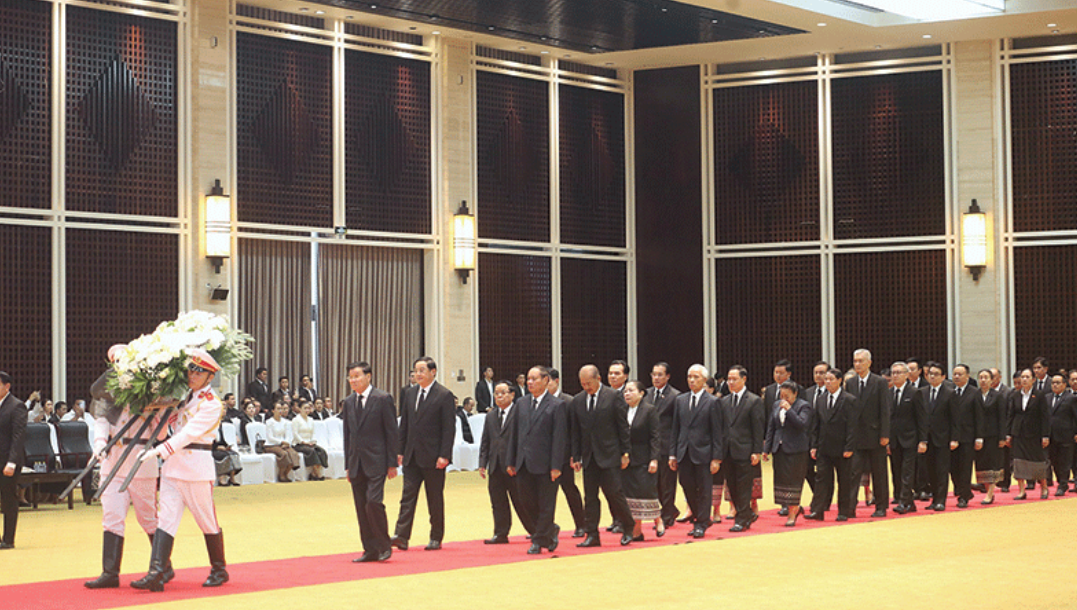
Laos held a solemn state funeral on Sunday, 9 August, to honour National Assembly President Xaysomphone Phomvihane, who died the previous day. The ceremony at the National Convention Hall in Vientiane drew together the nation's most senior political figures, led by Party Secretary General and President Thongloun Sisoulith, to pay their final respects to a figure whose career spanned decades of service to the state and ruling party.
The passing of Xaysomphone represents a watershed moment for Laos's political establishment. As a member of the Politburo of the Lao People's Revolutionary Party Central Committee and head of the National Assembly, he occupied one of the most influential positions in the one-party socialist state. His death has reverberated through the corridors of power in Vientiane, prompting widespread recognition of his contributions to the party, government and people of Laos. The National Assembly, where he spent much of his career, particularly felt his loss—he had played a pivotal role in strengthening the legislative institution while simultaneously steering the nation through matters of national defence and socio-economic development.
The ceremonial proceedings reflected the hierarchical structure of Laos's power apparatus, with delegations from each major organ of state and party placing wreaths in strict protocol order. The Lao People's Revolutionary Party Central Committee delegation, led by President Thongloun Sisoulith himself, initiated the tributes. Following this came wreaths from the Sisoulith family, the Standing Committee of the National Assembly, the government headed by Prime Minister Dr Sonexay Siphandone, and various family groupings of senior officials including Deputy Prime Minister and Finance Minister Santiphab Phomvihane. The formal nature of these proceedings underscored the symbolic importance attached to Xaysomphone's standing within the regime's elite circle.
Xaysomphone's prominence was partly rooted in his family connections—he was one of six sons of former President Kaysone Phomvihane, the founding father of modern Laos and central architect of the communist revolution. Born on 12 December 1956, Xaysomphone inherited his father's legacy and rose through party ranks during Laos's post-revolutionary consolidation. His five brothers, including Santiphab and Thongsavan Phomvihane, also occupy positions of significant influence within the party and government apparatus, creating a familial nexus of power that has characterised Lao politics for generations. This dynastic concentration of authority demonstrates the extent to which revolutionary elites and their descendants have maintained political dominance in the reclusive Southeast Asian nation.
The attendance of Vietnamese delegations at the funeral ceremony illuminates the strategic importance of the Lao-Vietnamese relationship in regional geopolitics. Leading the Vietnamese contingent was Tran Thanh Man, a Politburo member of the Communist Party of Vietnam and Chairman of the Vietnamese National Assembly. Delegations from Vietnam's Ministry of Public Security and Ministry of National Defence also participated, alongside numerous diplomatic representatives. Vietnam's declaration of two days of national mourning from 10 to 11 August underscores the bilateral bond between the two communist neighbours, who share deep historical ties rooted in anti-colonial struggle and decades of post-war alliance. This gesture carries weight beyond mere diplomatic courtesy—it reflects Vietnam's continuing influence in Lao affairs and the interconnected nature of governance structures in the two closely aligned nations.
Additionally, dignitaries representing the Lao Front for National Development, the party-affiliated mass organisation responsible for mobilising support among various social sectors, attended the proceedings. Its delegation was led by Prof Dr Kikeo Khaykhamphithoune, a Politburo member. The Justice Ministry, Commission for Information and Education, and Prime Minister's Office were all represented, as were representatives from line ministries, provincial authorities, business circles and the families of other party and state leaders. This comprehensive participation signals the entire governmental apparatus's acknowledgment of Xaysomphone's loss and the legitimacy conferred upon the succession arrangements through collective mourning.
The Lao authorities designated five days of national mourning from 8 to 12 August, during which wreath-laying ceremonies continued at the National Convention Hall. This timeframe allowed ordinary Lao citizens, foreign diplomats stationed in Vientiane, and officials across the bureaucratic hierarchy to pay their respects. The extended mourning period contrasts with Vietnam's two-day observance, reflecting Xaysomphone's pre-eminent status in the Lao political system relative to how Vietnam marked his passing. The inclusive nature of the funeral arrangements—extending beyond elite circles to encompass organisations, the business community, and the general public—provided a rare glimpse into Lao state pageantry and the performative dimensions of socialist governance.
Xaysomphone's cremation took place with full state honours on 12 August at the That Luang esplanade, Vientiane's most sacred Buddhist monument and a symbol of Lao national identity. Beginning at 1 pm, the ceremony followed traditional Lao practices while incorporating state ritual elements befitting his high office. The choice of venue—That Luang rather than a more generic crematorium—emphasised the fusion of socialist governance with Lao Buddhist cultural traditions, a pragmatic accommodation the communist party has maintained since seizing power in 1975. This blending of ideological and cultural elements reflects the particular character of Lao socialism, which has proven more flexible regarding religious observance than some neighbouring regimes.
Xaysomphone's death occurs amid broader questions surrounding leadership succession and generational transitions within the Lao communist establishment. At 67 years old at the time of his passing, he belonged to the founding revolutionary cohort that has dominated Lao politics for nearly five decades. The continuity of power within family networks and the party's upper echelons raises questions about institutional renewal and whether younger cadres will gain meaningful influence. His positions as National Assembly President and Politburo member represented accumulated power through institutional longevity rather than any recent appointment, suggesting the existing gerontocratic structure remains firmly entrenched. For Malaysian observers monitoring regional developments, Xaysomphone's career trajectory and the ceremonial response to his death offer insights into how one-party socialist states manage succession and perpetuate elite authority across generations.
For Southeast Asia more broadly, the state funeral underscores the robust institutional networks linking Laos and Vietnam—networks that extend beyond formal diplomatic channels into party structures, security services and economic arrangements. The Vietnamese National Assembly chairman's personal attendance at the ceremony and his country's formal mourning declaration illustrate how deeply embedded the two communist neighbours have become in shared governance frameworks. As China seeks to expand its influence across the region and as the United States re-engages with Southeast Asian nations through its Indo-Pacific strategy, the Lao-Vietnamese alignment remains a stabilising force maintaining socialist continuity in mainland Southeast Asia. The reverence shown to Xaysomphone, despite his passing, reinforces the legitimacy of the institutional arrangements that have kept the Lao People's Revolutionary Party in power and preserved the existing geopolitical balance.

