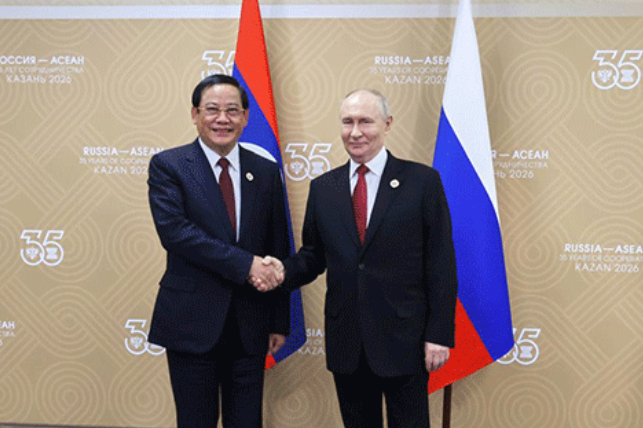
Prime Minister Sonexay Siphandone and Russian President Vladimir Putin have moved to consolidate the longstanding relationship between Laos and Russia, signalling a deepening of bilateral ties during their recent meeting on the margins of the Russia-Association of Southeast Asian Nations Summit in Kazan. The engagement represents a significant moment for Laos as Sonexay undertook his inaugural official visit to Russia since assuming the premiership, arriving at the invitation of Russian Prime Minister Mikhail Mishustin from June 14 to 17. This carefully orchestrated diplomatic visit underscores the importance both nations place on their historical partnership and sets a trajectory for expanded cooperation across multiple sectors.
The centrepiece of the bilateral discussions involved Putin's acknowledgement of Russia's enduring appreciation for ties with Laos, rooted in principles of friendship, mutual respect, and reciprocal consideration of national interests. The Russian president's remarks carried particular weight given the international context in which they were delivered, effectively positioning Laos as an important partner in Russia's broader strategic engagement with Southeast Asia. Putin emphasised Russia's recognition of Laos's contributions to deepening Moscow's relationship with the ten-member regional bloc, a matter of considerable strategic importance for Russia as it navigates geopolitical realignments in Asia.
An especially noteworthy element of the discussions centred on Moscow's gratitude for Laos's participation in Russian commemorative events. President Thongloun Sisoulith's attendance at Russia's Victory Day celebrations in May, combined with the Lao People's Army's participation in the 80th anniversary parade marking Soviet victory in World War II, resonated strongly with the Russian leadership. These symbolic gestures carry profound meaning within Russian political culture and demonstrate Laos's willingness to acknowledge Russia's historical narratives and celebrate shared commemorative occasions, thereby reinforcing emotional and historical bonds between the two societies.
The signing of an intergovernmental agreement on nuclear energy cooperation represents perhaps the most consequential development emerging from these talks, projecting Russia's technological influence well into Laos's future energy infrastructure. This accord establishes the foundational legal framework for constructing a small nuclear power plant utilising Russian technology within Laotian territory. For Laos, a nation grappling with energy demands generated by rapid development and regional economic integration, such an agreement offers potential pathways toward energy security and reduced dependence on hydropower sources vulnerable to climatic fluctuations. The initiative simultaneously extends Russia's technological reach into Southeast Asia at a moment when energy security preoccupies regional policymakers.
Beyond the headline-grabbing nuclear agreement, the two countries mapped out an ambitious cooperative agenda spanning traditional and contemporary economic sectors. Energy cooperation, industrial development, agricultural initiatives, mining operations, digital economy advancement, banking sector collaboration, transport infrastructure, tourism promotion, and educational exchange constitute the broad framework within which bilateral engagement will unfold. This comprehensive approach reflects the evolution of Laos-Russia relations from Cold War-era solidarity to a multifaceted partnership addressing 21st-century development priorities. Each sector carries implications for Laos's integration into global value chains and its positioning within Southeast Asian economic networks.
Educational cooperation emerged as a particularly valued dimension of the partnership, with Prime Minister Sonexay specifically commending Russia's annual scholarship programmes and training opportunities afforded to Lao nationals, especially government officials. These human resource development initiatives represent an often-overlooked yet crucial mechanism through which international partnerships exert influence and build institutional relationships. By nurturing Laotian technical expertise and administrative capacity through Russian educational institutions, Moscow cultivates long-term goodwill and creates networks of professionals with direct experience of Russian systems and approaches. Such capacity-building investments typically yield dividends that extend far beyond their immediate participants.
The jointly-announced Laos-Russia Friendship School project in Vientiane symbolises the cultural dimension of bilateral relations and reflects both nations' commitment to people-to-people exchanges. Expected completion in the near future, this institution will serve as a tangible monument to shared history whilst functioning as an operational platform for linguistic and cultural education. For Vientiane, such educational facilities diversify student exposure to international pedagogical approaches and facilitate language acquisition increasingly valued in professional environments. The school also potentially anchors Russian cultural presence within Laotian society across generational lines.
Prime Minister Sonexay's separate discussions with Russian Prime Minister Mikhail Mishustin further reinforced the bilateral commitment to expanding cooperation grounded in mutual trust and reciprocal support. The emphasis on steadily expanding partnership suggests that both administrations view the relationship not as static but as subject to continuous development and deepening. Such language, whilst common in diplomatic exchanges, often reflects genuine institutional commitment to expanding trade volumes, investment flows, and technological transfers. For Laos, a landlocked nation seeking to attract foreign direct investment and diversify its economic partnerships beyond predominant Chinese influence, Russian engagement offers useful counterbalancing possibilities.
The bilateral business forum convened during Sonexay's visit attempted to catalyse commercial interaction and investment opportunities, demonstrating that official government engagement operates in tandem with private sector participation. Trade and investment cooperation constitute the practical mechanisms through which strategic partnerships generate measurable economic benefits for both nations. For Russian businesses, Laos presents market access opportunities and potential participation in infrastructure projects whilst offering Lao enterprises partnerships with established Russian firms across various industrial sectors. The forum format suggests both governments recognise that sustainable bilateral relations require robust commercial foundations underpinning official diplomatic exchanges.
The symbolic presentation of two elephants to Kazan Zoo merits attention as more than ceremonial gesture. The gift, marking both the 65th anniversary of Laos-Russia diplomatic relations and Russia Day on June 12, deployed cultural symbolism to reinforce bilateral affinity. Elephants occupy profound significance within Laotian national identity and cultural imagination, making them potent symbols for conveying national goodwill. Their arrival in a major Russian city effectively renders Laotian cultural presence visible within Russian public consciousness, thereby promoting people-to-people recognition and mutual appreciation beyond governmental circles.
The timing of these engagements within the broader Russia-ASEAN framework carries regional implications that warrant Malaysian attention. Russia's demonstrated commitment to deepening ties with individual ASEAN members whilst simultaneously engaging the bloc collectively indicates Moscow's determination to maintain relevance in Southeast Asian affairs despite broader geopolitical tensions. For Malaysia and other ASEAN states, Russia's active diplomatic outreach underscores the continued multipolar character of regional international relations and the availability of partnership options beyond traditional Western and Chinese frameworks. The nuclear energy agreement, in particular, may inspire comparable discussions within other Southeast Asian capitals weighing energy security imperatives against technological dependencies and geopolitical considerations.
Looking forward, the trajectory established during Sonexay's visit suggests Laos-Russia relations will continue expanding across economic and strategic domains. The nuclear agreement particularly merits monitoring, as its implementation will illuminate Russia's capacity to deliver on technological commitments in Southeast Asian contexts and may influence comparable discussions elsewhere in the region. Malaysia's policymakers might judiciously observe how Laos manages the balance between deepening Russian engagement and maintaining the diversified diplomatic approach characterising ASEAN strategies. The partnership demonstrates that smaller Southeast Asian nations continue exercising agency in selecting development partners and pursuing cooperation arrangements serving their specific national interests, a reminder that regional geopolitics involve far more than Sino-Western competition.

