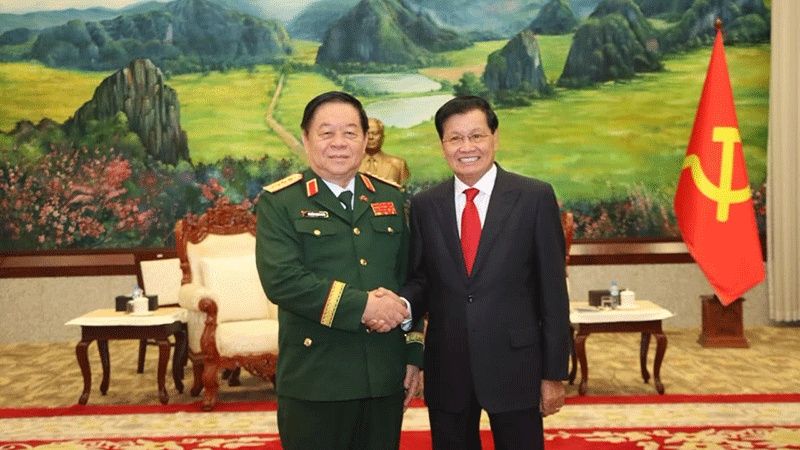
Laos and Vietnam have moved to deepen their longstanding defence relationship, with Lao President Thongloun Sisoulith receiving General Nguyen Trong Nghia, the Chairman of the General Department of Politics of the Vietnam People's Army, on Thursday in Vientiane. The visit, which runs from August 5–7, represents another milestone in the two countries' efforts to consolidate their military and strategic alignment, a relationship that has become increasingly important amid broader geopolitical shifts across Southeast Asia.
The discussions between the two nations' defence establishments signal their determination to maintain close coordination on security matters. President Thongloun praised the outcome of military talks between the Lao People's Army and the Vietnam People's Army, noting that these exchanges would facilitate expanded practical cooperation and reinforce bonds forged over decades of shared history. The Lao leader's characterisation of the visit as deepening "great friendship, special solidarity, comprehensive cooperation and strategic cohesion" reflects the historically intimate nature of the bilateral relationship, which extends beyond conventional military ties into political and party-level engagement.
General Nguyen Trong Nghia's delegation serves a multifaceted purpose in Laos's capital, addressing both the symbolic and substantive dimensions of regional defence architecture. As the head of the Vietnam People's Army's political apparatus, his presence underscores Hanoi's prioritisation of ideological alignment and party-to-party relations alongside conventional military cooperation. This approach mirrors how both communist parties have traditionally conducted statecraft, with political education and ideological cohesion forming the bedrock of bilateral engagement.
During his visit, General Nguyen held separate meetings with key Lao defence figures, including Deputy Prime Minister and Defence Minister General Khamlieng Outhakaisone, as well as Lieutenant General Vongsone Inpanphim, the Deputy Minister of National Defence and Director General of the Lao People's Army's General Department of Politics. These layered engagements at different ministerial levels demonstrate the systematic approach both countries take to consolidating defence ties, ensuring that cooperation frameworks are embedded across multiple institutional levels within their respective military hierarchies.
The agenda emerging from these talks reveals where Laos and Vietnam intend to channel their collective security efforts. Border management ranks prominently among shared priorities, reflecting the practical realities of maintaining a 2,130-kilometre frontier that requires ongoing coordination to prevent smuggling, illegal migration, and cross-border incidents. Personnel training and military exchanges also feature as key cooperation pillars, allowing both armies to share expertise and build interoperability, which could prove significant should either nation face security challenges requiring coordinated responses.
Political education and younger generation engagement constitute another crucial dimension of the partnership. Both nations have committed to educating their younger military officers and cadets about the historical foundations of their special relationship and the enduring value of their solidarity. This generational investment suggests that Laos and Vietnam view their defence partnership not merely as a current strategic necessity but as a civilisational commitment extending decades into the future, transcending individual leaderships or policy cycles.
For readers across Southeast Asia, this deepening of Laos-Vietnam defence ties carries broader regional implications. Laos, as a landlocked nation entirely surrounded by Thailand, Vietnam, Cambodia, and Myanmar, occupies a geographically sensitive position in Southeast Asian geopolitics. Its strategic alignment with Vietnam provides Hanoi with influence in mainland Southeast Asia and reinforces Vietnam's position as a significant regional power. The partnership also demonstrates how bilateral defence cooperation among smaller and mid-sized Southeast Asian states continues to shape regional security architectures, often operating independently of or in parallel to multilateral mechanisms like ASEAN.
The emphasis on "comprehensive strategic partnership" in official statements reflects an evolution beyond traditional military alliances. It encompasses political coordination, economic cooperation, and cultural exchange, suggesting that Laos and Vietnam view their relationship as spanning the full spectrum of national statecraft. This holistic approach contrasts with transactional defence relationships that focus narrowly on weapons sales or tactical military cooperation, indicating instead a deep institutional integration between the two countries.
Vietnam's commitment to preserving the bilateral relationship, as reiterated by General Nguyen, carries particular weight given Hanoi's multiple strategic commitments across the region and beyond. Vietnam maintains relationships with major powers including Russia, China, Japan, and the United States, yet its rhetorical emphasis on the Laos partnership suggests that the nation views its mainland Southeast Asian relationships as foundational to its broader strategic posture. This balancing act—managing great power relationships while maintaining special bonds with smaller neighbours—remains central to Vietnamese foreign policy.
The outcomes of these military talks will likely manifest in concrete forms over coming months and years, potentially including joint exercises, training deployments, and increased intelligence sharing. Such practical cooperation strengthens the operational capacity of both militaries while deepening personal relationships among officers who may work together across decades of service, creating informal networks that reinforce official diplomatic channels.
Laos's reception of the Vietnamese delegation reflects its own strategic calculations, as the landlocked nation depends heavily on maintaining cooperative relationships with its more powerful neighbours to ensure its security and facilitate economic development. By elevating defence cooperation with Vietnam, Laos signals both to Hanoi and to other regional powers that it prioritises this particular bilateral relationship, a message that carries implications for how other nations calibrate their own engagement with Vientiane.
Moving forward, the success of this partnership will depend on both nations' ability to address practical challenges while maintaining the political will to sustain high-level engagement. Border disputes, though manageable between Laos and Vietnam, could potentially complicate relations, while broader regional developments—including changing dynamics involving China, Thailand, and Cambodia—may influence how the two countries operationalise their defence cooperation commitments.

