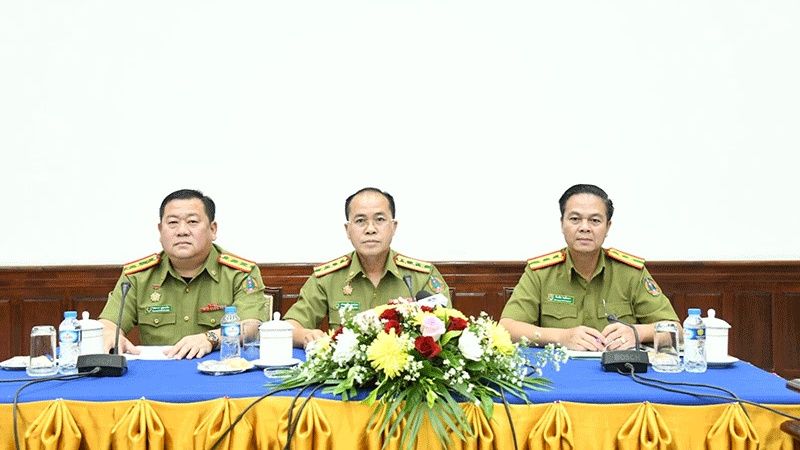
The Laotian police investigation into the deaths of six foreign tourists in Vangvieng during late 2024 has culminated in formal charges against the Tiger Vodka distillery owner and multiple hostel employees, though investigators acknowledge significant legal barriers in establishing culpability for most of the fatalities. The announcement emerged during a detailed briefing at the Ministry of Public Security in Vientiane on Friday, representing the most comprehensive public accounting of the inquiry to date.
Authorities identified methanol concentrations exceeding permissible levels in Tiger Vodka manufactured by a privately-operated distillery situated in Xaimoungkhoun village, Naxaithong district, near Vientiane. This finding gains particular significance given that the Australian Embassy confirmed through Thailand's Aek Udon Hospital that methanol was detected in the bloodstream of two deceased Australian nationals. Despite these technical findings, investigators face an insurmountable legal problem: the inability to prosecute for five of the six deaths stems directly from the absence of autopsy examinations, which prevents them from satisfying Lao legal standards for establishing causation between the contaminated vodka and actual cause of death.
The deceased comprised James Louis Hutson of the United States, Danish nationals Freja Vennervald Sorensen and Anne-Sofie Orkild Coyman, Australian nationals Bianca Jones and Holly Bowles, and British national Simone White. Each case presents distinct circumstances that complicate the investigation. The distillery owner faces charges under Article 275 of the Penal Code for manufacturing and distributing consumer goods detrimental to health, alongside allegations of operating an unlicensed business under Article 297. The case has proceeded to the Vientiane Province People's Court for adjudication.
Prosecutors initially contemplated charges relating to food safety violations but subsequently abandoned that legal avenue, citing insufficient evidence to support such allegations. Instead, they directed investigators toward the broader charge concerning hazardous consumer goods—a determination that reflects the complexity of establishing legal liability in cross-jurisdictional tourism deaths. This prosecutorial strategy shift demonstrates how Laotian authorities navigated between the available evidence and the practical limitations of their legal framework.
A parallel investigation concerning the Nana Backpackers Hostel has already resulted in convictions. Police discovered that following Hutson's death in Room 205 on November 13, 2024, hostel personnel relocated his body to Vangvieng District Hospital before notifying authorities, thereby contaminating the potential crime scene and preventing initial police examination. The hostel owner and ten staff members were charged with destroying evidence under Article 383 of the Penal Code. All eleven defendants received convictions from the Vangvieng District Court, though the Vangvieng People's Prosecutor's Office has appealed, contending that sentences were insufficiently severe and requesting the Vientiane Province People's Court impose stiffer penalties.
The Nana Backpackers Hostel remains shuttered pending resolution of ongoing legal proceedings. All proprietors and staff members have had travel documents confiscated and face restrictions preventing departure from Laos until judicial determination concludes. Police initially learned of Hutson's death on November 14 after hospital notification, subsequently establishing that he had expired at the hostel the preceding day. Investigators catalogued items recovered from his room, including beer containers, glasses bearing residue of Tiger Vodka, soft beverages, bottled water, pharmaceutical products, and a handwritten note suggesting suicide. Hutson's family declined autopsy authorization, resulting in body release for funeral rites.
The two Danish women exhibited symptoms including respiratory distress, vertigo, and gastric illness before receiving treatment at Vangvieng District Hospital and subsequent transfer to Hospital 103 in Vientiane, where they succumbed. Their families similarly refused autopsy requests. The two Australian nationals registered at the hostel on November 9, with investigators unable to reconstruct their complete movements or comprehensively document consumables during their residence. Following acute illness, they received care at Vangvieng District Hospital, transferred to Settathirath Hospital in Vientiane, and subsequently relocated via medical evacuation to Thailand for advanced treatment, where they ultimately expired.
British national White experienced loss of consciousness at Mahosot Hospital and underwent transfer to Kasemrad International Hospital on November 13, dying eight days later on November 21. Police confirmed opening investigations into all five cases but consistently encountered the autopsy obstacle—without post-mortem examinations, Lao law provides no mechanism for establishing that deaths resulted from the specific actions of identifiable persons. Although methanol above legal limits appeared in Tiger Vodka samples and methanol registered in the blood of the two Australian women, Deputy Chief Colonel Khamfong Vongdalasane emphasized that available evidence did not satisfy Lao legal requirements for determining causal responsibility.
The briefing involved representatives from the Ministry of Public Security, Ministry of Foreign Affairs, and diplomatic missions representing the United States, Australia, Denmark, and the United Kingdom. Police committed to sustained investigation pursuant to the Law on Criminal Procedure and pledged continued coordination with these embassies. Colonel Khamfong extended official condolences to bereaved families while reaffirming commitment to conducting investigations maintaining transparency, impartiality, and adherence to lawful procedures. The case illustrates both the particular challenges facing developing nations' legal systems when confronting complex, multi-jurisdictional fatalities and the critical importance of immediate autopsy authorization in establishing causation within criminal frameworks.
For Southeast Asian travelers and tourism stakeholders, the Vangvieng incident underscores persistent risks associated with unregulated alcohol distribution in regional tourist destinations. Malaysia and neighboring countries have intensified monitoring of imported spirits and illicit distillation operations, though enforcement remains inconsistent across borders. The investigation's constraints reveal how administrative decisions—or family preferences regarding post-mortem examination—can fundamentally shape prosecutorial options and outcomes, a consideration relevant to regional tourism safety protocols and emergency response coordination across Southeast Asia.

