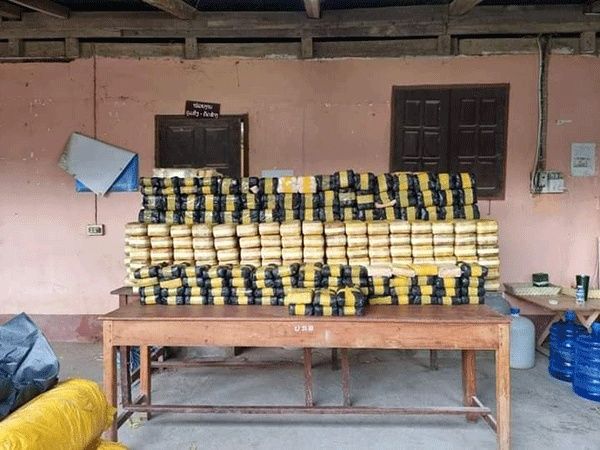
The security situation in Xaysomboun province, located in central Laos, has become increasingly strained by a surge in drug-related criminal activity, with narcotics offences now dominating law enforcement concerns. During the first six months of this year, drug crimes represented 24 of the 54 total criminal cases handled by provincial authorities—a startling proportion that underscores how thoroughly the illicit drug trade has penetrated the region's security landscape. This concentration of drug-related cases reflects a troubling pattern wherein the fight against narcotics has become the primary preoccupation for local police forces, overshadowing many other categories of crime that typically demand significant investigative resources.
The breakdown of these drug cases reveals a system struggling to keep pace with enforcement demands. Of the 24 narcotics-related incidents recorded, police managed to conclude only two cases and refer them to prosecution, leaving 22 investigations still in progress. This substantial backlog suggests that provincial authorities lack either the personnel, technical capacity, or investigative infrastructure needed to process cases efficiently. The wider criminal caseload presents an equally challenging picture: across all offence categories, police resolved 15 cases and completed four for prosecution, yet 29 others remain open, indicating that the provincial security apparatus faces considerable strain in maintaining progress across multiple enforcement fronts.
The provincial security leadership acknowledged these pressures during a high-level meeting in August when Police Brigadier General Ouday Insouvanh briefed Police Lieutenant General Vanthong Kongmany, Laos's Minister of Public Security, who travelled to the province on an inspection visit. The presentation of these statistics signalled both an attempt to demonstrate police activity and an implicit plea for additional resources and support. Officials attributed their focus to efforts maintaining political stability and social order throughout the first half of the year, framing their work as part of a broader mandate extending beyond conventional crime fighting into the maintenance of state authority and public confidence in governance.
The minister's response to these figures was unambiguous: enforcement must become significantly more aggressive. Police Lieutenant General Vanthong explicitly demanded that the provincial force escalate its campaign against drug trafficking and newly emerging narcotics variants, recognising that criminal networks continuously adapt by introducing synthetic or modified substances that evade existing legal classifications. His broader directives extended well beyond narcotics alone, encompassing smuggling operations, human trafficking networks, theft and burglary rings, illegal mining enterprises, and underground gambling operations. This comprehensive mandate reflects recognition that Xaysomboun faces interconnected criminal challenges rather than isolated problems, with many of these illicit enterprises often overlapping through shared trafficking routes, money laundering mechanisms, and criminal personnel.
The national government's campaign against the drug trade provides crucial context for understanding this provincial intensification. Prime Minister Sonexay Siphandone reported to the National Assembly in recent weeks that nationwide authorities had processed 1,786 drug-related cases during the same six-month period, resulting in 4,025 arrests including 93 foreign nationals. These figures demonstrate that Xaysomboun's experience reflects a nationwide phenomenon rather than an isolated provincial crisis. The fact that narcotics enforcement was formally designated as a national agenda five years ago indicates that this struggle represents a multi-year governmental priority, suggesting that drug trafficking has posed a persistent and escalating challenge to Laotian security and governance.
Beyond traditional crime categories, the minister introduced cybercrime and social media monitoring as emerging security priorities for the province. This directive reflects recognition that criminal activity has increasingly moved into digital domains, encompassing everything from online drug markets to fraud schemes and illicit financial transfers. The instruction to strengthen oversight of digital communications and online activities represents an adaptation to evolving criminal methodologies, yet it also raises significant questions about surveillance capabilities, technical training among police personnel, and the legal frameworks governing such monitoring activities. For the provincial force, this represents an additional enforcement responsibility layered atop existing caseloads without necessarily accompanying resource increases.
Road safety emerged as another significant public safety concern during the ministerial visit, with statistics revealing the hidden toll of traffic accidents on provincial communities. During the six-month period, 60 accidents claimed four lives and injured 80 people, causing damage to 109 vehicles valued at more than 2.56 billion kip. These figures translate to real suffering within families and communities, with each death and injury representing personal tragedies alongside the broader economic losses. The substantial financial impact—damage costs exceeding 2.56 billion kip represents a significant burden for a developing province—demonstrates how traffic incidents drain resources that might otherwise support economic development or social services.
The provincial police command's management of foreign nationals and tourism represented another accountability focus during the inspection. Officers had examined 1,698 tourists during the first half of the year, identifying 396 foreign visitors among this population. While this supervisory activity may appear routine, it reflects the strategic importance that Vientiane places on border security, counter-intelligence monitoring, and the prevention of criminal exploitation of tourism flows. Tourism represents an important economic sector for Laos, yet it also creates security vulnerabilities through increased cross-border movement and opportunities for smuggling operations to conceal contraband within tourist infrastructure.
Minister Vanthong's emphasis on professionalism in immigration management and foreign national oversight indicated concern that existing procedures may lack rigour or consistency. His insistence that immigration work be conducted with clearly defined responsibilities and personnel appropriately assigned according to expertise suggests that current arrangements may rely on generalist officers lacking specialised training. For Malaysian readers observing regional security developments, this aspect warrants attention, as weaknesses in Laotian border management and tourism oversight can affect Southeast Asian security more broadly, particularly given the cross-border nature of many trafficking networks that operate across multiple nations in the region.
The minister's broader assessment of institutional performance extended beyond operational metrics to encompass organisational culture and personnel discipline. He urged provincial security leadership to strengthen political and ideological education among officers, emphasising compliance with Party policies, state laws, and institutional disciplinary requirements. These directives reflect traditional governance approaches in communist-led states, wherein political reliability and ideological alignment remain central to personnel management alongside technical competence. His call for officers to acknowledge weaknesses and assume direct responsibility for performance outcomes, rather than passively awaiting direction, suggests concerns about accountability gaps and possible deficiencies in institutional culture and motivation.
The comprehensive nature of the minister's directives—spanning drug enforcement, human trafficking, smuggling, cybercrime, immigration management, road safety, and personnel development—reveals an administration attempting to address security challenges across multiple simultaneous fronts. For provincial authorities in Xaysomboun, this multi-faceted mandate presents a substantial challenge given what appear to be existing resource constraints reflected in their investigative backlogs. The meeting itself served multiple purposes: enabling the minister to assess provincial capacity, demonstrating central government engagement with security concerns, and clearly signalling that enhanced performance is expected from local authorities.
Looking forward, the trajectory of security challenges in Xaysomboun province will likely remain problematic given the structural factors underlying drug trafficking in the region. Xaysomboun's geographic position along trafficking routes and its relative economic underdevelopment create persistent vulnerabilities that enforcement alone cannot address. The provincial authorities face the difficult task of implementing a comprehensive security agenda that spans traditional and emerging crime categories while operating within resource constraints and institutional limitations. For regional observers monitoring Southeast Asian security dynamics, developments in Xaysomboun represent a microcosm of broader challenges confronting governance in the Mekong region, where insufficient state capacity meets persistent criminal networks operating across porous borders.

