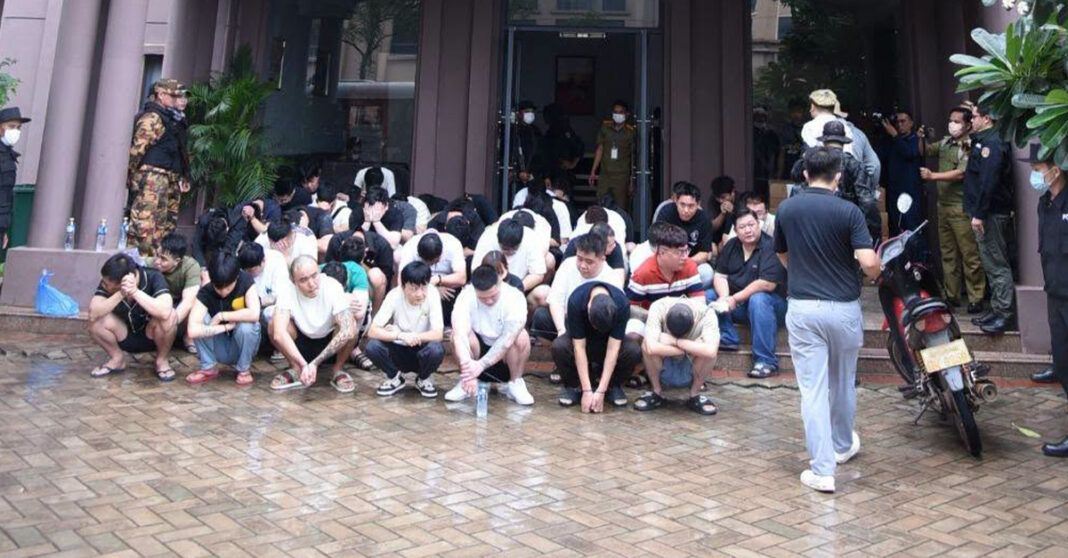
Laos has escalated its enforcement action against transnational cybercrime syndicates with a significant operation targeting a sprawling fraud operation embedded within a special economic zone in the capital. On August 8, Vientiane police descended on a facility in the Thatluang Lake Special Economic Zone and apprehended 261 individuals suspected of orchestrating telecommunications fraud and illegal online gambling schemes. The detainees represented a multinational cohort spanning seven countries, underscoring the deeply interconnected nature of modern scam networks that transcend borders and exploit regional vulnerabilities.
The composition of those detained reveals the dominant role of Chinese nationals in coordinating such operations across Southeast Asia. Among the 261 suspects, 153 were Chinese citizens, representing nearly 59 percent of those taken into custody. Vietnamese nationals comprised the second-largest contingent with 61 individuals, whilst Thai citizens numbering 36 were also implicated in the scheme. The remaining detainees included five Taiwanese, two Malaysian, two South Korean and two Myanmar nationals, reflecting how these criminal enterprises recruit operatives from across the region based on linguistic capabilities, technical expertise, and local market knowledge.
The scale of the infrastructure seized during the raid demonstrates the sophisticated operational capacity of these fraud rings. Police recovered approximately 500 desktop computers and laptops used to manage the illicit activities, alongside 2,355 mobile phones that likely served as communication and customer contact devices. Such technological capacity suggests an organisation with substantial financial resources and logistical coordination, capable of simultaneously managing multiple scam campaigns targeting victims across different countries and time zones. The accumulation of these devices points to a centralised operation rather than scattered freelance activity.
Investigative authorities have identified the building as property owned and operated by Lao Thatluang Investment Development Co., Ltd., raising questions about the company's legitimate activities and whether owners or senior management were cognisant of the criminal enterprise operating within their premises. The involvement of a registered Laotian entity suggests either that criminal networks have successfully penetrated ostensibly legitimate corporate structures, or that regulatory oversight of special economic zone operations requires strengthening. Laotian authorities have signalled their commitment to pursuing the investigation upstream, with explicit intention to identify and prosecute both the masterminds directing the operation and their accomplices across the chain of command.
This August raid represents merely the most recent manifestation of a concerted governmental campaign to dismantle scam infrastructure nationwide. The timing and scale of operations suggest Laotian officials have identified telecommunications fraud and online gambling as priority concerns demanding rapid, decisive action. For Malaysia and other Southeast Asian nations, the Laotian crackdown carries direct relevance, as these criminal networks frequently target victims across multiple countries, including Malaysians who receive fraudulent calls and messages originating from call centres operating in Indochina.
Within days of the Thatluang Lake operation, Laos demonstrated coordinated deportation protocols by returning suspected offenders to their home countries. On August 10, authorities transferred 41 Thai nationals across the 1st Lao-Thai Friendship Bridge to Thai counterparts, following an earlier handover of 32 Thai citizens through the same crossing four days prior. These bilateral deportations indicate functional cooperation mechanisms between neighbouring states, allowing Laos to swiftly remove foreign nationals whilst returning them to jurisdictions where they may face charges.
The cumulative impact of these removal operations has been substantial. Through the two tranches of deportations alone, at least 73 Thai nationals have been returned to Thailand for prosecution. These individuals had been detained during an earlier and larger operation conducted on July 18 targeting the ST Vegas complex located in Dongphosy village within Hatsayfong district of Vientiane. That previous raid proved even more extensive in scope, netting 589 suspected scammers across multiple nationalities, with Thai nationals again representing the plurality, supplemented by Laotian, Vietnamese and Cambodian detainees.
The consecutive major operations in July and August reveal the entrenched nature of scam infrastructure within Vientiane and surrounding areas. Rather than isolated incidents, these raids suggest systematic networks with multiple operational nodes, capable of reconstituting activities even after significant enforcement action. The prevalence of Thai involvement in both the July and August operations points toward Thailand as a significant source of recruitment for these criminal enterprises, or alternatively, a pipeline through which operators travel to establish new schemes in Laotian jurisdictions offering potentially weaker regulatory oversight.
For Malaysian authorities and telecommunications regulators, these Laotian developments underscore the cross-border dimensions of cybercrime that individual nations cannot adequately address through domestic measures alone. Malaysians remain frequent targets of telecommunications fraud originating from call centres throughout Indochina, and the removal of operational capacity in Laos directly reduces the infrastructure available for targeting domestic victims. The cooperation demonstrated between Laos and Thailand provides a model for similar bilateral and multilateral arrangements involving Malaysia, though expanding such frameworks requires sustained diplomatic engagement and resource commitments.
The broader context of Southeast Asian scam operations reveals how special economic zones and porous regulatory environments can inadvertently become havens for transnational criminal activity. The Thatluang Lake SEZ facility, ostensibly intended to attract legitimate foreign investment and facilitate regional trade, instead harboured an extensive fraud manufacturing operation. This misuse highlights the tension between economic liberalisation and security, forcing policymakers throughout the region to reassess how special zones can be monitored without deterring legitimate business activity.
Laotian authorities signal their intention to sustain and expand enforcement efforts against these networks. The sequential large-scale raids, coupled with expedited deportations, indicate a shift toward more aggressive postures regarding transnational organised crime. Whether such initiatives represent a temporary surge or a sustained commitment remains to be determined by continued operational activity and resource allocation over coming months. For Southeast Asian neighbours including Malaysia, the momentum generated by these Laotian operations creates an opportune moment to pursue coordinated regional strategies targeting the financial flows, recruitment channels and technological infrastructure sustaining these scam ecosystems across the region.

