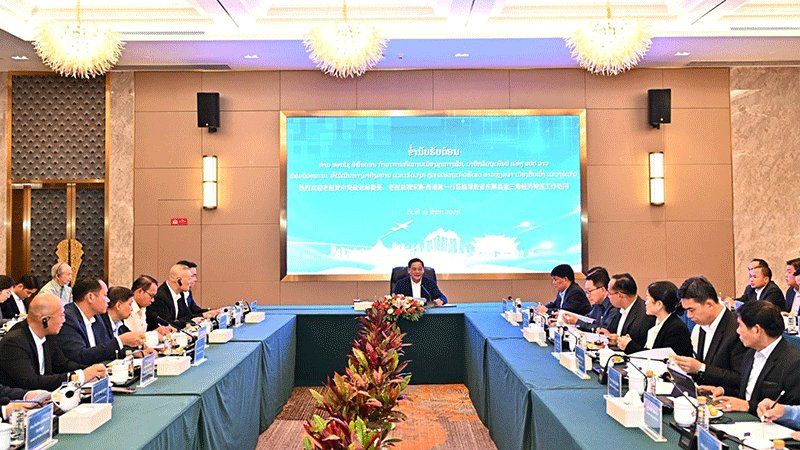
Prime Minister Sonexay Siphandone has signalled a significant shift toward stricter oversight of the Golden Triangle Special Economic Zone (GTSEZ), one of Laos's flagship development projects, during a working visit to the facility this week. The announcement reflects mounting frustration with the pace and quality of development at the zone, which has attracted roughly US$10 billion in cumulative investment since its inception in 2007 yet continues to fall short of its developmental targets. The Prime Minister's intervention suggests the Lao government is taking a more hands-on approach to managing the sprawling 10,000-hectare complex, which straddles the tri-border region where Laos, Myanmar and Thailand converge near the Chinese frontier.
The Golden Triangle SEZ remains a critical component of Laos's strategy to leverage its geographic position between Southeast Asia's largest economies and emerging markets. Straddling the banks of the Mekong River in Tonpheung district, Bokeo province, the zone was deliberately positioned to offer investors preferential access to consumer bases and labour pools across the region. Despite these inherent advantages, the zone's performance has proven disappointing relative to initial ambitions. Official figures reveal that only 60 per cent of the activities pledged in investment contracts have materialised over the past 19 years, exposing what appears to be a fundamental disconnect between investor expectations and actual implementation capacity.
The Prime Minister's call for enhanced regulation addresses a range of operational deficiencies that have plagued management of the zone. Dr Sonexay specifically requested stricter enforcement of Laos's Law on Enterprises and mandated that all commercial transactions—encompassing trade, investment, wage payments, and service provision—be conducted exclusively through the domestic banking system. This directive appears designed to combat informal transactions and improve the government's ability to monitor and tax economic activity within the zone. The requirement to channel all financial flows through formal banking channels would also provide authorities with greater visibility into the zone's actual economic performance and help detect illicit activities.
Border management and cross-border labour flows have emerged as another critical concern for policymakers. The zone currently hosts more than 10,000 registered workers, with additional tens of thousands of investors, business operators, and residents transiting through regularly. Dr Sonexay instructed authorities to implement tighter controls on entry and exit procedures and to establish more effective mechanisms for managing the cross-border workforce. These measures carry implications beyond mere administrative efficiency; they reflect concerns about security, labour exploitation, and the informal economy that typically thrives in special economic zones located in remote border regions.
The diversification of the zone's economic base represents another priority flagged by the Prime Minister. Since 2007, enterprises across manufacturing, real estate, hospitality, finance, tourism, and services have established operations within the zone. However, Dr Sonexay specifically identified tourism, manufacturing, processing, transport, education, and public health as sectors meriting greater promotional attention and investment incentives. This selective approach suggests the government wishes to steer the zone toward activities with stronger multiplier effects and developmental spillovers into the wider Lao economy, rather than allowing unguided specialisation in lower-value sectors.
The institutional framework governing the zone has also drawn criticism. Dr Sonexay called for the concession agreement to be revised to align with relevant legislation and instructed the Zone's Management and Administration Committee to enhance its operational effectiveness. These directives hint at governance challenges and potential conflicts between zone management and national regulatory bodies. More than 400 government officials from various sectors already work at the facility, yet coordination and enforcement remain problematic. Strengthening institutional capacity appears essential to realising the zone's potential and ensuring that development occurs according to Lao national priorities rather than investor preferences alone.
Regional cooperation features prominently in the revised development strategy. Dr Sonexay emphasised the importance of deepening cross-border linkages, particularly through expanding airline connectivity with neighbouring countries and establishing bilateral mechanisms for managing cross-border commercial activity and labour movements. This emphasis acknowledges that the zone's viability depends heavily on seamless integration with Thailand, Myanmar, and China. Currently, limited transport infrastructure and complicated border procedures constrain the zone's ability to function as a true international economic hub. Improved regional connectivity could unlock significant value but requires coordinated policy action across multiple countries.
The Prime Minister's intervention also reflects broader patterns in Southeast Asia where special economic zones have underperformed relative to expectations. Many zones in the region suffer from similar challenges: weak institutional governance, inadequate infrastructure, limited integration with national economies, and investor reluctance to commit major capital without demonstrable returns. The Golden Triangle SEZ's failure to achieve targeted activity levels mirrors experiences in comparable zones across Laos, Cambodia, and Myanmar. However, the zone's strategic location and existing infrastructure investments mean that revitalisation remains economically rational, provided governance improves and development priorities align with genuine market demand.
For Malaysian investors and businesses considering operations in the broader Mekong region, the Prime Minister's pronouncements carry important implications. They signal that the Lao government intends to exercise firmer control over special zones and will require greater financial transparency and regulatory compliance. Investors should anticipate stricter labour regulations, enhanced border controls, and potentially higher compliance costs. Conversely, the emphasis on tourism, manufacturing, and services creates opportunities for businesses offering expertise in these sectors. The zone's position at the intersection of four major markets remains compelling, but success will depend on whether governance improvements translate into tangible operational improvements and reduced transaction costs for legitimate business activities.

