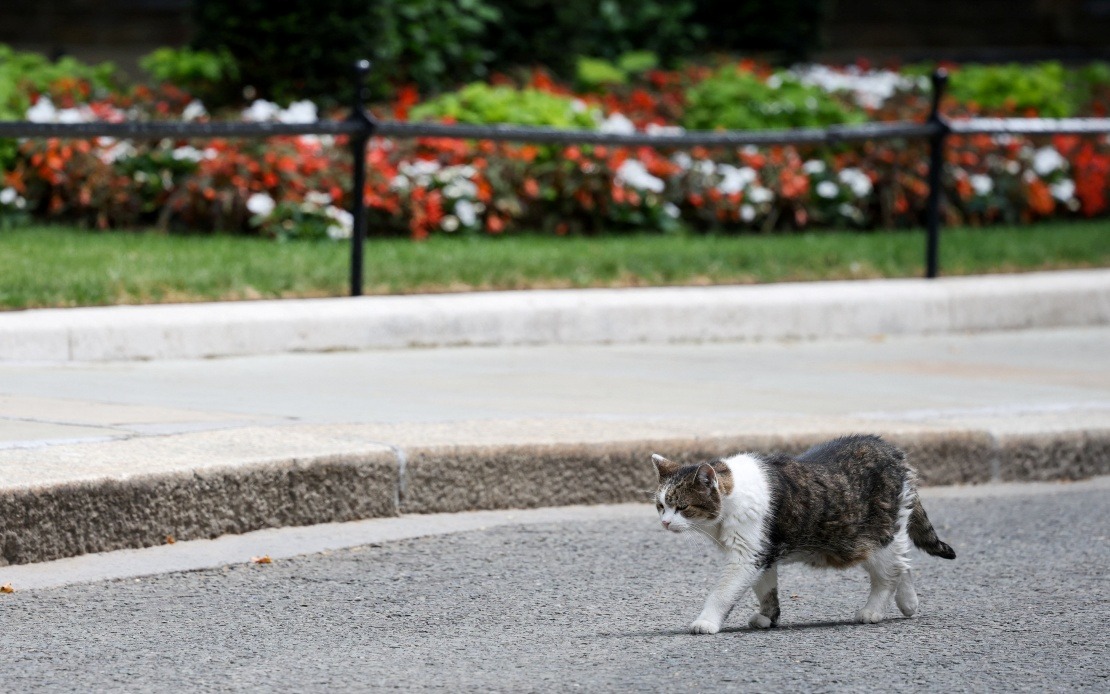
In the grand sweep of British political history, one creature has proven far more durable than the politicians who occupy the nation's most powerful address. Larry, the tabby cat of 10 Downing Street, has now lived through the administrations of six separate British prime ministers, a longevity that speaks volumes about both his own remarkable constitution and the turbulent state of recent Westminster governance. On Tuesday, July 21, as Andy Burnham presided over his inaugural Cabinet meeting following his appointment as Prime Minister, Larry demonstrated his characteristic indifference to the machinery of power by simply wandering outside the official residence, seemingly unbothered by the historic proceedings unfolding within its walls.
The appearance of Larry during this moment of transition carries a particular symbolic weight in British political culture. The cat's presence during moments of governmental change has become almost ritualistic, a reminder that while prime ministers come and go with increasing frequency, the institution of Number 10 and its symbols endure. Larry's casual stroll on the summer day represented a continuity that the stream of prime ministerial appointments has struggled to maintain. Where human leaders have cycled through with notable speed in recent years, Larry has remained a fixture, observing the comings and goings from his privileged vantage point within the corridors of power.
The journey from Larry's initial posting at Downing Street through six different prime ministerial regimes reflects broader patterns in British politics that would be of significant interest to observers across the Commonwealth and internationally. The accelerating rate of prime ministerial change speaks to deep fractures within the Conservative and Labour parties alike, to the challenges of governing in an era of polarized public opinion and complex policy challenges ranging from economic management to constitutional questions. For Malaysian readers accustomed to relative political stability, the revolving door at Number 10 might seem particularly striking.
Burnham's assumption of the premiership marks a watershed moment, representing a return to Labour governance after a period of Conservative administration. His first Cabinet meeting, attended by the full weight of Britain's senior government officials, represented the official commencement of a new political era. Yet in the timeless tradition of Downing Street, where symbols and ceremony matter deeply, the cat proved indifferent to these grand proceedings. Larry's wandering outside during the meeting was neither protocol violation nor unusual occurrence—it was simply Larry being Larry, exercising the rights of a creature whose tenure has proven far more secure than that of any prime minister serving beneath that same roof.
The history of Larry's residency provides an interesting lens through which to examine the relative stability or instability of British government. When a domestic pet achieves greater tenure than the chief executives of a major world power, it invites reflection on governance, institutional continuity, and the human capacity for building lasting structures. Larry has effectively watched the country navigate major transformations: Brexit, pandemic responses, economic challenges, and fundamental questions about the role of Britain in the world. Through it all, he has maintained his position with a persistence that transcends politics.
For those following British politics from Southeast Asia, Larry's enduring presence serves as a reminder that while individual leaders change, institutions persist. The cat represents something larger than any single administration—the continuity of the British state itself, the physical embodiment of Downing Street as a location that retains significance regardless of which party or which personality occupies its principal office. In an era when political figures dominate media cycles and policy debates capture headlines, Larry's quiet persistence offers a different kind of commentary on power.
The Cat's visibility on July 21, as Cabinet ministers gathered to chart the new government's course, underscored a particularly British phenomenon. The presence of Larry has transcended party lines and become almost a national institution in itself. Prime ministers may come with ambitious agendas and specific visions for the nation, but Larry approaches each day with the same feline pragmatism he has demonstrated throughout his tenure. His appearances at moments of governmental transition have become almost expected, a small ritual that acknowledges the cyclical nature of democratic politics.
Burnham inherits not only the responsibilities of the premiership but also implicit custodianship of Larry, a responsibility that has fallen to his predecessors and will presumably fall to his successors. The cat's welfare is taken seriously within the institution; he is fed, cared for, and protected as part of the official establishment. In this respect, Larry represents an unusual form of state responsibility, a living connection to the continuity of governance that transcends partisan boundaries.
Looking forward, speculation will inevitably arise about how long Larry's tenure might extend. Will he outlast Burnham as he has outlasted five predecessors? The question is asked with genuine curiosity by observers of British politics both domestically and internationally. For Malaysian readers and other international audiences, Larry has become a symbol of stability in an institution that has experienced considerable turbulence. Whether this endurance speaks to feline resilience or broader questions about the sustainability of contemporary political leadership remains an open question, but one that Larry, in his characteristic manner, remains content to leave unanswered.

