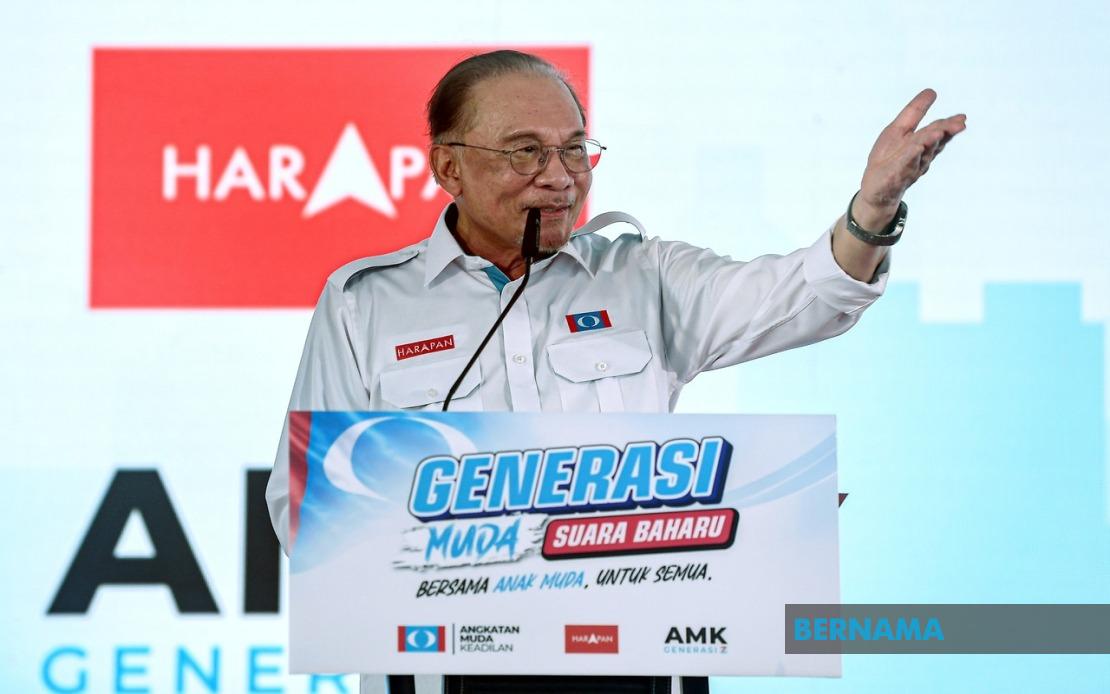
Prime Minister Datuk Seri Anwar Ibrahim has issued a direct appeal to Malaysian voters to prioritise the selection of political leaders whose primary strength lies in their ability to forge national unity rather than exploit divisions along communal lines. Speaking at the 'Generasi Muda Suara Baharu' programme in Petaling Jaya on July 24, Anwar underscored that the calibre of political leadership serves as a foundational determinant for the nation's trajectory across economic development and educational advancement, making the choice of leaders a matter of fundamental national consequence.
Anwar's remarks, delivered to a gathering that included Communications Minister Datuk Seri Fahmi Fadzil, centred on his conviction that younger voters—particularly Generation Z—possess the capacity to catalyse a fundamental shift in Malaysia's political culture. He articulated a vision in which the generational cohort transcends what he characterised as the outdated mechanics of fear-based politics, communal antagonism, and identity-driven polarisation that have historically shaped electoral discourse in Malaysia. The Prime Minister specifically rejected divisive narratives that position ethnic communities in opposition to one another, arguing that fostering animosity between Malays and Chinese, between Chinese and Indian communities, or between peninsular Malaysians and those from Sabah and Sarawak represents a profound failure of political leadership.
Instead of perpetuating these divisions, Anwar advocated for a unifying message centred on collective resistance to corruption and systemic racism. This framing represents a strategic reorientation of national political debate away from zero-sum communal competition toward shared institutional challenges that transcend ethnic boundaries. By anchoring his appeal around anti-corruption and anti-racism platforms, Anwar implicitly suggests that these issues possess sufficient gravity to supersede the identity-based politics that have traditionally dominated Malaysian elections and shaped coalition-building dynamics.
The Prime Minister further refined his message by stipulating the attributes that should define the selection of suitable political representatives. Beyond their capacity to unite disparate communities, leaders must demonstrate personal integrity by maintaining unblemished records regarding corruption allegations. Simultaneously, they must govern with demonstrable competence and strategic vision, qualities Anwar suggests are essential to rescuing Malaysia from the institutional and economic challenges it currently faces. This multi-faceted criteria—unity, integrity, freedom from corruption, and administrative capability—establishes a demanding standard that implicitly critiques predecessors and competitors who fall short across these dimensions.
Anwar's commentary on the mechanics of political change carried particular relevance for a younger demographic potentially sceptical of incremental reform. He cautioned against superficial activism that generates rhetorical noise without producing substantive outcomes, distinguishing between passionate expression and calculated reform strategy. This distinction reflects awareness that Gen Z voters may feel frustrated by perceived inaction during periods when opposition parties occupy marginal political positions. His argument—that meaningful change requires both access to governmental power and prudent execution—attempts to reconcile youthful demands for transformation with the operational realities of governance and institutional change.
The Prime Minister expressed notable optimism regarding the contemporary racial climate among Malaysian youth, observing that younger generations across Malay, Chinese, Indian, and indigenous Sabahan and Sarawakian communities demonstrate unprecedented willingness to collaborate toward shared objectives. This observation, if accurate, suggests demographic differentiation in attitudes toward communalism, with younger cohorts potentially less invested in the identity-based politics that have characterised older generations. Such generational divergence could reshape Malaysia's political terrain significantly if it continues to deepen and translates into electoral behaviour patterns.
Anwar's explicit enthusiasm about what he termed the "Reformasi" spirit among Generation Z invokes Malaysia's 1998 reform movement while positioning contemporary youth activism as a continuation of that broader political trajectory. By linguistically linking current youth mobilisation to a recognisable historical reform moment, he attempts to lend legitimacy and historical resonance to contemporary political activism while suggesting continuity with Malaysia's periodic democratic renewal cycles. This rhetorical strategy may particularly resonate with younger voters educated sufficiently to recognise the Reformasi reference but old enough to appreciate its historical significance within Malaysian politics.
The 'Generasi Muda Suara Baharu' programme itself represents an institutional effort to embed reform messaging and youth engagement into systematic grassroots organisation. Anwar's announcement that this initiative would extend into every parliamentary district nationwide suggests a recognition that electoral success among younger voters requires sustained, localised engagement rather than episodic rallies or media-focused messaging. Such district-level organisation mirrors strategies employed by both ruling and opposition coalitions in previous electoral cycles, indicating that appeals to youth political participation require infrastructure comparable to traditional political machinery.
For Malaysian readers and the broader Southeast Asian context, Anwar's intervention addresses a recurring challenge across the region: whether demographic shifts toward younger, more diverse, and potentially less communally polarised populations can fundamentally alter political cultures historically organised around ethnic or religious lines. Malaysia's experience in this regard carries implications extending beyond its borders, as Thailand, Indonesia, and the Philippines similarly navigate questions regarding youth political engagement and the persistence or erosion of identity-based political cleavages.
The timing of these remarks also merits consideration within Malaysia's broader political calendar and factional dynamics. Anwar's emphasis on integrity, anti-corruption credentials, and competent governance implicitly establishes benchmarks by which competing political leaders—whether within his coalition or among opposition factions—might be evaluated. This rhetorical positioning allows him to elevate the discourse while simultaneously establishing implicit comparative advantages for his own leadership profile, even as he frames his advocacy as an appeal to universal principles transcending factional competition.
Critics might note that exhortations toward unity and cross-communal cooperation, while rhetorically compelling, do not automatically overcome structural incentives embedded in Malaysia's electoral system and coalition mechanics that reward the mobilisation of communal constituencies. Anwar's vision of post-communal politics confronts these institutional realities, suggesting that achieving his stated objectives would require either demographic transformation sufficient to alter voter behaviour patterns or institutional reforms that reconfigure electoral incentive structures.
The challenge for Anwar and reformist political forces lies in translating aspirational rhetoric regarding unity, integrity, and generational change into durable political organisations and measurable policy outcomes that sustain youth engagement beyond initial mobilisation phases. Whether the 'Generasi Muda Suara Baharu' programme can achieve such institutionalisation remains uncertain, but the initiative reflects recognition that claims to generational support require systematic investment in organisational infrastructure and localised political presence.

