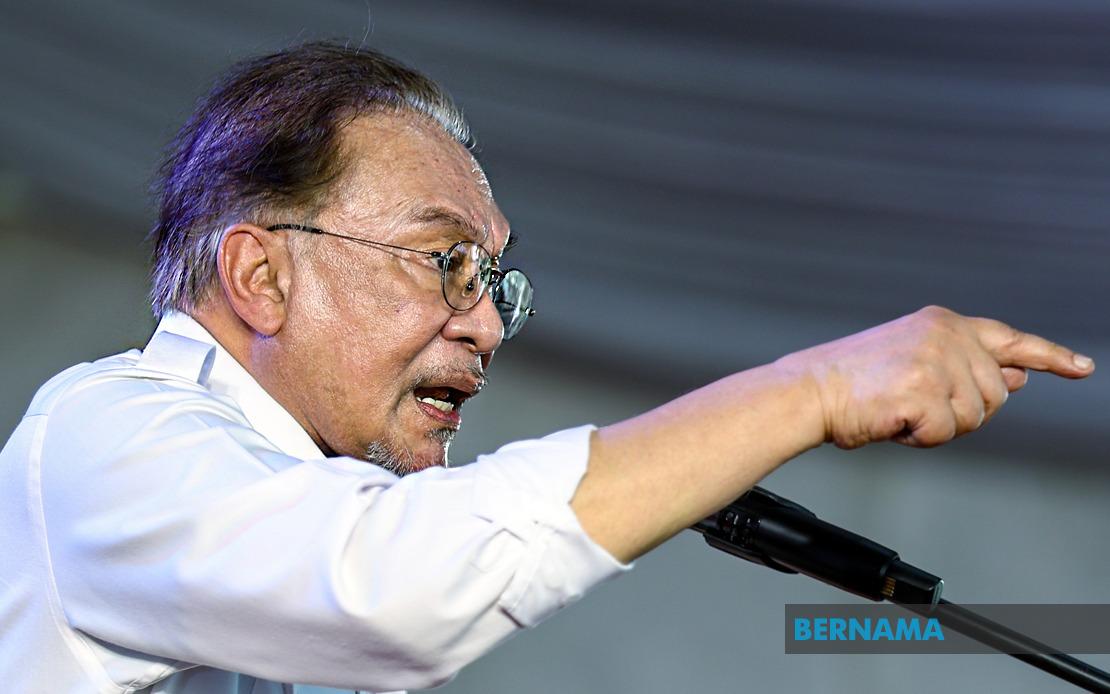
Prime Minister Datuk Seri Anwar Ibrahim has urged government leaders at federal, state and local levels to maintain fair and open engagement with all communities, stressing that such an approach is fundamental to protecting Malaysia's national unity and ensuring long-term political stability. Speaking during a gathering with Johor community leaders in Johor Bahru, Anwar highlighted the importance of transparent governance and equitable treatment across all segments of society, regardless of their background or interests.
While acknowledging that the MADANI Government has implemented significant reforms at the national level, Anwar recognised that considerable work remains to be done in translating those commitments into concrete action at state governments and municipal councils. He noted that the gap between national policy intentions and ground-level implementation continues to present challenges, particularly as different state administrations interpret and apply government directives through their own lenses and priorities. This observation reflects a broader tension within Malaysia's federal system, where the distribution of power between central authority and state governments sometimes creates friction in policy execution.
The Prime Minister clarified that fairness in governance does not mean approving every application or request placed before decision-makers. Instead, he emphasised that the essence of fair administration lies in granting citizens and communities a genuine opportunity to present their positions, articulate their concerns, and have their cases considered through proper channels. Anwar stressed that the process itself must be perceived as equitable and just, regardless of the eventual outcome. This distinction is particularly relevant in a diverse, multicommunal society where the legitimacy of government decisions often depends as much on procedural fairness as on the substantive merits of those decisions.
Anwar articulated that state administrations and municipal authorities should maintain a posture of openness to community engagement while making decisions that adhere to existing legal frameworks and established administrative principles. This formulation seeks to balance the competing demands of inclusivity and rule-based governance, recognising that administrative boundaries and legal constraints must sometimes limit what governments can accommodate. The challenge, as the Prime Minister implied, is ensuring that these constraints are applied consistently and transparently rather than arbitrarily or selectively.
Shifting to a broader economic perspective, Anwar contended that measuring Malaysia's national progress through economic growth indicators alone provides an incomplete and potentially misleading picture of the country's true development. He emphasised that preserving national unity, fostering compassion among citizens, and maintaining mutual respect across different communities constitute equally important measures of national success. This holistic approach to development reflects a recognition that social stability and intercommunal harmony generate tangible economic benefits and enable sustainable long-term growth that purely market-driven metrics might overlook.
In his capacity as Finance Minister, Anwar highlighted the geographic expansion of Malaysia's economic activity, noting that investment and business development are no longer confined to traditional economic powerhouses such as the Klang Valley and Penang. The emergence of new investment corridors spanning Negeri Sembilan, Melaka and Johor through the Johor-Singapore Special Economic Zone (JS-SEZ), coupled with growing economic activity in Sabah and Sarawak, signals a deliberate effort to distribute economic opportunities more equitably across the nation. This geographic diversification of economic activity potentially addresses longstanding regional disparities and could strengthen political cohesion by demonstrating that development benefits extend throughout the federation.
Anwar underscored that Malaysia's engagement with transformative technologies and economic transitions, including artificial intelligence adoption, digital transformation initiatives, and the shift toward renewable energy, must remain grounded in moral values, cultural sensitivity and religious principles. This statement reflects an awareness that rapid technological change can destabilise traditional social structures and cultural norms if pursued without consideration for Malaysia's multicultural and multireligious context. The Prime Minister's emphasis on values-based technology adoption suggests concern that purely technocratic approaches to development may overlook or inadvertently damage the social fabric that underpins national cohesion.
Anwar expressed particular concern about the persistence of narratives centred on race and religion that strain Malaysia's social fabric and undermine national unity. He called on religious leaders to assume greater responsibility in promoting faith-based values including compassion, justice, and mutual understanding within their respective communities. This appeal recognises that religious institutions and leaders wield considerable influence over public discourse and community attitudes in Malaysia, and that their contributions are essential to countering divisive messaging. By enlisting religious leaders as partners in promoting social cohesion, Anwar sought to mobilise influential community figures as counterweights to polarising influences.
The Prime Minister also assigned responsibility to political and administrative leaders to provide accurate information and actively resist narratives that exploit race and religion for factional political advantage. This observation acknowledges a recurring problem in Malaysian politics where sensitive communal issues are sometimes instrumentalised by political actors seeking short-term electoral advantage at the cost of long-term national harmony. Anwar's call for leadership in information provision and narrative correction addresses a fundamental governance challenge in the digital age, where false or inflammatory information spreads rapidly and can inflame dormant communal tensions.
Anwar grounded his appeal for unity in fundamental aspirations that transcend communal divisions, noting that most Malaysians share common desires for quality education, good health, strong infrastructure and the freedom to practice their chosen beliefs. He underscored that these aspirations and constitutional protections for religious practice are not novel demands but rather foundational elements of Malaysia's social contract, established by the nation's founding fathers during independence. By anchoring his call for unity in these shared values and constitutional principles, Anwar sought to reframe intercommunal cooperation as a matter of preserving established national foundations rather than introducing controversial new frameworks.
The gathering included Deputy National Unity Minister R Yuneswaran, whose presence signalled government coordination on national unity messaging. The participation of a minister specifically responsible for unity affairs reflected the significance attached to the Prime Minister's message and suggested that community engagement and fair governance have been designated as priority areas within the current administration's policy agenda. This institutional emphasis on unity work may indicate recognition that social cohesion requires sustained, deliberate effort across multiple government agencies and ministerial portfolios.

