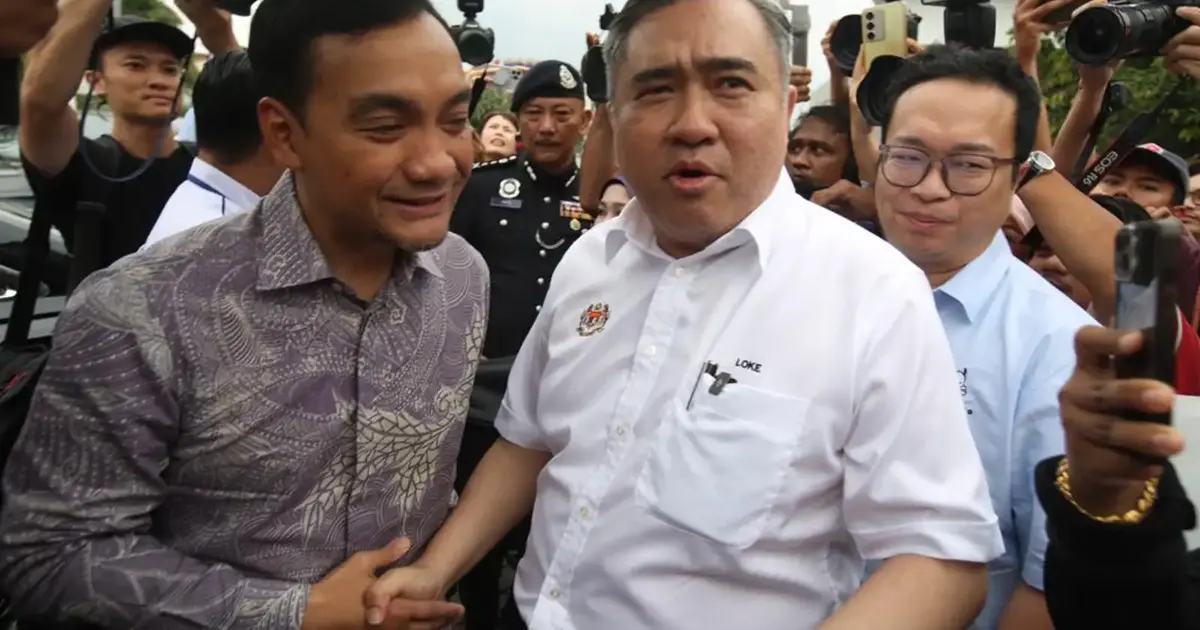
Transport Minister Loke Chua Tian Chang and Johor Menteri Besar Onn Hafiz managed to keep proceedings professional when they met for the first time since their recent online exchange, though the interaction revealed the fragile nature of their working relationship despite maintaining a veneer of civility.
The two political figures crossed paths at an official event organised by the transport ministry, where both maintained careful composure in front of observers. Their attendance represented a test of how Malaysia's political leadership handles disagreements that have played out across social media platforms, increasingly a venue where public officials air grievances.
Onn Hafiz took the opportunity during his remarks to deliver a pointed comment directed at the DAP political leader, one of several subtle jabs embedded within his speech rather than overt confrontation. The Johor leader's words suggested that the short notice for his invitation to the transport ministry event had forced him to reorganise his official schedule, implying that the timing may have been arranged without adequate consideration.
This veiled criticism reflected the underlying tension between the two camps, even as both men appeared to maintain professional boundaries throughout the gathering. The Johor MB's decision to reference the scheduling inconvenience signalled that frustrations remain despite the public calm, suggesting that cordiality in such settings masks deeper disagreements about how government business should be conducted and respected.
The dynamics between transport leadership and state-level governance have grown more complicated across Malaysia in recent years as coalition arrangements at federal and state levels have fractured traditional party discipline. The federal transport ministry and Johor state government operate under different political configurations, creating friction points when coordinating public initiatives or managing infrastructure matters that span both jurisdictions.
Onn Hafiz's subtle swipe at the short notice reflected broader complaints from state governments about top-down policy implementation and event scheduling that does not adequately account for ministerial and administrative workloads. Malaysian states have increasingly asserted that federal authorities should accord greater deference to state-level scheduling needs, particularly when events involve attendance by senior state officials.
The meeting illustrated how Malaysian political culture has evolved to express disagreement through indirect commentary rather than open hostility during formal occasions. By embedding criticism within otherwise ceremonial remarks, Onn Hafiz avoided direct confrontation while signalling that he had taken note of what he perceived as disrespect toward his office and time. This approach reflects diplomatic calculation about maintaining working relationships while refusing to absorb perceived slights.
Loke's choice to proceed with the event despite the likely knowledge of such sensitivities suggested that transport ministry priorities took precedence over accommodation of state schedules, a reality that underscores the current distribution of power within the federal coalition. The DAP-led transport ministry operates with confidence that its initiatives can move forward regardless of state-level objections, a posture that contributed to the earlier online disagreement.
The earlier social media exchange between the two leaders had captured public attention and sparked commentary about the state of government collaboration across Malaysia's federal structure. Such public disputes risk undermining public confidence in institutional coordination and raise questions about whether coalition partners can effectively work together on matters requiring joint effort between federal and state authorities.
Both officials demonstrated political maturity by attempting to preserve surface-level respect at the official gathering, avoiding escalation that could have provoked further public commentary. However, their interaction suggested that the underlying frustrations driving the online dispute remain unresolved, likely to resurface if either party perceives future instances of disrespect or inadequate consultation.
For Malaysian political observers, the encounter highlighted how coalition governance functions imperfectly when ideological and administrative differences strain working relationships. The cordial facade at the transport ministry event should not be mistaken for genuine reconciliation or resolution of the scheduling and consultation issues that sparked the earlier disagreement.
Looking forward, whether Loke and Onn Hafiz can move beyond this episode toward more constructive collaboration will depend on whether the transport ministry adopts greater flexibility in scheduling and whether the Johor leadership feels that their concerns about state autonomy have been heard. The broader implication for Malaysian governance is that sustained coalition stability requires not only public civility but genuine institutional respect between federal and state partners.