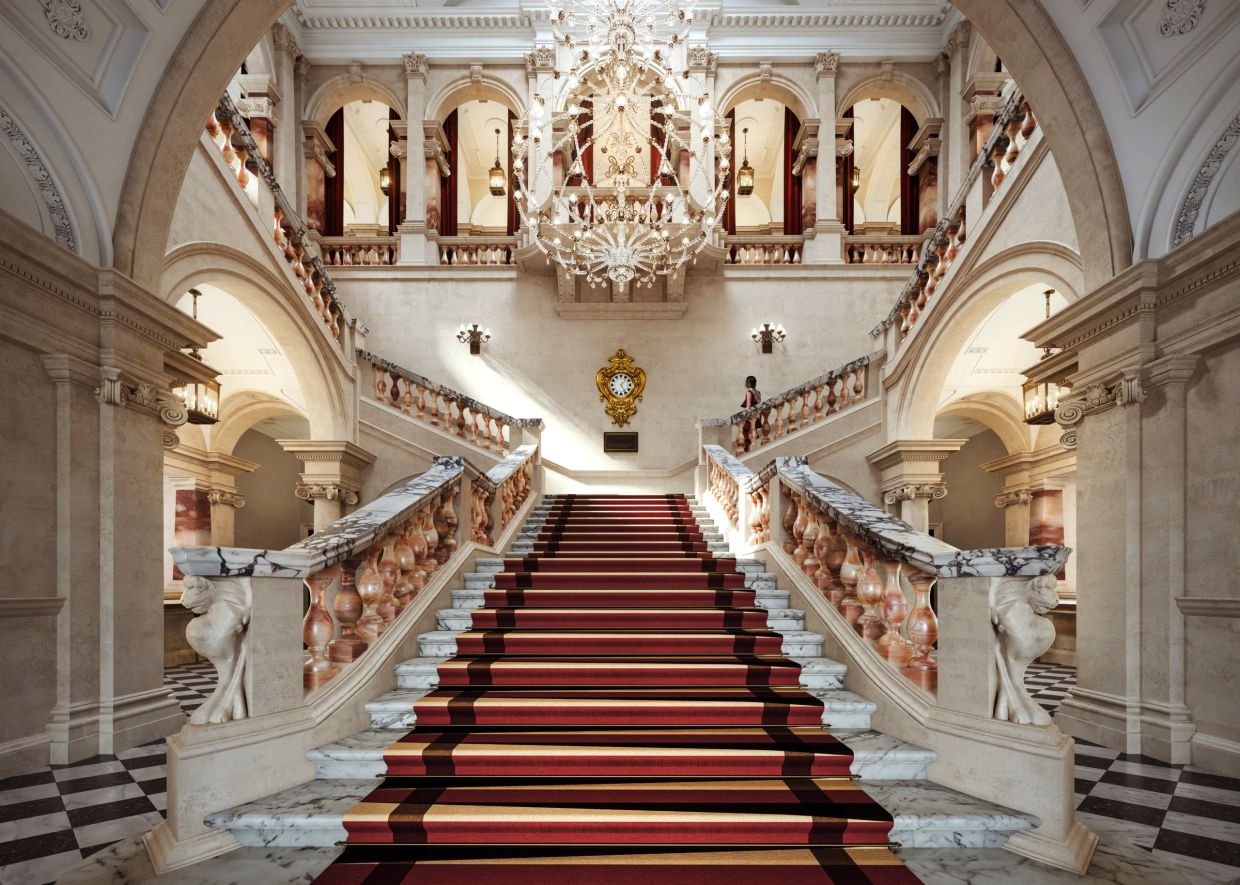
The basement bars at London's newest ultra-luxury hotels come with unusual backstories. At Raffles London at the OWO, guests sipping cocktails in the Spy Bar occupy rooms where MI5 officers once exchanged classified intelligence during the Cold War. Down the street, NoMad London invites visitors to explore prison cells where literary figure Oscar Wilde awaited trial in what was once Covent Garden's magistrates court. Meanwhile, in Grosvenor Square—long the symbolic heart of Anglo-American relations—the Chancery Rosewood now occupies the building that housed the United States Embassy, one of the world's most prestigious diplomatic postings. These establishments represent far more than conventional hospitality; they offer something luxury markets rarely achieve: authentic historical immersion wrapped in five-star service, commanding nightly rates exceeding £1,000 (RM5,506) in the process.
The phenomenon of converting decommissioned government architecture into high-end hotels extends across Europe, with former French ministerial buildings in Paris, ex-central bank headquarters in Rome, and redundant government ministries in Lisbon all reopening under hotel management. Yet London distinguishes itself through the sheer concentration and pace of such transformations. As Britain's public sector contracts and modernises, luxury developers have stepped in to acquire surplus civic buildings that governments increasingly regard as financial liabilities rather than assets. This represents a fundamental shift in how Britain manages its institutional real estate, driven by fiscal pressures and changing workplace expectations.
The appeal of these conversions lies partly in what architects and hospitality consultants call the "gift" of pre-existing character. According to John O'Ceallaigh, associate director at hospitality consultancy PRCO, these buildings arrive with inherent advantages that no contemporary construction could replicate: imposing facades, soaring ceilings, period mouldings, and the intangible weight of historical significance. Whereas modern luxury hotels often blur into interchangeable experiences—recognisable spas, contemporary dining, standardised room layouts—converted heritage properties offer guests something genuinely memorable. The psychological dimension matters considerably; travellers retain vivid impressions of sleeping in a former war room or walking corridors once traversed by prime ministers and intelligence operatives, whereas they typically forget generic marble surfaces within weeks.
O'Ceallaigh articulates a subtler appeal that resonates particularly with contemporary audiences: what he describes as the "strangely subversive" thrill of occupying spaces formerly cordoned off from ordinary access. When citizens feel disengaged or cynical toward present-day political institutions, there exists something psychologically satisfying about being granted permission to inhabit and even luxuriate within buildings that once represented impenetrable centres of power. This transformation of exclusivity into an entertainment product reflects broader cultural trends among affluent leisure travellers seeking authenticity and narrative depth within their consumption experiences.
The conversion process itself demands extraordinary technical sophistication. Raffles London at the OWO, which reopened in 2023 following an £1.4 billion (RM7.7 billion) redevelopment, required eight years of intensive work. Beyond aesthetic restoration, developers confronted deteriorating mechanical systems, antiquated electrical infrastructure, outdated plumbing networks, and office layouts that bore no resemblance to hotel requirements. The project involved adding three entirely new floors atop the existing structure while excavating six basement levels beneath it. Historic building protections complicated even routine alterations; local planning authorities, consulting with Historic England, had to approve new doorways and entrances. The Old War Office's fortress-like isolation required architectural intervention to create permeable public spaces—restaurants, bars, and circulation areas that spill onto Whitehall, transforming institutional remoteness into urban activation.
Similarly, the forthcoming Waldorf Astoria conversion at Admiralty Arch represents an ambitious reclamation of one of London's most ceremonially significant neoclassical structures. Standing between Trafalgar Square and Buckingham Palace, Admiralty Arch has guarded the ceremonial route used during Trooping the Colour and royal processions since its Edwardian construction. The building served administrative functions until 2011, hosting figures from Louis Mountbatten to Winston Churchill to Ian Fleming. Jamie Reuben, principal at Reuben Brothers—the developer who acquired the project—frames the conversion as restoring a national monument to public life, ending more than a century of restricted access and reintroducing the building to both Londoners and international visitors.
The underlying economics driving these conversions stem from fundamental shifts in how government and corporate entities now operate. Post-pandemic, London's office market has not recovered evenly; occupiers increasingly demand highly efficient buildings equipped with modern environmental systems, renewable energy credentials, and amenities capable of persuading employees back from home-working arrangements. Traditional government buildings, with their sprawling layouts designed for hierarchical bureaucracies that no longer exist, poorly serve contemporary office requirements. Geoff Hull, director at EPR architects overseeing the Raffles redesign, explains that Britain's civil service has contracted significantly, while hybrid work models have permanently reduced large-building space demand. Government ownership increasingly became an administrative burden rather than an asset.
Private developers possessed both the capital and operational flexibility to undertake these transformations. The Hinduja Group's acquisition and renovation of the Old War Office, and the Reuben Brothers' commitment to Admiralty Arch, underscore how wealthy international investors recognise heritage buildings as premium luxury assets. Hotels offer far superior repurposing options: perimeter rooms with natural light become guest suites, while internal spaces without windows convert into kitchens, spas, storage facilities, and service areas. The British government received substantial payments for these properties—approximately £60 million (RM330.13 million) for Admiralty Arch in 2012 and £350 million (RM1.926 billion) for the Old War Office in 2016—though such sales generated cultural pushback, with critics contending that disposing of strategically positioned government properties represented a form of "public theft."
Historic England, the government body responsible for protecting England's architectural heritage, navigates a pragmatic position. David Brock, head of the government historic estates unit, acknowledges that converting vacant or underutilised historic buildings into functioning hotels represents an acceptable compromise. The alternative—allowing landmark buildings to deteriorate through vacancy or neglect—poses far greater risks to architectural preservation. As Britain's public sector footprint shrinks, the organisation recognises that conversion into luxury hospitality frequently represents the most viable mechanism for maintaining these structures' physical integrity while ensuring their active use.
The marketing strategies employed by these converted hotels deliberately weaponise their institutional pedigrees. NoMad London houses the Bow Street Museum of Crime & Justice, narrating the history of London's early law enforcement apparatus within guest-accessible exhibition spaces. Raffles deploys tour guides who unveil hidden architectural secrets, recounting stories of Boy Scouts cycling through cavernous corridors delivering wartime dispatches, or detailing how specific rooms functioned as war rooms or intelligence facilities. Guest reviews on Google and Tripadvisor consistently emphasise heritage appeal; one visitor enthusiastically noted that the historical tours and unique atmosphere delighted them as a history enthusiast. These properties have transformed institutional history itself into a luxury amenity, converting what might otherwise appear as mere nostalgia into an experiential product that justifies premium pricing.
Richard Tubb, project director at EPR who led the NoMad transformation, articulates the contemporary luxury hospitality philosophy underlying these conversions: affluent travellers no longer desire interchangeable accommodations; they demand experiences, authenticity, and the sensation of inhabiting distinctive places rather than generic hotel chains. This trend reflects broader consumption patterns among high-income leisure travellers who increasingly value uniqueness and narrative coherence. London's luxury hotel market remains extraordinarily robust by global standards, with significant room inventory commanding prices exceeding US$1,000 (RM4,089) nightly. Both average daily rates and revenue per available room in the city's luxury segment have continued rising despite geopolitical volatility and Britain's loss of tax-free shopping following Brexit in 2021, according to real estate analytics firm CoStar. Heritage buildings strengthen this competitive position considerably; as Cristina Balekjian, director of hospitality analytics at CoStar, observes, such properties possess inherent distinctiveness that luxury markets particularly value.
For Southeast Asian readers and investors monitoring luxury real estate trends, London's heritage conversion phenomenon offers instructive lessons. As societies mature and government footprints shrink through privatisation and administrative consolidation, adaptive reuse of prominent institutional buildings represents an increasingly valuable investment opportunity. The financial returns justify extraordinary renovation expenditures when properties combine architectural significance, strategic location, and authentic historical narratives. Malaysia, Singapore, and other developed Southeast Asian economies possess their own portfolios of aging government buildings facing similar obsolescence questions. The London model demonstrates that heritage preservation need not conflict with market-driven profitability; instead, historical authenticity—when properly marketed—becomes a premium amenity commanding luxury pricing. These conversions also illustrate how private capital can assume custodianship of civic architecture, transferring maintenance responsibilities from constrained public budgets to commercially motivated operators with vested interests in long-term preservation.

