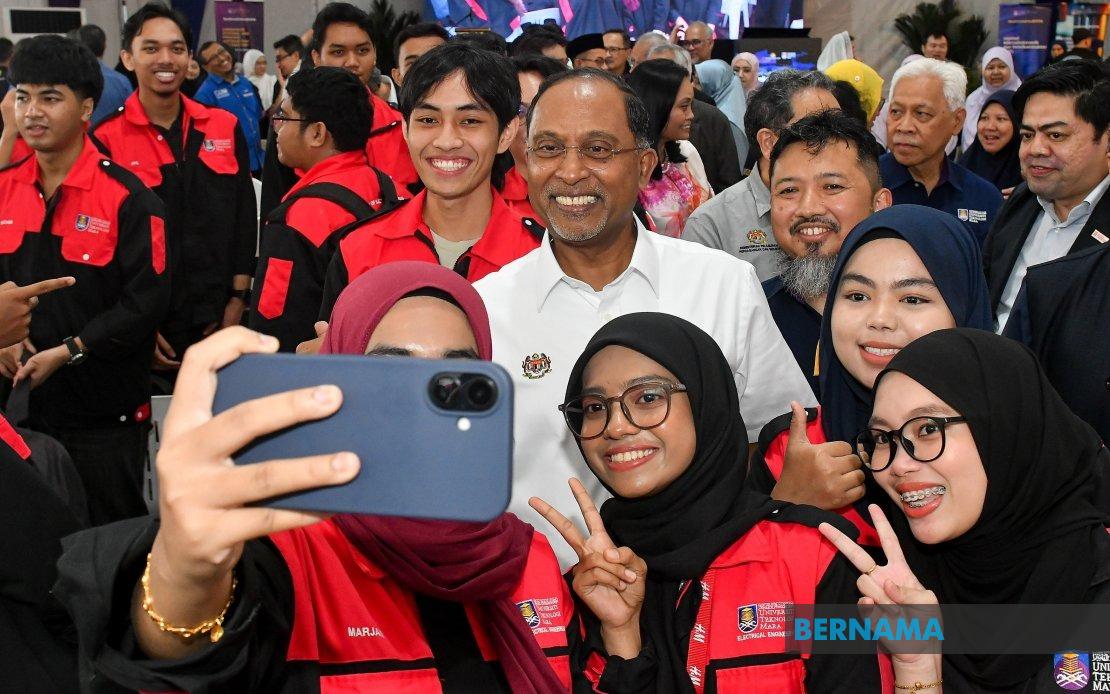
The opening of the Light Rail Transit 3 Shah Alam Line marks a significant milestone for student mobility in Selangor, delivering tangible benefits to the Universiti Teknologi MARA Shah Alam community and reshaping commuter patterns across the Klang Valley. Higher Education Minister Datuk Seri Dr Zambry Abd Kadir noted on Sunday that the newly operational service has already transformed daily travel experiences for UiTM's student population, while simultaneously alleviating persistent traffic pressures that have long plagued the institution's campus vicinity.
The introduction of the LRT3 Shah Alam Line represents a watershed moment for regional public transport infrastructure. Comprising 20 stations stretching from Bandar Utama through to Johan Setia, the line serves as a critical artery connecting multiple residential, commercial and educational nodes across the wider metropolitan area. For UiTM Shah Alam specifically, the dedicated station provides students with seamless access to the campus while simultaneously linking the institution to broader Klang Valley employment, entertainment and residential zones. Minister Zambry observed palpable enthusiasm amongst the student body, describing scenes of visible excitement as young commuters discovered the convenience and accessibility advantages the new rail connection offers.
A particularly significant feature underpinning the service's immediate uptake involves the introductory free fare policy announced by Prime Minister Datuk Seri Anwar Ibrahim during the line's official launch. Passengers using the service throughout June 29 until July 31 incur no charges, a strategic decision designed to encourage commuter adoption and demonstrate the tangible value of the investment to the travelling public. For cost-conscious students balancing limited budgets against daily transport requirements, this complimentary access period represents meaningful financial relief whilst normalising public transport usage amongst demographic groups that might otherwise rely upon personal vehicles.
Beyond immediate mobility benefits, the LRT3 Shah Alam Line exemplifies how strategic infrastructure investment directly supports broader economic and educational objectives. The line's configuration deliberately incorporates UiTM Shah Alam Station within its network design, reflecting institutional importance to regional planning frameworks. This deliberate integration acknowledges the university's role as a major employer, educational anchor and contributor to Selangor's knowledge economy. Students previously spending hours navigating congested roads can now redirect time and financial resources toward academic pursuits, productive engagement and personal development. The consequent reduction in transportation-related stress potentially yields measurable improvements in academic outcomes and student wellbeing metrics.
Minister Zambry simultaneously highlighted complementary initiatives advancing Malaysia's technological capabilities and human capital development. During his visit to UiTM Shah Alam, he officially launched the Semiconductor@UiTM programme, a strategic initiative designed to position the institution as a primary generator of semiconductor industry talent. This RM20 million government-funded programme reflects deliberate policy alignment with the National Semiconductor Strategy, ensuring domestic educational capacity meets evolving industry demands. The initiative encompasses upgraded laboratory facilities, industry-aligned curricula and structured collaboration mechanisms with global semiconductor manufacturers and supply chain participants.
Malaysia's semiconductor sector occupies a formidable position within global industrial hierarchies, commanding approximately 13 per cent of worldwide market share whilst generating over RM300 billion in annual economic value. This substantial contribution underscores the strategic importance of developing indigenous technical expertise capable of sustaining and expanding Malaysia's competitive advantages. UiTM's Semiconductor@UiTM programme directly addresses this imperative by establishing specialised training pathways in Electrical and Electronics Engineering, incorporating practical exposure to cutting-edge technologies alongside theoretical foundations. The university's positioning as a leading centre for producing internationally competitive graduates serves both domestic industry requirements and regional talent aspirations.
The initiative extends beyond conventional classroom instruction to encompass meaningful industry-academic collaboration. Students gain direct exposure to contemporary technological challenges confronting global semiconductor manufacturers whilst establishing professional networks with key industry participants. This cross-sector learning approach translates abstract theoretical knowledge into practical competencies aligned with workplace realities. Employers gain visibility into emerging talent pools early, whilst universities obtain real-time feedback regarding curriculum adequacy and skills alignment. Such symbiotic relationships strengthen educational institutions' relevance and responsiveness to dynamic market conditions.
Minister Zambry characterised UiTM's achievement as establishing a benchmark for Malaysian higher education institutions seeking to support high-technology sector growth. The university's demonstrated capability in translating government allocations into tangible infrastructure and educational outcomes provides a replicable model for other institutions pursuing similar objectives. This demonstration effect potentially catalyses comparable initiatives elsewhere, amplifying cumulative impacts across Malaysia's higher education ecosystem. The ultimate beneficiary remains the national economy, strengthened through enhanced technical talent availability and sustained competitive positioning within global technology markets.
The geographical specificity of the LRT3 Shah Alam Line's routing reflects sophisticated urban planning that recognises UiTM Shah Alam's regional significance. The station sequence deliberately incorporates diverse Klang Valley constituencies including established residential zones, emerging suburban developments and commercial districts. This comprehensive coverage acknowledges that contemporary university students represent mobile populations requiring efficient connectivity to employment opportunities, cultural amenities and residential choices distributed across metropolitan regions. Centralised campus locations increasingly compete with distributed educational delivery models and hybrid work arrangements, making transportation accessibility a crucial institutional competitive advantage.
Looking forward, the LRT3 Shah Alam Line's operational success and Semiconductor@UiTM's institutional establishment exemplify integrated approaches combining physical infrastructure investment with human capital development. Neither initiative alone would achieve maximum impact; together they represent holistic metropolitan development strategy addressing transportation, economic diversification and educational excellence simultaneously. For Malaysian policymakers, the Shah Alam experience provides instructive lessons regarding infrastructure investment returns when coupled with deliberate institutional capacity building. Students benefit from immediate mobility advantages whilst positioning themselves within globally competitive technical fields offering sustained career prospects.
The convergence of these initiatives occurs at a particularly opportune historical moment, as Malaysia navigates post-pandemic economic recovery and intensifying regional technology sector competition. Enhanced student mobility reduces daily friction whilst improved educational capacity ensures Malaysia's emerging professionals possess expertise requisite for advanced manufacturing and technology roles. The psychological and practical benefits accruing to UiTM students—reduced commute times, lower transport costs, enhanced professional preparation—collectively represent investments in human flourishing and national productivity that extend far beyond simple transport statistics or enrolment numbers.

