Malaysia observed Maal Hijrah 1448H on June 17 with a nationwide series of celebrations that positioned the Islamic calendar milestone as an opportunity for personal and collective renewal. The observance, marked across the country with religious programmes and formal ceremonies, centred on the concept of hijrah as a transformative journey—one that extends beyond the historical migration to encompass modern aspirations for better governance, stronger communities, and enhanced Muslim solidarity.
The central theme, "MADANI Dihayati, Ummah Diberkati," wove together the government's development philosophy with an emphasis on spiritual blessing and communal progress. This framing reflects how Malaysian authorities increasingly integrate religious observance with policy objectives, positioning Islamic principles as foundational to national advancement rather than treating spirituality and governance as separate domains. The thematic choice signals recognition that religious occasions carry significant soft power in shaping national discourse and public expectations around leadership standards.
Deputy Prime Minister Datuk Seri Fadillah Yusof and Minister in the Prime Minister's Department (Religious Affairs) Dr Zulkifli Hasan lent their presence to the main ceremony, which attracted approximately 5,000 participants. Their attendance underscored the event's political significance and the administration's commitment to championing Islamic values as central to its governance model. The presence of such high-ranking officials typically amplifies media coverage and public awareness, elevating Maal Hijrah beyond a community religious occasion into a platform for articulating government messaging about national direction and ethical leadership.
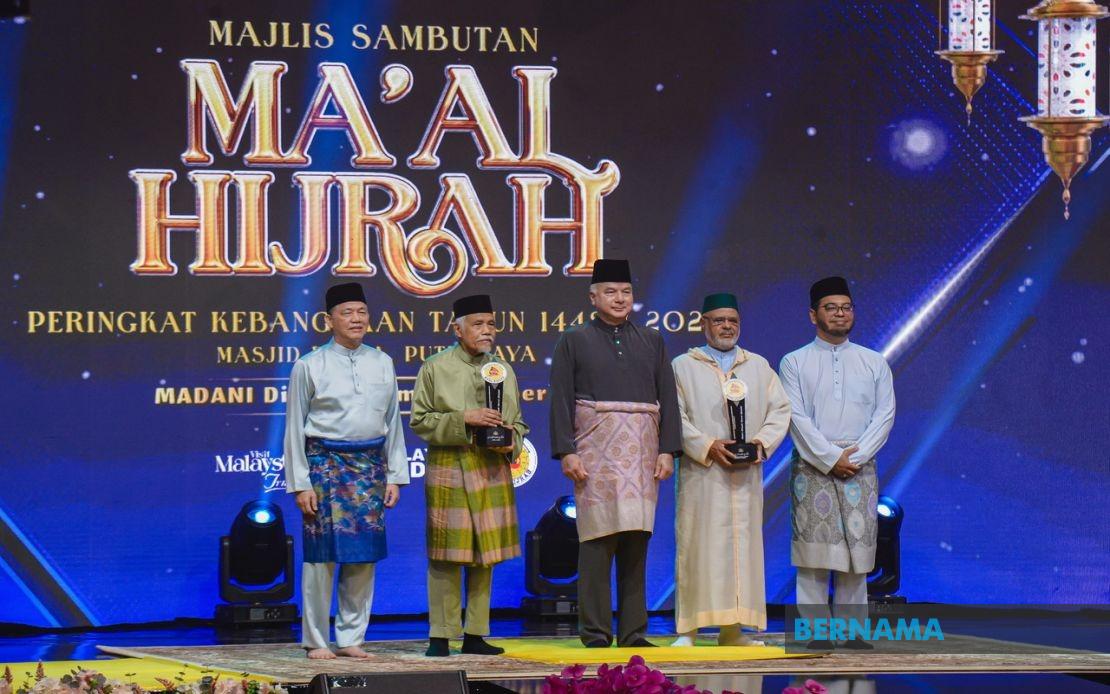
The centrepiece of the ceremony was the presentation of Maal Hijrah awards, honouring individuals deemed exemplary in their service to Islamic knowledge and community advancement. Sultan Nazrin, in his capacity as Sultan of Perak, presented the National Tokoh Maal Hijrah Award to Prof Emeritus Datuk Dr Osman Bakar, rector of the International Islamic University Malaysia. Bakar's selection reflects institutional prioritisation of scholarship and education within Malaysia's Islamic hierarchy of recognition. As a prominent academic bridging Western and Islamic intellectual traditions, his award carries symbolic weight beyond individual achievement, endorsing the integration of rigorous scholarship with religious commitment.
The International Tokoh Maal Hijrah Award went to Dr Ahmad Al-Raysuni, a distinguished Moroccan Islamic jurisprudence scholar. This recognition demonstrates Malaysia's positioning within broader Islamic intellectual networks, acknowledging that excellence in religious scholarship transcends national boundaries. By honouring a non-Malaysian scholar, the ceremonies reinforce Malaysia's aspiration to serve as a hub for Islamic thought and learning in Southeast Asia—a strategic objective that intersects with soft power ambitions and cultural diplomacy.
Parallel ceremonies in Sabah further distributed honours among community figures and religious educators. Datuk Ag Sharin Alimin, a community activist and former director of Sabah's Islamic Religious Affairs Department, received recognition in the male category, while former Sabah deputy state secretary Datuk Masnah Matsalleh was honoured among females. These selections reflect an institutional preference for recognising individuals with established government connections or administrative experience, suggesting that state-approved leadership models emphasise the marriage of official position with community service. Chief Minister Datuk Seri Hajiji Noor's involvement in welcoming state dignitaries demonstrated political coordination across levels of government.
A separate ceremony witnessed the honouring of Jusoh @ Muda Ismail, a 95-year-old Quran teacher described as the adopted son and student of the late Tuan Guru Haji Mat Lintar, a renowned Quranic scholar. This recognition carries particular significance for Malaysia's religious heritage, as it acknowledges the custodianship of Quranic knowledge through traditional transmission networks. The selection of an elderly educator highlights institutional efforts to preserve and honour oral-transmission traditions even as Malaysia simultaneously champions modern Islamic scholarship and education through universities. The dual recognition of traditional and contemporary Islamic learning reflects the complexity of navigating religious authenticity in a rapidly modernising society.
The nationwide scale of Maal Hijrah 1448H observances underscores how Islamic calendar milestones function as touchstones for national identity in Muslim-majority Malaysia. Unlike secular public holidays, which mark historical or political events, Maal Hijrah celebrations invite Malaysians to reflect on spiritual principles and ethical renewal. This positions religious observance not merely as personal devotion but as a civic exercise in recommitting to collective values and standards of conduct. For non-Muslim communities, such prominent state engagement with Islamic occasions occasionally generates conversations about religious pluralism and the relationship between state and faith.
The emphasis on leadership quality throughout the ceremonies reflects contemporary anxieties within Malaysia about governance standards and institutional integrity. By framing hijrah as a pathway to "stronger leadership," officials articulate an implicit acknowledgement that current governance challenges demand renewal and recommitment to higher ethical standards. This messaging resonates particularly in contexts where public confidence in institutions has been tested by corruption scandals, economic challenges, and governance questions. Religious frameworks become vehicles for addressing these secular concerns, offering moral vocabulary for discussions about accountability and public service.
The theme's invocation of "ummah unity" addresses another pressing concern in Malaysian Islamic discourse: the fragmentary nature of Muslim political and social organisation. Competing political parties, rivalries between Islamic states, and doctrinal differences among religious authorities sometimes undermine the notion of cohesive Muslim identity. Maal Hijrah celebrations that emphasise unity implicitly encourage Malaysians to transcend these divisions and focus on shared Islamic principles. The message carries particular relevance in Malaysia's multiethnic, multireligious context, where Muslim unity narratives sometimes serve as counterbalance to assertions of pluralistic national identity.
For Southeast Asian observers, Malaysia's Maal Hijrah celebrations demonstrate how Muslim-majority democracies integrate religious observance into state functions while maintaining democratic institutions. Unlike Iran or some Gulf states where religious authority is inseparable from political power, Malaysia's model positions Islamic values as inspirational and ethical guides within secular constitutional frameworks. The awards ceremonies and official participation create religious occasions that are simultaneously civic events, illustrating how state and faith can be configured in non-theocratic contexts. This model holds relevance for other Muslim-majority nations navigating similar relationships between governance and spirituality.
Looking forward, the prominence accorded to Maal Hijrah 1448H celebrations suggests that Islamic calendar observances will remain vehicles for state messaging about values, unity, and aspirational national direction. The ceremonies' emphasis on education, scholarship, and community service implicitly outline an ideological vision in which Islamic commitment manifests through intellectual rigour and practical service rather than through political militancy or sectarian identity. For Malaysian policymakers, such occasions provide platforms to shape religious narratives toward developmental and stability-oriented ends—a strategic calculus that distinguishes Malaysia's approach to managing Islamic identity within modern governance structures.