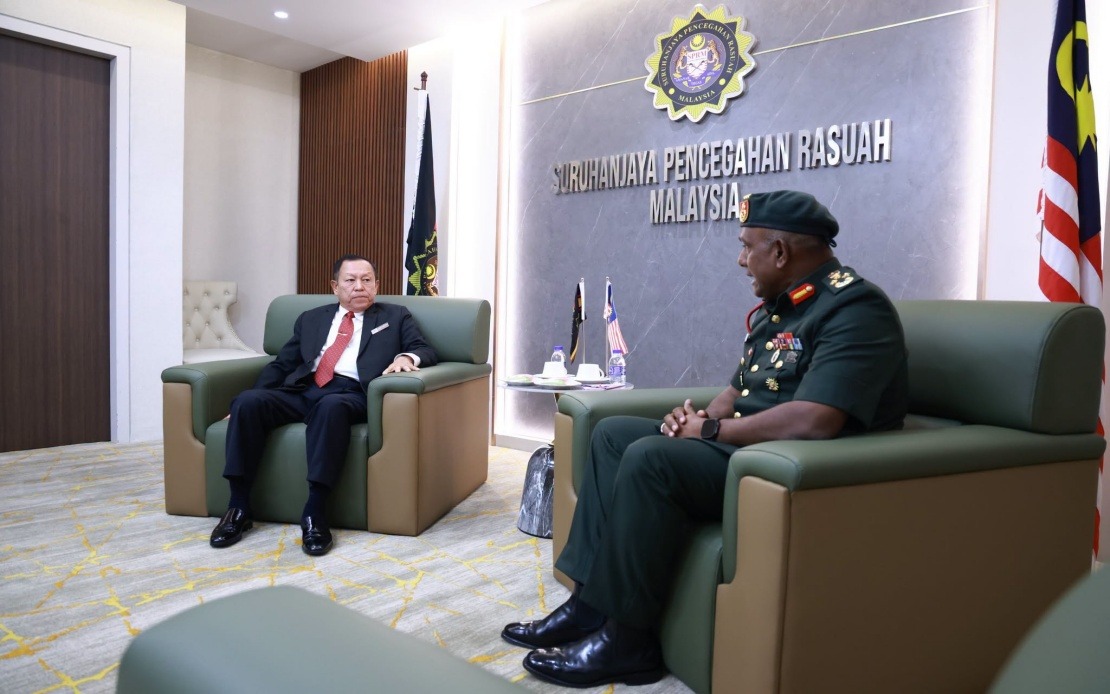
The Malaysian Anti-Corruption Commission and the Malaysian Armed Forces have moved to deepen their institutional ties through enhanced intelligence-sharing arrangements and coordinated governance initiatives. The commitment was reaffirmed during a formal courtesy visit at MACC headquarters in Putrajaya, where senior officials from both organisations underscored their determination to work more closely in tackling corruption and maintaining public sector integrity.
MACC Chief Commissioner Datuk Seri Abd Halim Aman characterised the existing relationship between the two agencies as longstanding and valuable, signalling his confidence that collaborative efforts would expand substantially in coming months. He emphasised that synergies emerging from closer coordination would enable the anti-corruption body to discharge its mandate with greater effectiveness, ultimately serving the broader national interest in upholding standards of conduct across government institutions and the security apparatus.
The deeper cooperation represents a natural extension of institutional responsibilities, given that the armed forces manage substantial resources, personnel and operational activities that demand robust internal oversight mechanisms. By working in tandem with Malaysia's premier anti-graft agency, the military can leverage specialised investigation expertise and intelligence analysis to identify and address potential breaches of conduct standards within its own ranks. Such collaboration also enhances the ability of both organisations to identify systemic vulnerabilities and recommend preventative governance improvements across defence and security institutions.
Lieutenant General Datuk Fazal Abdul Rahman, who heads the Malaysian Defence Intelligence Organisation, affirmed the armed forces' unwavering commitment to maintaining exemplary governance standards and upholding professional conduct throughout military operations. His remarks reflected broader institutional efforts within Malaysia's defence establishment to embed ethical standards and disciplinary frameworks that resonate with contemporary expectations of public sector accountability. The positioning of governance excellence as central to military identity signals a conscious shift away from historical narratives that sometimes portrayed defence institutions as operating outside normal civilian oversight mechanisms.
The emphasis on intelligence sharing between the two bodies holds particular significance for Malaysia's security environment. The armed forces maintain sophisticated intelligence collection capabilities and networks that could prove invaluable in identifying corruption patterns involving defence procurement, security contracts, or diversion of military resources. Conversely, MACC's investigative methodologies and financial analysis expertise can help the military trace illicit transactions and map networks of corrupt actors operating within defence infrastructure. Such reciprocal capability-sharing creates multiplier effects that neither organisation could achieve in isolation.
Information exchange arrangements also address a historical gap in anti-corruption architecture. Military institutions traditionally operated with significant operational autonomy and limited external scrutiny, creating environments where corrupt practices could flourish undetected. By formalising structured information-sharing protocols, both organisations acknowledge that transparency and external accountability mechanisms strengthen rather than undermine institutional effectiveness. This philosophical shift reflects evolving attitudes toward governance within Malaysian security institutions and alignment with international best practices regarding military integrity.
The governance enhancement pillar of the partnership suggests a proactive rather than purely reactive approach to corruption prevention. Rather than simply investigating misconduct after discovery, the two bodies can collaborate to design and implement systems, policies and oversight mechanisms that reduce corruption opportunities in the first instance. This preventative orientation proves particularly valuable in defence contexts, where procurement processes, personnel management and asset control systems generate recurring vulnerability points susceptible to exploitation by corrupt actors.
The courtesy visit marked the official assumption of duties by the new Malaysian Defence Intelligence Organisation director-general, signalling that relationship-building with civilian oversight bodies ranks among immediate institutional priorities. Such high-level engagement demonstrates that senior military leadership views anti-corruption cooperation not as an inconvenience imposed by civilian agencies but as a strategic imperative essential to maintaining institutional legitimacy and operational effectiveness. This messaging cascades throughout defence hierarchies and influences how middle-ranking and junior personnel approach ethical and transparency obligations.
For Malaysia's broader anti-corruption agenda, the MACC-Armed Forces partnership expands the commission's reach into institutional domains previously characterised by limited external accountability. The defence sector commands significant budget allocations and operational authorities, making it a natural target for corrupt actors seeking to exploit gaps in oversight. By establishing formalised cooperation mechanisms with military intelligence and security bodies, MACC strengthens its capacity to investigate defence-related corruption and deter potential violators operating within military structures.
Regionally, the Malaysian initiative reflects growing recognition across Southeast Asia that militaries must integrate with national anti-corruption frameworks rather than operate as autonomous entities. Countries throughout the region have recognised that defence sector corruption undermines national security, diverts resources from legitimate defence capabilities and corrodes public confidence in government institutions. Malaysia's approach of establishing structured partnerships between military and civilian anti-graft agencies offers a model that neighbouring countries may study and potentially adapt to their own institutional contexts.
The participation of senior officials from MACC's Intelligence Division and the Armed Forces' Security and Counter Intelligence Directorate in the discussions indicates that implementation will proceed through substantive professional engagement rather than symbolic gestures. These specialist units possess operational capability to translate strategic commitments into concrete intelligence-sharing protocols, joint investigation frameworks and information-management systems. Their involvement suggests that partnership architecture will reflect realistic assessments of institutional capacities and tactical requirements rather than aspirational rhetoric disconnected from practical realities.
Moving forward, the effectiveness of this deepened cooperation will ultimately depend on developing detailed operational protocols, training personnel in collaborative procedures and establishing performance metrics that allow both organisations to assess whether intelligence-sharing and coordinated investigations are yielding measurable improvements in corruption detection and prevention. Success requires sustained institutional commitment extending beyond senior leadership statements to embed collaboration in standard operating procedures and professional expectations throughout both organisations.

