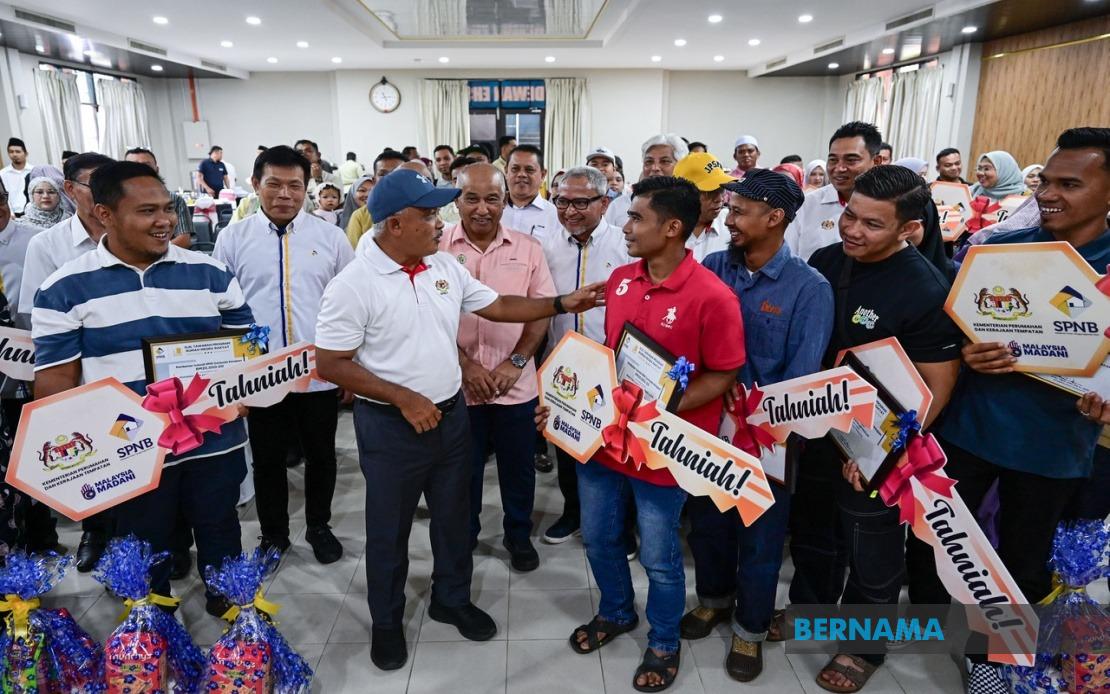
Fifty families across the Kuala Terengganu and Kuala Nerus parliamentary constituencies received tangible relief from housing pressures this week, as the Housing and Local Government Ministry distributed assistance under the Rumah Mesra Rakyat (RMR) programme. The beneficiaries, presented with either completed homes or construction offer letters during a ceremony at Dewan Ehsan in Felda Wilayah Timur, represent the latest cohort supported by this long-running affordable housing initiative that has quietly reshaped living conditions for Malaysia's lower-income households since its inception two decades ago.
The RMR scheme, administered by state-owned developer Syarikat Perumahan Negara Berhad (SPNB) under the Housing and Local Government Ministry, targets a specific demographic that conventional housing markets have historically neglected: landowners without adequate shelter. Unlike programmes that require home buyers to secure their own plots, the RMR model recognises that many Malaysians possess ancestral or individually-owned land but lack the capital, financing access, or construction expertise to build habitable dwellings. By constructing quality homes on these existing properties, the scheme addresses what ministry officials describe as a fundamental gap between asset ownership and liveable housing.
Ministry secretary-general Datuk Dr M. Noor Azman Taib, speaking during the Terengganu distribution, articulated the government's broader vision for the programme beyond mere brick-and-mortar delivery. He emphasised that RMR represents an investment in human dignity and family stability, creating anchors for community cohesion and generational prosperity. This framing reflects a recognition that housing security extends beyond physical shelter into psychological wellbeing, educational opportunity for children, and economic resilience for working families. The initiative thus positions itself as a social safety net with multiplier effects across household outcomes.
Numerically, the scale of RMR's ambition has expanded considerably under the MADANI administration. The government's 2026 budget allocation targets construction of 6,545 units nationwide, continuing an acceleration begun in previous fiscal years. As of the latest reporting period, roughly 3,900 units have entered the implementation pipeline, with 2,478 already completed and transferred to rightful occupants. An additional 1,422 units remain under active construction, indicating sustained momentum in delivery despite Malaysia's broader infrastructure and labour pressures.
Terengganu's allocation reflects its particular housing needs within the national programme. The state currently hosts 680 RMR units distributed across parliamentary constituencies, backed by RM46.67 million in state-level funding. Progress remains steady if gradual: as of May, nearly one-third of these units (246) had been completed and handed to qualifying families, with another 154 actively under construction. Notably, the two constituencies featured in this week's announcement—Kuala Terengganu and Kuala Nerus—together account for 66 implemented units, with completion rates suggesting the programme maintains its delivery track record despite logistical challenges typical of regional construction projects.
The Kuala Terengganu constituency, historically among Malaysia's more economically challenging areas, has seen 34 RMR units activated, with 18 already occupied and 16 in various stages of construction. Kuala Nerus, a neighbouring constituency encompassing both urban and semi-rural populations, registered 32 units in implementation, of which 25 have reached occupancy stage. These figures underscore how the programme distributes benefits across constituencies with distinct demographic profiles, from established parliamentary seats to newer administrative divisions.
Looking backward, the RMR programme's two-decade trajectory reveals impressive cumulative reach. Since its launch in 2002, the initiative has channelled secure, dignified housing to more than 80,000 families across Malaysia's peninsular and island regions. This translates to roughly 300,000 to 400,000 individuals whose living standards have been materially altered through access to proper shelter. For context, this exceeds the total housing stock of many developing nations and represents a significant portion of Malaysia's lower-income demographic, though substantial unmet demand remains given the country's continuing housing affordability crisis.
The MADANI government's sustained commitment to RMR carries particular significance for Southeast Asian observers tracking Malaysia's social policy direction. At a moment when regional governments grapple with rapid urbanisation, rural-urban migration, and affordability challenges echoing Malaysia's own experience, the RMR model offers a counterpoint to market-only solutions. By directly intervening to match assets with need, the programme demonstrates that targeted state action can address specific housing market failures without requiring wholesale nationalisation or price controls that might distort broader property markets.
For eligible families in Terengganu and beyond, receipt of an RMR offer letter or completed home represents more than administrative paperwork. It signals access to formal property rights, potential collateral for microfinance, and stable housing costs that won't escalate with market rentals. In rural and semi-urban contexts where traditional banking relationships remain tenuous, such stability compounds across generations. Children attend school without housing insecurity concerns; parents can plan beyond month-to-month survival; accumulated equity, however modest, transfers as inheritance.
The programme's expansion under current budget allocations suggests policymakers view housing affordability as a continuing pressure point requiring sustained resource commitment. With 6,545 units targeted for 2026 alone—compared to perhaps 2,000-3,000 annual completions in earlier years—the trajectory indicates recognition that demand far exceeds supply. Yet even at accelerated rates, closing the gap between eligible households and available units will require multi-year effort, suggesting RMR will remain a central fixture of Malaysian housing policy through the current decade.
Operationally, RMR's partnership with SPNB enables design standardisation that reduces per-unit costs while maintaining quality benchmarks. Homes typically feature three bedrooms, proper sanitation, and construction materials suitable for Malaysian climates, avoiding both slum conditions and unnecessary luxury that might exclude lower-income beneficiaries. This calibration—between dignified housing and fiscal sustainability—represents a calibration that development practitioners across the region increasingly seek to replicate.
For policymakers observing from other Southeast Asian capitals, the Terengganu distribution illustrates how targeted programmes can generate visible, measurable outcomes in politically sensitive areas. Housing ranks consistently among voter priorities across the region, and administrations that demonstrate concrete delivery—keys handed to families, foundations laid for new construction—build political capital extending beyond housing sector itself. This week's 50-recipient ceremony functions simultaneously as social policy implementation, community development initiative, and political messaging.
Looking forward, sustaining RMR's momentum will require continued budget allocations, stable construction supply chains, and effective targeting of genuinely eligible households. Early programme evaluations suggest administrative capacity has generally matched ambition, though monitoring occupancy quality and preventing secondary market distortions remain ongoing challenges. As Malaysia's housing conversation increasingly emphasises affordability alongside sustainability and urban planning, RMR's direct-delivery model will likely persist as a complement to broader market mechanisms, serving as the safety net for households market forces consistently overlook.

