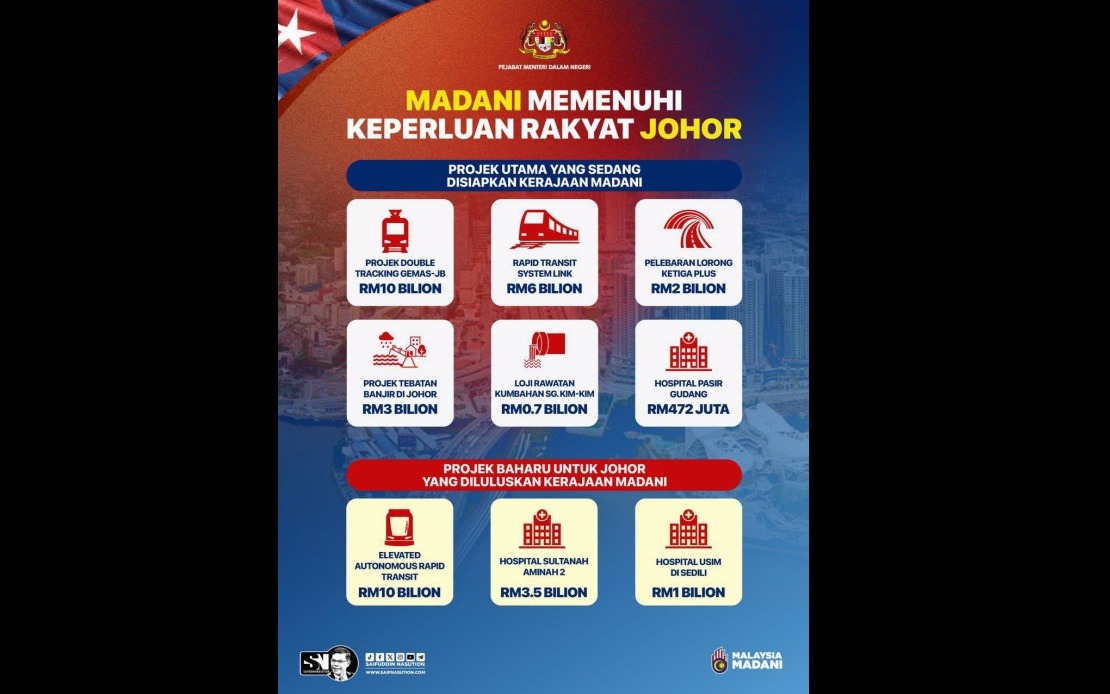
The MADANI Government remains steadfastly dedicated to delivering broad-based, equitable development that reaches every corner of the country, including Johor, according to Pakatan Harapan secretary-general Datuk Seri Saifuddin Nasution Ismail. Speaking on the government's developmental agenda, the Home Minister emphasised that Prime Minister Datuk Seri Anwar Ibrahim has positioned infrastructure investment, public transportation expansion, healthcare delivery, and flood management as pillars of a comprehensive strategy to elevate living standards nationwide.
Under this framework, Johor has emerged as a strategic focus area with multiple large-scale initiatives designed to transform its economic and social landscape. The state is currently implementing the Gemas-Johor Bahru Electrified Double Tracking Project, a railway modernisation effort that promises to enhance regional connectivity and support economic integration across the corridor. The project represents part of a broader vision to weave together the nation's transport networks into a more efficient, interconnected system that facilitates both passenger and freight movement across state boundaries.
Urban mobility has equally captured government attention through the Rapid Transit System (RTS) Link, a project aimed at addressing congestion and offering commuters reliable, sustainable alternatives to private vehicles. This initiative reflects broader aspirations to reduce carbon emissions and reshape how Malaysians move within metropolitan areas. Simultaneously, the government is advancing the third lane widening of the PLUS Highway, a critical infrastructure upgrade that addresses capacity constraints on one of the country's most heavily trafficked expressways.
Flood resilience has emerged as an increasingly urgent priority across Malaysia, and Johor is no exception. The state-specific flood mitigation initiative works in tandem with broader water management efforts, including the Sungai Kim Kim Sewage Treatment Plant. These projects acknowledge the intersection between environmental management, public health, and disaster preparedness—a nexus that has grown more pressing as climate variability intensifies across Southeast Asia.
Healthcare expansion rounds out the immediate project portfolio, with the Pasir Gudang Hospital serving as a foundational facility for one of the state's major industrial zones. Three additional healthcare facilities approved for development—the Elevated Autonomous Rapid Transit (E-ART), Sultanah Aminah Hospital 2, and USIM Hospital in Sedili—signal the government's intention to distribute medical capacity more evenly across Johor's geography, addressing access disparities between urban and peripheral communities.
Saifuddin Nasution has reframed the government's development philosophy in terms that extend beyond conventional metrics. Rather than fixating solely on project costs or capital outlay, the administration assesses success through tangible improvements in citizen welfare. This reorientation encompasses employment generation stemming from infrastructure construction and ongoing operations, enhanced transportation efficiency that saves commuters time and expense, strengthened healthcare accessibility that reduces treatment delays, and cumulative improvements in quality of life that accumulate across households and communities.
This philosophical shift carries particular relevance for Malaysian policymakers and regional observers evaluating the MADANI administration's performance. The emphasis on distributional outcomes—ensuring that development benefits permeate through society rather than concentrating in specific sectors or geographies—responds to longstanding criticisms that previous development models generated growth without proportionate welfare improvements for broader populations. For Johor specifically, a state that combines significant economic activity with persistent regional disparities, this approach suggests an attempt to integrate peripheral areas into expanding economic networks.
The concentration of multiple projects in Johor reflects the state's strategic position within Malaysia's economic architecture. As a major manufacturing hub, port centre, and gateway to Singapore, Johor's infrastructure capacity constrains regional development potential. Bottlenecks in transportation, healthcare, or utilities ripple beyond the state's borders, affecting supply chains and commerce across Southeast Asia. By investing substantially in Johor's foundational systems, the MADANI Government addresses both immediate state-level needs and broader regional economic efficiency.
For observers in neighbouring countries, these investments signal Malaysia's intention to maintain competitive infrastructure advantage within the region. The electrification of the Johor-Gemas corridor positions Malaysia as increasingly integrated with modern rail networks, while RTS development and highway improvements enhance logistics efficiency. These projects collectively suggest a government attempting to position the country advantageously within ASEAN's deepening economic integration and supply chain reorganisation.
The approval of three new major healthcare facilities warrants particular attention given ongoing regional pressures on medical systems. Malaysia's healthcare infrastructure has faced strains from rising demand, demographic ageing, and regional health crises. The strategic placement of hospitals in Sedili, expansion of Sultanah Aminah facilities, and the USIM Hospital addition suggest an attempt to distribute specialist capacity beyond traditional urban concentration zones. This dispersal strategy could reduce treatment backlogs, improve outcomes through earlier intervention, and address geographic health inequities that persist despite Malaysia's relatively advanced medical sector.
Implementing this ambitious portfolio presents considerable logistical and fiscal challenges. Coordinating multiple large infrastructure projects across different time horizons requires sophisticated project management, secure funding streams, and sustained political commitment across electoral cycles. For Malaysian investors and development stakeholders, the government's willingness to greenlight capital-intensive projects signals confidence in fiscal sustainability and long-term economic stability, though questions regarding implementation timelines and cost escalations remain pertinent.
The MADANI Government's developmental narrative aligns with wider Southeast Asian trends emphasising inclusive growth and distributed prosperity. Thailand, Vietnam, and Indonesia have similarly pursued infrastructure dispersal and healthcare expansion strategies as foundations for political legitimacy and sustainable economic performance. Malaysia's approach, if effectively executed, could serve as a model for balancing urban dynamism with rural development while maintaining macroeconomic prudence—a balance that has eluded several regional peers.

