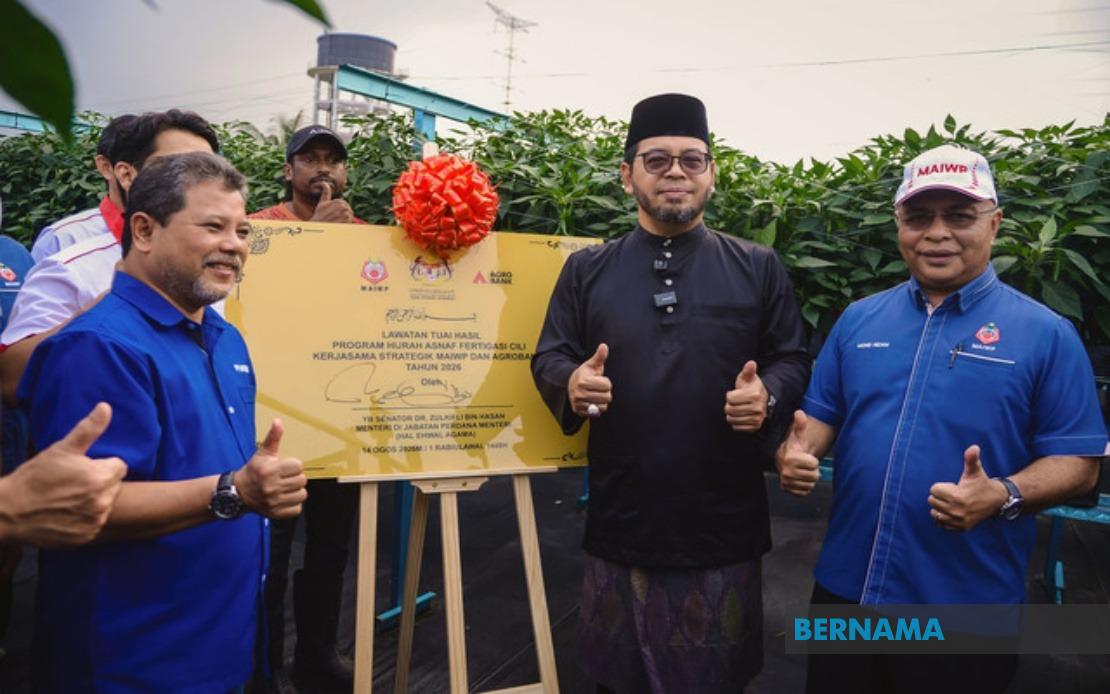
The Malaysian Islamic Development Agency (MAIWP) is scaling up its innovative chilli cultivation initiative aimed at empowering disadvantaged Muslim communities, following impressive results from the initial phase. The expansion to five acres marks a significant step in broadening what has proven to be a transformative agricultural programme, with plans to unlock greater economic potential for participating asnaf households in the coming seasons.
Dr Zulkifli Hasan, Minister in the Prime Minister's Department (Religious Affairs), highlighted the remarkable performance of the project during a recent visit to the farming site in Kuala Lumpur. The first harvest alone produced more than 16.7 tonnes of chillies, translating into revenues exceeding RM207,000 for the participating group. These figures demonstrate the commercial viability of the fertigation technique, which uses controlled irrigation systems to deliver nutrients directly to plant roots, significantly boosting productivity compared to traditional farming methods. The strong financial returns have validated the agency's decision to invest in training and infrastructure for this high-value crop.
Beyond the immediate agricultural output, the programme's architects see substantial opportunity for value chain development. Participants are being encouraged to explore downstream processing activities, producing chilli-based value-added products such as sauces, pastes, and dried variants. This vertical integration strategy could expand market reach far beyond fresh produce sales, potentially opening export pathways and higher-margin business opportunities for asnaf entrepreneurs. The approach reflects a deliberate shift from subsistence farming towards commercially oriented smallholder agriculture capable of sustaining household incomes year-round.
The human impact of the initiative is equally compelling. Alinda Rosely, a 49-year-old single mother and programme participant, credits the training and support with enabling her economic recovery. She reports earning RM40,000 within six months during a period when chilli prices were particularly favourable, transforming her financial circumstances and family prospects. Her experience encapsulates the broader mission: equipping vulnerable populations with practical skills and access to productive assets that create genuine pathways out of poverty. The programme has proven particularly valuable for women-headed households and divorced or widowed individuals within the asnaf category.
The expansion to five acres represents a calculated scaling of proven success. Before committing resources to larger cultivation areas, MAIWP conducted thorough monitoring of the initial plot, documenting yield rates, cost structures, market demand, and participant experiences. The decision to expand reflects confidence in both the agronomic model and the capacity of trained farmers to manage larger operations. This phased approach reduces risk while building institutional knowledge about what works within Malaysia's climate and market conditions, valuable lessons for potential replication in other districts or states.
MAIWP's broader strategy integrates this chilli project within its comprehensive welfare ecosystem. As of August 12, 2026, the agency had distributed RM699.57 million in zakat funds through 38 distinct welfare assistance schemes, addressing immediate needs while simultaneously investing in long-term income generation. The chilli initiative represents a strategic pivot: moving beyond emergency relief toward productive capacity building that reduces long-term dependency on welfare. This aligns with Islamic principles of self-reliance and dignified livelihood, concepts embedded in the agency's institutional DNA.
The relevance of such initiatives extends beyond individual beneficiaries to community and national development agendas. Malaysia faces persistent income inequality despite economic growth, with certain Muslim communities remaining disproportionately represented among lower-income brackets. Agricultural entrepreneurship offers a particularly promising avenue because it requires relatively modest capital investment, can utilise available land, and generates employment across multiple seasons. The chilli sector in particular benefits from steady domestic demand across food manufacturing, food service, and retail channels, insulating participants from export-dependent volatility.
The fertigation technology itself merits particular attention. By optimising water and nutrient delivery, the system increases yields while reducing input waste—a crucial consideration in Malaysia's tropical climate where water management presents both opportunities and challenges. Farmers trained in these methods gain competitive advantages over conventional producers, with measurable improvements in crop quality, consistency, and shelf life. Knowledge transfer around these technologies represents intellectual capital that participants can leverage across future endeavours or share within their communities.
Geographically, the Kuala Lumpur location offers advantages for market access and logistics that rural-based projects might lack. Participants benefit from proximity to wholesalers, retailers, processors, and consumers, reducing transportation costs and spoilage risks inherent in distance marketing. However, this model's scalability to other regions would require similar infrastructure assessments and potentially tailored approaches reflecting local market structures and competitive dynamics.
Looking forward, the programme's success will likely attract policy attention and potentially inspire similar initiatives across Malaysia's federal territories and states. Agricultural cooperatives, government agencies, and faith-based organisations are increasingly recognising that technology-enabled farming can serve social objectives without compromising commercial performance. The MAIWP chilli project demonstrates this compatibility in practical terms, offering a replicable model for policymakers seeking cost-effective, dignity-preserving interventions addressing unemployment and underemployment among vulnerable populations.
The expansion announcement also reflects wider trends in Islamic finance and development, where earnings from waqf assets and zakat funds are increasingly directed toward productive investments rather than purely consumptive support. This philosophical shift, grounded in Islamic jurisprudence emphasising self-sufficiency and wealth creation, offers interesting parallels to development economics literature on graduation from poverty and asset-based social protection. MAIWP's approach essentially operationalises these principles through practical agricultural enterprise, creating measurable, sustainable improvements in participants' economic circumstances while reinforcing community cohesion and institutional trust.

