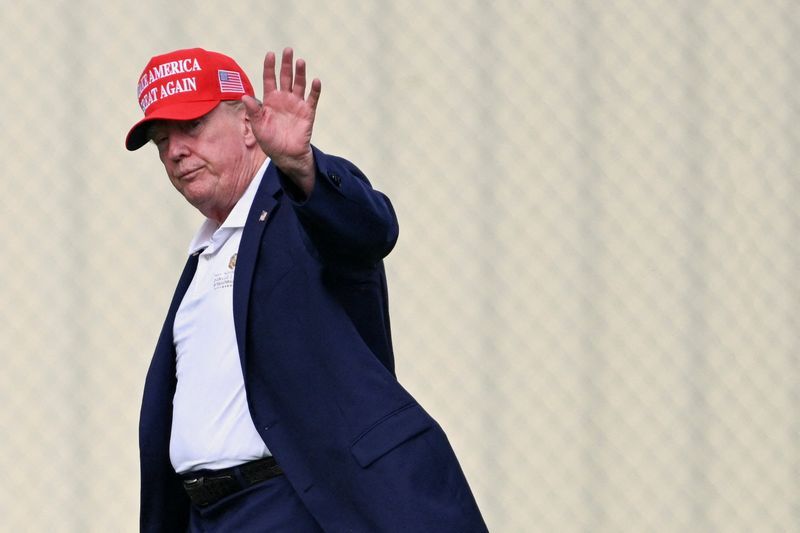
The latest Reuters/Ipsos survey has exposed significant public concern over President Donald Trump's financial entanglements while holding office, with a commanding majority of Americans expressing disapproval of his cryptocurrency-related earnings since his second term began. The four-day poll, completed on August 17, presents a striking challenge to a president who entered office on promises to eliminate Washington corruption and "drain the swamp." The findings carry particular weight because they reveal deep fractures even within Trump's own Republican base, with half of GOP respondents acknowledging that business interests may be influencing the president's decisions.
Trump's wealth accumulation through digital assets has reached extraordinary proportions, with documented earnings exceeding $1.4 billion last year derived from his family's cryptocurrency operations, particularly through ventures such as World Liberty Financial and his personally branded meme coin. The president has actively promoted these digital assets on social media platforms, including a March 2025 post describing his crypto offering in emphatic terms. This hands-on promotional approach stands in sharp contrast to his administration's assertion that he maintains no day-to-day involvement in family business operations and that his investments are managed by independent financial institutions.
The ethical dimension of this situation cannot be understated when examining American public sentiment. The poll data indicates that 63 percent of respondents believe it inappropriate for Trump and his family to have profited from cryptocurrency ventures, while 32 percent endorsed such arrangements. The partisan breakdown reveals a telling story: roughly 70 percent of Republicans accepted the president's cryptocurrency profits as legitimate, whereas approximately 30 percent of GOP voters joined the broader majority in viewing the situation as improper. Among Democrats and independents, opposition to these financial arrangements approached near-unanimity, demonstrating that concerns about presidential ethics transcend typical partisan divisions.
More broadly, the survey uncovered deep anxiety about the intersection of personal business interests and presidential decision-making. Nearly 70 percent of Americans, including two-thirds of independent voters and nine in ten Democrats, expressed conviction that Trump's private commercial ventures are shaping his policy choices. This perception extends beyond cryptocurrency into the administration's broader approach to digital asset regulation. Since returning to office, Trump has championed policies favourable to the cryptocurrency industry, continuing a courting process that began during his campaign fundraising efforts. The alignment between his personal financial interests and his policy agenda has not escaped public notice.
Presidential ethics experts have sounded alarm bells about the unprecedented nature of Trump's situation. Richard Painter, who served as chief ethics counsel during the George W. Bush administration, stated unequivocally that the current arrangement surpasses anything witnessed in recent presidential history, including Trump's first term. The complexity and breadth of business interests now present in the White House represent uncharted territory in modern American governance. Painter's assessment carries particular credibility given his Republican background and his experience navigating ethics questions within a previous conservative administration.
The White House has firmly rejected accusations of impropriety, with spokeswoman Anna Kelly issuing a statement asserting that no conflicts of interest exist and that the president acts solely in the public interest. This defensive posture mirrors the administration's broader strategy of dismissing ethics concerns while simultaneously launching investigations into alleged Democratic corruption in states controlled by that party. The political calculation appears clear: by emphasizing corruption narratives against political opponents, the administration hopes to deflect from questions about its own ethical foundations.
Wider perceptions of corruption within American government remain complicated and polarised. Roughly 41 percent of respondents identified the Democratic Party as more corrupt, while 49 percent pointed to Republicans, a significant swing toward viewing the GOP as the more corruption-prone party. Democrats demonstrated substantially greater anger about government corruption generally, with 40 percent expressing extreme frustration compared with 25 percent of Republicans. These findings suggest that Trump's personal enrichment while in office has shifted broader American perceptions about which political party better represents anti-corruption principles.
The implications for the November midterm elections are potentially serious for Republicans. Voters' judgments about presidential ethics and conflict of interest often translate into electoral consequences, particularly when corruption narratives gain currency in the media environment. Democrats have begun emphasising alleged Trump administration corruption as a central campaign theme heading into Congressional races that will determine control of the legislative branch during the remainder of Trump's term. The administration's vulnerability on this front differs markedly from Trump's 2016 campaign positioning, when he successfully weaponised corruption concerns against Hillary Clinton.
The polling data extends beyond simple approval or disapproval metrics to reveal the erosion of Trump's core campaign messaging on anti-corruption grounds. One respondent, Thomas Schmidt, a semi-retired crossing guard from Wisconsin who voted for Trump in 2024, exemplified the shift in voter sentiment. Schmidt acknowledged growing disappointment with the president's focus on personal business practices rather than governing priorities, citing persistent inflation and military entanglements as concerns that should supersede financial interests. His observation that all presidents engage in some version of business-politics mixing represents a form of resigned acceptance rather than genuine approval.
For Malaysian and Southeast Asian observers, Trump's situation illustrates broader global tensions between democratic governance and executive power when concentrated wealth intersects with political authority. Many nations in this region grapple with similar questions about whether leaders sufficiently separate personal financial interests from public decision-making. The American case demonstrates that even in established democracies with robust institutional checks and media scrutiny, the boundaries between business and politics can blur dangerously. The Reuters/Ipsos findings suggest that public trust erodes when presidents appear to legislate in their own financial interests, a lesson relevant to governance everywhere.
The 1,166 respondents surveyed between August 14 and 17 provided data with a margin of error of three percentage points overall and five points for partisan subgroups, offering reasonably reliable insight into American public opinion. As the midterm election cycle progresses, these underlying currents of concern about Trump's financial arrangements may prove decisive in determining Congressional outcomes and shaping the final two years of his presidency.

