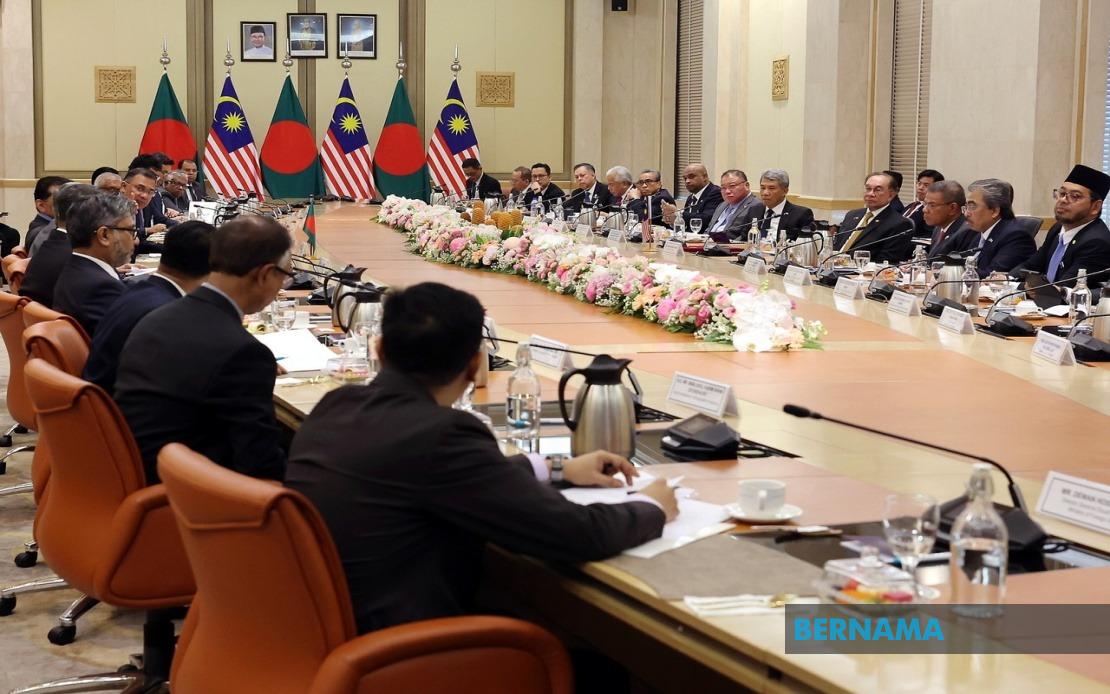
Prime Minister Datuk Seri Anwar Ibrahim has called for Malaysia and Bangladesh to deepen their strategic partnership by venturing into high-growth technological sectors, including artificial intelligence, renewable energy, and semiconductor manufacturing. Speaking alongside visiting Bangladesh Prime Minister Tarique Rahman at a joint press conference in Putrajaya on June 22, Anwar stressed that while investment ties remain crucial, the two nations must simultaneously pursue collaboration in frontier technologies that will define competitiveness in coming decades.
The bilateral engagement, marked by Rahman's two-day official visit, signals renewed momentum in Malaysia-Bangladesh relations at a time when both Southeast Asia and South Asia are competing for technological leadership and foreign direct investment in emerging industries. Anwar emphasised that expanding beyond conventional agricultural and commodity-based commerce represents a necessary evolution for a partnership that has historically relied on well-established trade mechanisms. He specifically highlighted semiconductors, the digital economy, energy transitions, and advanced manufacturing as priority areas warranting structured cooperation frameworks.
Artificial intelligence emerged as a particularly critical focus area during the discussions. Anwar framed AI not merely as a commercial opportunity but as a defining challenge of the future that demands coordinated regional responses. For Malaysia, which has positioned itself as a Southeast Asian technology hub, collaborating with Bangladesh—a nation of 170 million people with growing tech ambitions—opens pathways for knowledge transfer, shared research initiatives, and supply chain integration. Bangladesh's lower labour costs and expanding tech workforce complement Malaysia's advanced manufacturing capabilities and established semiconductor ecosystem, creating complementary strengths.
The energy sector represents another convergence point with substantial geopolitical implications. Both nations face mounting pressure to diversify away from fossil fuel dependency and meet increasingly stringent carbon targets under international climate commitments. A coordinated approach to renewable energy development, including solar, wind, and potentially green hydrogen technologies, could accelerate both countries' energy transitions while reducing regional dependence on volatile global energy markets. Such collaboration might also position Malaysia and Bangladesh as technology exporters within South and Southeast Asia, where energy security remains a persistent challenge for developing economies.
The semiconductor dimension carries particular significance given global supply chain vulnerabilities exposed during recent years. Malaysia already hosts substantial semiconductor fabrication and assembly operations, while Bangladesh represents an emerging market with untapped potential for electronics manufacturing and component assembly. Expanding cooperation in this sector could strengthen ASEAN's technological resilience and reduce regional reliance on distant suppliers during international disruptions. Additionally, semiconductor manufacturing attracts capital-intensive foreign investment and creates high-skilled employment opportunities, benefiting both economies.
Formalising these aspirations, the two leaders witnessed the signing of three diplomatic instruments during the Putrajaya engagement. These included a Memorandum of Understanding on Cultural Cooperation, an Exchange of Notes on Counter-Terrorism Research, and an Exchange of Notes addressing Investment Promotion and Facilitation. The counter-terrorism framework reflects shared security concerns across both regions, while the investment protocol removes bureaucratic impediments that previously constrained cross-border capital flows. Together, these agreements establish the institutional scaffolding necessary for ambitious technological collaboration.
The cultural cooperation agreement underscores that bilateral advancement extends beyond purely economic metrics. Malaysia and Bangladesh share significant historical, religious, and demographic connections that provide a foundation for deeper people-to-people engagement. Educational exchanges, cultural festivals, and academic partnerships can nurture the human capital necessary for technological innovation. Many Malaysian professionals and entrepreneurs trace ancestry to Bangladesh, creating informal networks that facilitate business relationships and knowledge spillover.
For Malaysian policymakers, deepening technological ties with Bangladesh aligns with broader regional positioning strategies amid intensifying great power competition. A stronger ASEAN-South Asia technological corridor diminishes the region's vulnerability to external pressures and creates alternative pathways for development financing and technology acquisition. Bangladesh's status as a potential middle-income economy offers Malaysia opportunities to position itself as a technology partner and advisor for nations pursuing similar development trajectories.
The timing of Rahman's visit carries additional significance given evolving geopolitical currents in Asia. Enhanced Malaysia-Bangladesh cooperation represents a tangible expression of ASEAN's broader engagement with South Asia, formalised through mechanisms like the East Asia Summit and ASEAN Regional Forum. Strengthening bilateral relationships within this framework reinforces multilateralism and regional connectivity at a moment when bilateral and strategic alignments are intensifying across Asia.
Implementing these ambitious cooperation agendas will require establishing dedicated institutional mechanisms, allocating research funding, and facilitating visa and regulatory frameworks that reduce friction for technology professionals and entrepreneurs moving between nations. Both governments must move beyond diplomatic declarations to concrete sectoral working groups, joint ventures, and research consortiums that generate measurable outcomes. Success hinges on sustained political commitment and the ability to navigate differing regulatory environments and development priorities.
For Malaysian businesses, particularly those in semiconductors, renewable energy, and digital technology, the enhanced bilateral framework offers concrete opportunities to expand market presence in Bangladesh while building strategic partnerships with local enterprises. Export credit facilities and government-backed investment guarantees could facilitate Malaysian technology companies' entry into a market of significant scale. Similarly, Bangladeshi firms gain access to Malaysia's advanced manufacturing ecosystem and export networks to developed economies.
The expansion into AI, energy, and semiconductors represents Malaysia's recognition that 21st-century development depends on technological sophistication and regional integration rather than isolated pursuit of competitive advantage. By investing in partnership with Bangladesh, Malaysia positions itself as a technology leader within a broader Asian development narrative. This approach builds resilience, diversifies economic risks, and creates opportunities for inclusive growth that benefits multiple stakeholder communities across both nations.

