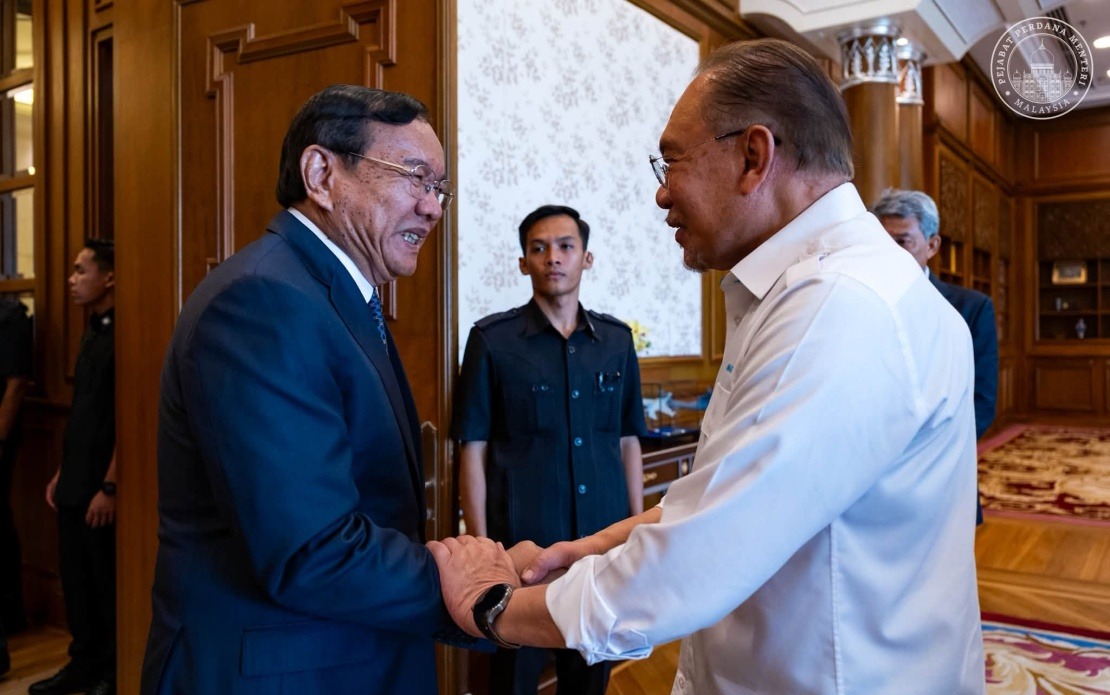
Malaysia and Cambodia have renewed their commitment to forge stronger strategic partnerships spanning multiple economic and security domains, Prime Minister Datuk Seri Anwar Ibrahim announced on August 3. The pledge emerged following a high-level meeting with Cambodian Deputy Prime Minister and Minister of Foreign Affairs and International Cooperation Prak Sokhonn, who arrived for a two-day official visit that underscores the growing momentum in bilateral relations between the two neighbouring ASEAN members.
The scope of cooperation outlined by Anwar encompasses some of the region's most strategically important sectors. Digital economy development and artificial intelligence feature prominently in the expanded partnership, reflecting both nations' recognition that technological advancement will shape their economic trajectories over the coming decade. Beyond the digital realm, Malaysia and Cambodia are placing renewed emphasis on the halal industry—a sector where Malaysia's established expertise and certification frameworks can unlock significant commercial opportunities for Cambodia's growing food and beverage exporters. Food security has also been prioritised, a particularly pressing concern across Southeast Asia given supply chain vulnerabilities exposed by recent global disruptions and the region's vulnerability to climate-related agricultural shocks.
Human capital development constitutes another pillar of the revitalised partnership. This focus suggests both governments recognise that skilled workforces and educational exchanges will prove essential for navigating economic transitions and competing effectively in a knowledge-driven regional economy. For Malaysia, which has long positioned itself as an educational hub for Southeast Asian students, expanded cooperation with Cambodia offers opportunities to deepen institutional ties and create pathways for Cambodian professionals seeking advanced training. The commitment also addresses practical governance challenges facing both nations through enhanced coordination in combating cross-border crime—an area where operational cooperation between national law enforcement agencies yields tangible security gains.
The timing of this diplomatic engagement proves significant. Prak Sokhonn's visit coincides with preparations for the Third Malaysia-Cambodia Joint Commission for Bilateral Cooperation (JCBC) meeting scheduled for August 4, a formal mechanism that allows both governments to structure their engagement systematically and track progress against agreed benchmarks. Such institutional frameworks transform rhetorical commitments into measurable outcomes, enabling implementation across multiple ministry portfolios and ensuring continuity regardless of political transitions.
Looking further ahead, Malaysia and Cambodia are consciously positioning their relationship as a long-term strategic asset. The announcement references the approaching 70th anniversary of diplomatic relations in 2027, signalling that both nations view this milestone not merely as a historical marker but as an opportunity to consolidate gains and chart an ambitious agenda for the next phase of bilateral engagement. This forward-looking perspective contrasts with transactional diplomacy and suggests a commitment to building institutional depth and people-to-people connections that can weather geopolitical fluctuations.
For Southeast Asia more broadly, the Malaysia-Cambodia partnership carries broader implications. Both countries occupy distinct yet complementary positions within ASEAN's architecture. Malaysia's role as a developed economy with advanced financial and technological infrastructure, combined with Cambodia's position as a developing nation with abundant human resources and untapped potential, creates a natural complementarity. Cooperation between these two members can serve as a model for how ASEAN states can leverage differentiated comparative advantages while pursuing collective regional objectives.
Anwar's emphasis on ASEAN community building and the shared responsibility of preserving regional peace speaks to deeper strategic thinking. As ASEAN navigates complex geopolitical pressures from major powers and grapples with internal challenges ranging from the Myanmar crisis to South China Sea tensions, bilateral relationships that strengthen member-state cohesion become increasingly valuable. A robust Malaysia-Cambodia partnership contributes to the collective resilience and unity that ASEAN requires to maintain its centrality in regional affairs.
The reference to ASEAN Community Vision 2045 demonstrates that bilateral cooperation is being explicitly linked to regional integration architecture. This framing ensures that bilateral initiatives align with and reinforce broader ASEAN goals, creating synergies rather than silos. When two member states coordinate around shared regional visions, they amplify the impact of their individual efforts and create demonstration effects that can inspire similar partnerships elsewhere within ASEAN.
For Malaysian businesses and investors, the expanded cooperation framework opens concrete opportunities. The emphasis on digital economy and AI cooperation suggests both governments will likely implement supportive policies for companies seeking to operate across borders in these sectors. The halal industry focus particularly benefits Malaysian firms with established regional networks, as Cambodia's growing middle class and food export ambitions create natural demand for Malaysian technical expertise and certification services.
Cambodia's perspective on this partnership also warrants attention. For Phnom Penh, deepening ties with Malaysia offers access to technological expertise, business practices and institutional models that can accelerate its own development trajectory. The food security cooperation carries particular weight for Cambodia, which seeks to diversify its agricultural exports and improve supply chain resilience. Conversely, Malaysia gains a capable neighbour and reliable partner for managing shared security challenges, particularly given Cambodia's geographic position and role in regional connectivity initiatives.
The diplomatic language employed by Anwar—emphasising friendship, strategic partnership and mutually beneficial cooperation—reflects genuine alignment of interests rather than mere courtesy. Both countries face similar challenges around ensuring inclusive economic growth, managing labour mobility, addressing cybersecurity threats and positioning themselves advantageously within evolving regional power dynamics. These shared challenges create powerful incentives for substantive cooperation rather than symbolic gestures.
As implementation of these commitments proceeds through the JCBC and various sector-specific working groups, success will depend on sustained political will from both capitals and effective coordination among multiple government agencies. The substantive nature of the agenda—spanning digital transformation, food security and law enforcement—requires technical expertise and operational coordination that extends well beyond foreign ministry diplomacy. Regular high-level visits, as exemplified by Prak Sokhonn's current trip, provide essential momentum and political cover for bureaucratic implementation.
Ultimately, the Malaysia-Cambodia partnership demonstrates that bilateral cooperation within ASEAN remains a vital tool for advancing shared prosperity and security. As regional geopolitics grows more complex and economic competition intensifies, strong partnerships between member states become crucial anchors for regional stability and prosperity. The commitments announced during this visit, if effectively implemented, can yield tangible benefits for Malaysian and Cambodian citizens while strengthening ASEAN's collective capacity to pursue its 2045 vision.

