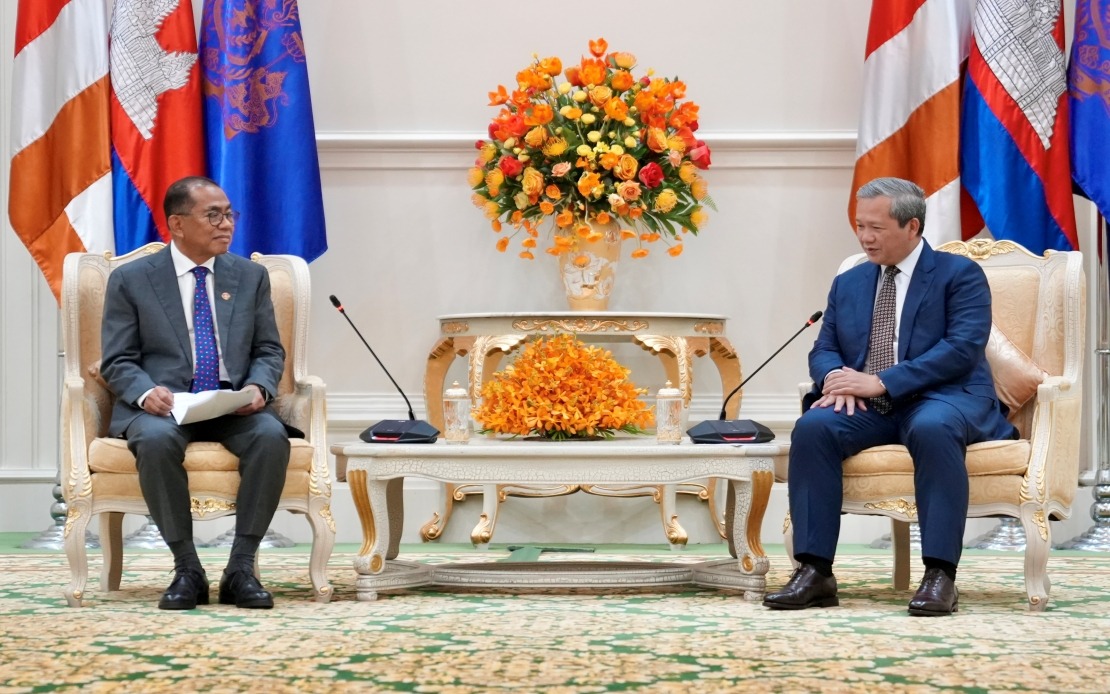
Malaysia and Cambodia are moving to cement their defence partnership through a comprehensive cooperation framework, underscoring the region's commitment to collective security amid evolving geopolitical challenges. During a working visit to Phnom Penh, Defence Minister Datuk Seri Mohamed Khaled Nordin engaged with Cambodian Prime Minister Samdech Thipadei Hun Manet and Defence officials to finalise bilateral defence arrangements that will shape cooperation for years ahead.
The centrepiece of these discussions is the Malaysia-Cambodia Defence Cooperation Memorandum of Understanding, a foundational agreement now in its final stages. This accord represents more than bureaucratic procedure; it will establish a formal architecture for military-to-military engagement across multiple domains, enabling both nations to coordinate more effectively on shared security interests. The timing reflects Malaysia's broader strategy to strengthen relationships across ASEAN at a moment when regional stability faces pressures from maritime disputes, transnational threats, and broader geopolitical competition.
One of the most pressing regional issues discussed was the situation along the Cambodia-Thailand border. Both nations emphasised the importance of dialogue and peaceful resolution mechanisms, with Malaysia reaffirming its support for the ASEAN Observer Team mechanism even after relinquishing the ASEAN chairmanship. This underscores how Malaysian defence diplomacy extends beyond bilateral engagement to reinforce the collective stability frameworks that benefit all Southeast Asian states. The ceasefire maintenance between Cambodia and Thailand remains fragile and dependent on sustained diplomatic attention from neighbouring countries.
The cooperation agenda extends to forward-looking security domains that reflect 21st-century threats and capabilities. Jungle warfare training capitalises on both nations' geographic and military experience in challenging terrain operations. More significantly, the two countries have identified defence industry collaboration, artificial intelligence applications, and drone technology as priority areas for joint development. These emerging fields represent where military advantage increasingly concentrates, and regional cooperation prevents technological dependence on external powers.
The South China Sea Code of Conduct emerged as another critical discussion point, with Malaysia emphasising its importance for maintaining a rules-based regional order. This reflects broader Malaysian policy positioning on maritime security, where balancing great power interests against ASEAN's collective voice remains delicate. As the code nears finalisation after years of negotiation, each ASEAN member's advocacy contributes to shaping its ultimate terms and enforceability mechanisms.
Mohamed Khaled expressed confidence that the defence cooperation memorandum could be formally signed during the forthcoming ASEAN Defence Ministers' Meeting in the Philippines, providing a symbolic capstone to these bilateral efforts. This timing would integrate Malaysia-Cambodia defence coordination into the broader ASEAN security dialogue, demonstrating how bilateral agreements reinforce regional frameworks rather than operating in isolation.
The visit forms part of a broader Southeast Asian engagement strategy that encompassed Vietnam immediately beforehand. Mohamed Khaled's sequential visits to Vietnam and Cambodia exemplify the systematic approach outlined in Malaysia's Defence White Paper and the Third Pillar of the National Defence Strategy focused on establishing credible partnerships. These missions reflect how defence diplomacy serves as a cornerstone of Malaysia's regional influence, particularly given its withdrawal from the current ASEAN chairmanship rotation.
Malaysia's diplomatic messaging during these visits has emphasised continuity rather than vacancy following its ASEAN chair transition. The Defence Minister's repeated affirmations that Malaysia's commitment to regional peace and stability remain unchanged aim to reassure partners that security cooperation transcends ceremonial leadership roles. This consistency matters for countries dependent on stable defence partnerships with multiple neighbours and maritime claims requiring multilateral management.
The approaching 70th anniversary of Malaysia-Cambodia diplomatic relations in 2027 provides a longer-term horizon for these cooperation efforts. Rather than viewing the anniversary as merely historical commemoration, both governments are positioning strengthened defence ties as a foundation for the next phase of bilateral engagement. This forward-looking perspective suggests these are not temporary initiatives but structural investments in enduring partnership.
The delegation composition—including the Chief of the Royal Malaysian Navy and senior Defence Ministry policy officials—signals the seriousness attached to these engagements beyond ministerial symbolism. Including naval leadership specifically reflects the maritime dimension of regional security concerns, where both nations maintain significant interests in freedom of navigation and resource access across Southeast Asian waters.
For Malaysia specifically, deepening Cambodia ties serves multiple strategic purposes simultaneously. It reinforces ASEAN cohesion at a moment when external pressures test regional unity, advances Malaysia's influence within the bloc despite stepping back from formal leadership, and creates practical mechanisms for addressing transnational security challenges including border management and maritime coordination. The emphasis on dialogue and peaceful resolution mechanisms demonstrates how Malaysian defence policy increasingly focuses on conflict prevention rather than military capabilities alone.
These defence cooperation developments carry implications for broader Southeast Asian stability architecture. As individual ASEAN members strengthen bilateral military partnerships through formalised arrangements, they collectively build resilience against external interference while maintaining the association's strategic autonomy. Malaysia's role in facilitating Cambodia's security integration reflects its traditional positioning as a bridge between competing regional interests and a guardian of ASEAN institutional interests.

