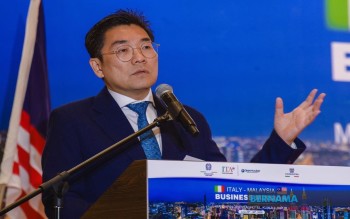
Negotiators from Malaysia and the European Union have advanced discussions on their proposed free trade agreement significantly, having wrapped up talks on five of the key contractual chapters and setting their sights on sealing the comprehensive pact within the next three years. Deputy Investment, Trade and Industry Minister Sim Tze Tzin confirmed that the fourth negotiating round, concluded earlier this month in Kuala Lumpur, yielded final agreements on three additional chapters covering customs procedures, trade remedies, and regulatory alignment—building on earlier successful closure of provisions addressing transparency and small business concerns.
The accelerating pace of these negotiations underscores Malaysia's strategic push to deepen commercial ties with Europe's integrated market of over 450 million consumers. Speaking at an Italy-Malaysia business gathering in the capital, Sim characterised the prospective MEUFTA as a transformative accord capable of repositioning Malaysia within global supply chains and opening avenues for Malaysian enterprises to participate in European innovation ecosystems, particularly within high-technology services, renewable energy infrastructure, and emerging digital commerce sectors. The agreement represents part of a broader diplomatic initiative that traces back to Prime Minister Anwar Ibrahim's formal visit to Rome last year, where he met with Italian Premier Giorgia Meloni to explore deeper bilateral cooperation.
With the fifth negotiating round now scheduled for late September in Brussels, both trading partners are demonstrating momentum toward their 2027 target. The calendar places the next critical discussions just three months ahead, allowing negotiators sufficient time to tackle remaining contentious chapters—likely to include intellectual property protections, government procurement standards, and dispute resolution mechanisms that typically consume extensive rounds of deliberation. Reaching final agreement by 2027 would position MEUFTA alongside other major regional trade architecture initiatives Malaysia has pursued, including its participation in the Regional Comprehensive Economic Partnership and various bilateral arrangements across Southeast Asia.
Italy's emergence as Malaysia's fifth-largest European trading partner reflects the depth of existing commercial engagement between the two economies. Recent trade data released by Sim shows bilateral commerce reaching approximately RM17 billion in 2025, representing robust 14.2 percent year-on-year growth. Malaysian shipments to the Italian market expanded by 12.7 percent to RM7.6 billion, driven substantially by palm-derived products and derivatives that dominate Malaysia's agricultural export portfolio alongside iron and steel commodities, electronics components, and industrial machinery. The composition of Malaysia's imports from Italy—predominantly high-specification machinery, optical instruments, chemical compounds, and precision electronics—indicates a complementary relationship where each economy supplies the other with goods reflecting its comparative advantages.
Beyond trade flows, Italy has demonstrated substantial confidence in Malaysia's manufacturing environment through significant direct investment. Over 80 Italian manufacturing enterprises have committed approximately US$442 million to projects across Malaysian territory, establishing operations in food transformation, chemical manufacturing, machinery production, and aerospace sectors. This investment pattern reveals how Malaysian policymakers have successfully positioned the nation as a reliable platform for European manufacturers seeking production bases serving the broader Southeast Asian market. The availability of established industrial ecosystems, existing supplier networks, and increasingly sophisticated logistics infrastructure has proven attractive to Italian entrepreneurs assessing alternative manufacturing locations outside traditional European hubs.
Sim emphasised the particular complementarity between Malaysia and Italy in electronics and machinery sectors, noting that both economies possess sophisticated manufacturing capabilities and institutional knowledge. Malaysia's established E&E industry, characterised by world-class fabrication facilities and decades of accumulated expertise, potentially offers Italian equipment manufacturers opportunities for deeper collaboration through co-production arrangements and technology partnerships. Such linkages could benefit Malaysian enterprises seeking to upgrade their own technological capabilities while providing Italian companies access to cost-competitive production environments without sacrificing quality standards or supply chain predictability.
The government's recently implemented New Investment Incentive Framework, activated in March 2025, signals Malaysia's commitment to deepening its manufacturing sophistication beyond assembly-line operations. The policy structure provides tax advantages targeting advanced manufacturing processes, front-end semiconductor fabrication activities, and integrated circuit design work—precisely the higher-value segments where Malaysian policymakers hope to expand the nation's footprint. Sim clarified that these incentives apply universally to qualifying investors regardless of origin, deliberately countering perceptions that Malaysia reserves preferential treatment exclusively for foreign enterprises. This universalist approach reflects recognition that Malaysian companies themselves require systematic support to transition from contract manufacturing toward original design and engineering functions.
Semiconductor advancement forms a cornerstone of Malaysia's long-term industrial strategy, particularly given the sector's escalating geopolitical importance and robust profit margins. By concentrating investment incentives on semiconductor-adjacent activities rather than lower-value assembly work, Malaysian authorities hope to capture greater value within the global electronics supply chain while building institutional competencies that translate into sustained competitive advantage. European semiconductor equipment manufacturers and materials suppliers potentially represent valuable partners for Malaysian companies attempting to climb the technological ladder, suggesting that a completed MEUFTA could facilitate knowledge transfer and collaborative ventures that benefit both economies.
The emphasis on assisting Malaysian firms in moving up the value hierarchy addresses a longstanding challenge within Southeast Asian industrial policy: how to transition from labour-intensive manufacturing toward innovation-driven production before wage-based competitiveness erodes. Sim's reframing of investment incentives as universally available tools, rather than merely foreign investor inducements, acknowledges this priority and suggests growing sophistication in how Malaysian policymakers approach structural economic transformation. This shift indicates recognition that sustainable competitive advantages derive from encouraging domestic enterprises to develop proprietary capabilities and technological depth rather than perpetually relying on imported expertise and foreign operational leadership.
The proposed MEUFTA carries implications extending well beyond bilateral Malaysia-EU commerce. As one of Southeast Asia's most industrialised economies and a crucial node within regional supply networks, Malaysia's deeper integration with European markets would influence how multinational production networks align across Asia and Europe. Increased trade rules predictability through the agreement could attract additional European investment into Malaysia and stimulate Malaysian enterprises' participation in European value chains. Furthermore, the accord would strengthen Malaysia's bargaining position within broader regional negotiations and reinforce its status as a preferred Southeast Asian partner for Western trading partners increasingly focused on supply chain resilience and geographic diversification away from concentrated production bases.

