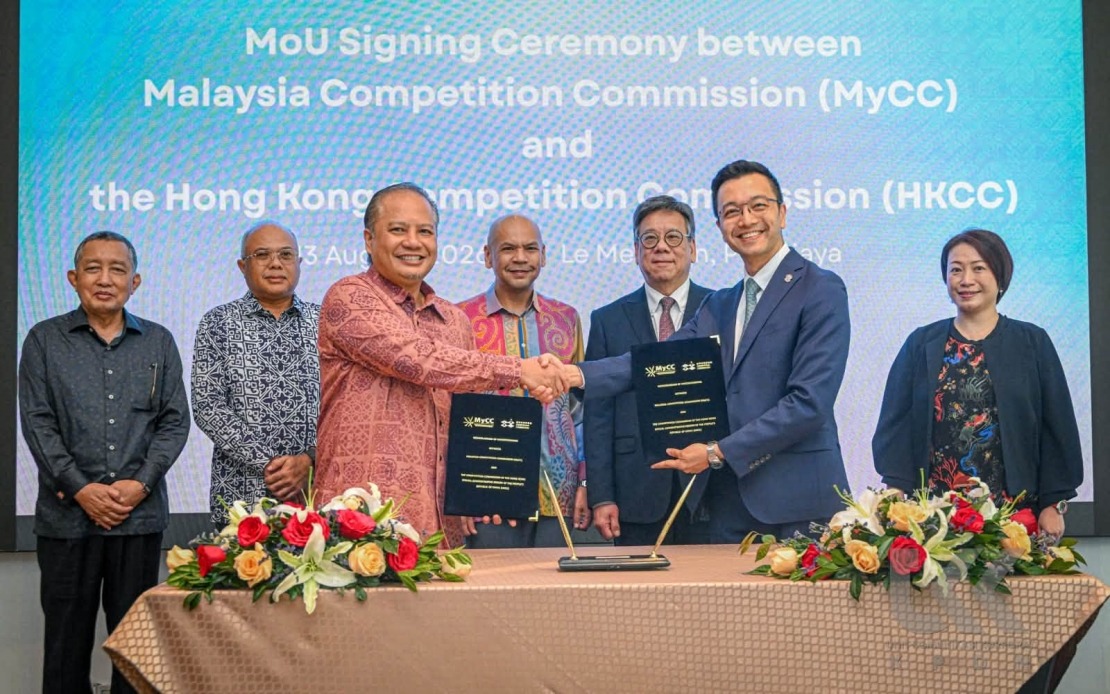
The Malaysia Competition Commission (MyCC) and Hong Kong Competition Commission (HKCC) have formalized their commitment to joint enforcement action through a new Memorandum of Understanding, positioning both jurisdictions to better manage competition challenges in an increasingly integrated regional economy. The agreement, signed today, underscores recognition by both authorities that corporate conduct rarely respects territorial boundaries, and that unilateral enforcement efforts often prove insufficient in addressing complex, multinational infringements. For Malaysian regulators and businesses operating across Southeast Asia and beyond, the pact signals a maturing institutional approach to competition policy at a time when digital platforms and supply chain integration have rendered traditional national enforcement models inadequate.
Domestic Trade and Cost of Living Minister Datuk Armizan Mohd Ali characterized the memorandum as Malaysia's fourth bilateral competition accord, following comparable frameworks established with Türkiye, South Korea, and the Philippines. This expanding network of formal agreements reflects a deliberate strategy by Kuala Lumpur to position MyCC as a credible regional player in enforcement coordination. Each agreement builds institutional capacity incrementally, allowing Malaysian competition authorities to learn from peers operating in larger or more developed markets while simultaneously exporting lessons learned in enforcing competition principles within Malaysia's own distinctive context. The sequential signing of these pacts also suggests growing confidence among trading partners in Malaysia's commitment to rules-based economic governance.
The substantive benefits of the MoU extend beyond symbolic cooperation. Both bodies will systematically exchange information on legislative developments affecting competition law, enabling each jurisdiction to anticipate and adapt to regulatory shifts that may have spillover effects. This intelligence sharing proves especially valuable in Hong Kong, a major financial and trading hub where corporate structures and cross-border arrangements often have profound implications for Southeast Asian markets. Malaysian businesses with operations in Hong Kong, and vice versa, will benefit from regulators acting on shared understanding rather than divergent interpretations of what constitutes anti-competitive conduct. The arrangement effectively reduces information asymmetries that previously allowed sophisticated actors to exploit gaps between jurisdictional frameworks.
Operational cooperation will deepen through technical assistance mechanisms including training exchanges, joint workshops, and officer secondment programs. These capacity-building initiatives serve multiple functions simultaneously. They standardize enforcement methodologies, ensuring that investigative techniques applied in Hong Kong investigations involving Malaysian parties align with standards Malaysian regulators would expect. They also create professional networks among competition officials that facilitate informal problem-solving when complex cases straddle both jurisdictions. For MyCC specifically, exposure to HKCC's practices offers opportunity to benchmark against a sophisticated regulator operating in a leading global financial centre, potentially elevating enforcement quality across Malaysian agencies.
Minister Armizan emphasized that cross-border competition issues now constitute the frontier challenge for national regulators working in isolation. Digital commerce, financial services, and technology sectors routinely involve commercial relationships spanning multiple countries with enforcement consequences that single authorities cannot adequately address. A Malaysian company facing anti-competitive restrictions imposed by a Hong Kong-based competitor, or vice versa, previously faced fragmented remedies with limited enforcement teeth. Under the MoU framework, authorities can coordinate investigations, share evidence subject to confidentiality protections, and pursue aligned enforcement action that amplifies deterrent effect. This coordination becomes especially critical in sectors like telecommunications and e-commerce where dominant platforms operate across the region.
The agreement's emphasis on addressing enforcement challenges through bilateral and multilateral channels reflects pragmatic acknowledgment that competition law has gradually transformed into an inherently international discipline. Cartels operating across borders require coordinated responses; predatory practices by dominant firms in one jurisdiction may only become visible when authorities compare patterns across multiple markets. Hong Kong's role as a financial centre and trade entrepot means that numerous cartels, bid-rigging schemes, and market allocation arrangements involving Malaysian parties inevitably transit through Hong Kong markets or involve Hong Kong-based coordinators. The HKCC gains corresponding benefit from MyCC's insights into the Southeast Asian markets where many suspected cartels source materials or distribute products.
Contextually, Malaysia's succession of bilateral competition agreements reflects broader regional dynamics in which ASEAN economies have begun institutionalizing cooperation mechanisms on economic regulation. While ASEAN lacks a binding supranational competition framework equivalent to European Union standards, individual members increasingly recognize that informal coordination produces superior outcomes to jurisdictional isolation. Hong Kong, though outside ASEAN, operates as a critical node in Southeast Asian trade and finance networks, making formal liaison channels especially valuable. The MoU also subtly positions Malaysia as a jurisdiction taking competition enforcement seriously—a reputational asset when multinational enterprises consider regional headquarters locations or investment destinations.
Domestic implications for Malaysian consumers and businesses extend beyond enforcement coordination. Stronger Hong Kong-Malaysia linkages in competition policy create deterrent effects against cartels and monopolistic practices that previously escaped scrutiny through jurisdictional arbitrage. A company might have previously calculated that cartelizing prices for goods sold to both Malaysian and Hong Kong buyers carried manageable enforcement risk if authorities in either jurisdiction worked independently. Coordinated enforcement raises those risk calculations substantially. For consumers, more effective competition enforcement translates gradually into more competitive pricing and greater product choice, particularly in sectors like telecommunications, banking, and consumer goods where Malaysia and Hong Kong overlap in supply chains or customer bases.
MyCC's positioning within this international framework merits particular attention for Malaysian stakeholders. The Commission continues evolving from a primarily domestic regulator into a member of the global competition enforcement community, gradually accumulating experience with complex cross-border cases and international best practices. This institutional development requires sustained investment in specialized personnel, forensic capabilities, and international legal expertise. The Hong Kong agreement, combined with earlier pacts with Turkey, Korea, and the Philippines, demonstrates that Malaysia's leadership recognizes these investments as essential to maintaining economic competitiveness and protecting consumers from international cartels.
Minister Armizan's statement that Malaysia will continue strengthening ties with additional international competition authorities suggests this network will expand further. The identification of cooperation as essential to maintaining Malaysia's competitive ecosystem positions competition enforcement as integral to economic strategy rather than a marginal regulatory function. As Southeast Asian economies integrate more deeply through ASEAN frameworks and bilateral trade arrangements, the capacity to enforce competition rules across borders becomes increasingly critical to ensuring that liberalization benefits actually reach consumers rather than enriching cartels and dominant firms exploiting regulatory gaps. Malaysia's methodical approach to building bilateral relationships, though less dramatic than regional supranational frameworks, may prove more durable and effective given the heterogeneity of enforcement approaches across Asia-Pacific jurisdictions.

