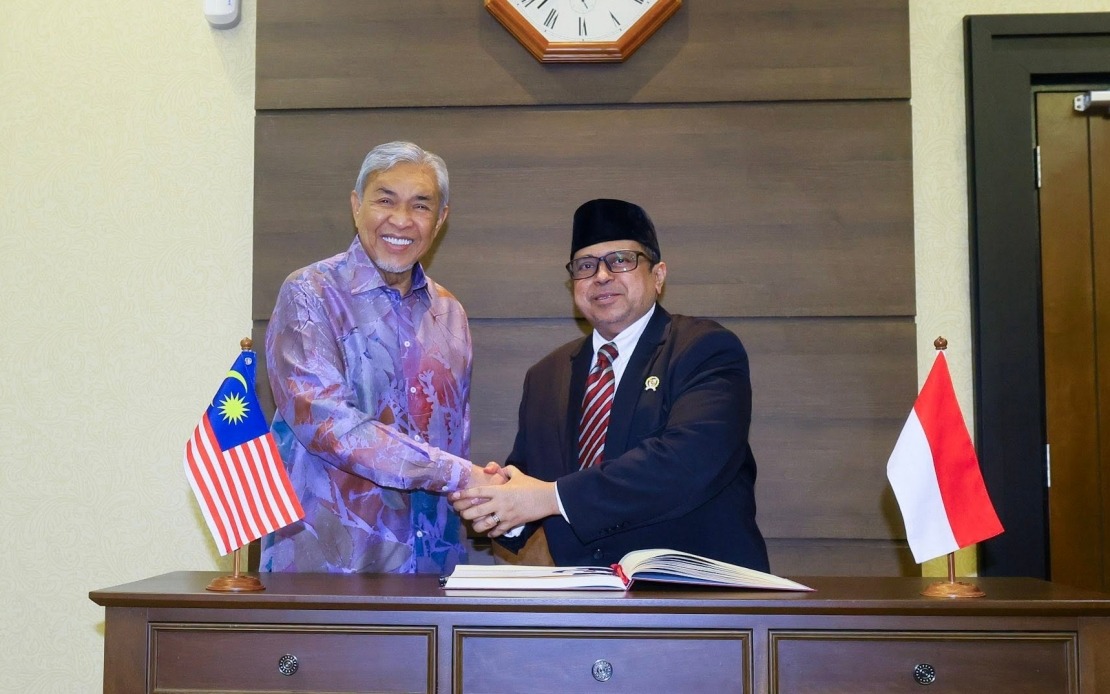
Malaysia and Indonesia have committed to broadening their partnership across the halal sector, with both nations moving forward on initiatives that could reshape how the region approaches Islamic commerce and standards. Deputy Prime Minister Datuk Seri Dr Ahmad Zahid Hamidi revealed the strategic direction during talks with Indonesia's Ambassador to Malaysia, Raden Datuk Mohammad Iman Hascarya Kusumo, and Dr Ahmad Haikal Hassan, head of Indonesia's Halal Product Assurance Organising Body (BPJPH), at Parliament on June 25. The discussions underscored the two nations' determination to leverage their historical and geographic proximity as a springboard for sectoral advancement.
The bilateral engagement extends far beyond halal manufacturing and certification. Both governments recognised the potential for coordinated development across trade corridors, agricultural expansion in rural communities, and workforce capability building. These intersecting dimensions reflect a mature understanding that sustainable halal industry growth depends not merely on labelling compliance but on integrated value chains spanning production, logistics, retail and consumer education. The timing proves significant given the region's mounting appetite for certified Islamic products and the rising international competition from non-Muslim-majority producers seeking halal market share.
Central to the partnership framework is the proposed Malaysia-Indonesia Halal Council (MIHC), conceived as a dedicated platform for bilateral standard-setting and operational alignment. By institutionalising dialogue at the council level, both nations aim to reduce friction in cross-border certification processes and create reciprocal recognition mechanisms that simplify market access for compliant businesses. This addresses a long-standing frustration among exporters in both countries who encounter inconsistent interpretation of halal requirements when entering each other's markets, despite shared Islamic heritage and similar regulatory philosophies.
Equally ambitious is the envisioned ASEAN Halal Council, which would extend coordination across the broader Southeast Asian bloc. Malaysia and Indonesia, as the region's largest Muslim-majority economies and established halal leaders, would anchor this broader architecture. Such a regional body could harmonise standards across diverse regulatory frameworks, reduce compliance costs for multinational halal companies operating throughout ASEAN, and project unified Southeast Asian influence in global halal governance discussions. It would also position the region as a coherent voice in international forums rather than allowing individual nations to negotiate separately from fragmented positions.
The World Halal Development Council represents the most expansive element of the envisioned structure. Its establishment would elevate the conversation beyond bilateral or regional confines to address halal industry challenges at the planetary scale. For Malaysia and Indonesia, this reflects strategic intent to shape global halal standards rather than passively adopt frameworks developed elsewhere. The council could facilitate knowledge exchange with non-Muslim nations increasingly engaged in halal production, establish common protocols for emerging sectors like plant-based and cultured meat, and create investment promotion vehicles that channel capital into halal ventures across developing economies.
Ahmad Zahid, serving concurrently as chairman of the Malaysia Halal Industry Development Council, positioned the cooperation within Malaysia's broader domestic agenda. His dual role signals how halal sector expansion connects to national economic diversification, particularly relevant given Malaysia's historical dependence on commodities and manufacturing. The halal industry represents a knowledge-intensive, high-margin opportunity where Malaysia already possesses genuine competitive advantage through established certification infrastructure, trained personnel, and brand recognition. Deepening Indonesian partnership multiplies these assets across a market of over 270 million people while creating spillover benefits for Malaysian service providers and equipment suppliers.
Indonesia's participation carries distinct implications for both nations. For Indonesia, collaboration with Malaysia's more formalised halal governance system offers pathways to accelerate its own certification infrastructure. The BPJPH, while relatively young, governs a vast Muslim population producing increasing volumes of halal goods. Access to Malaysian expertise and joint certification frameworks could reduce time-to-market for Indonesian exporters entering stringent international markets. For Malaysia, Indonesian partnership expands the hinterland of raw material sourcing and labour-intensive production, allowing Malaysian companies to maintain competitive positioning while focusing on higher-value activities like quality assurance and marketing.
The investment implications merit attention. Halal financial services, halal logistics, halal tourism, and halal pharmaceuticals represent growth sectors beyond food manufacturing. A Malaysia-Indonesia halal ecosystem supported by multilayered councils could attract foreign direct investment from both Islamic finance institutions and mainstream corporations seeking to capture Muslim consumer demographics. Japanese, Turkish, and South African companies have already signalled interest in using Malaysian hubs to access Southeast Asian halal markets. Formalised bilateral cooperation reduces investment uncertainty and creates durable frameworks that survive political transitions.
Regional dynamics add further context. Vietnam, Thailand, and the Philippines possess significant Muslim populations and food processing capabilities yet lack mature halal governance structures. A robust Malaysia-Indonesia-led halal framework could become the de facto standard across ASEAN, extending both nations' soft power while creating commercial opportunities for their certification bodies and consulting firms. Singapore's position as a regional financial and logistics hub makes it a natural complementary partner in the broader ecosystem, though predominantly non-Muslim demographics limit its direct participation.
The global halal market, valued at approximately USD 2 trillion across food, pharmaceuticals, cosmetics and other sectors, continues expanding as Muslim populations grow and purchasing power rises in emerging markets. Malaysia and Indonesia together represent roughly 40 percent of the global Muslim population, positioning them as natural leaders in halal industry architecture. However, this leadership must be actively maintained through coordinated standard-setting and market development. Competition from established halal producers in Turkey, Pakistan, and Australia demonstrates that market share depends on continuous innovation and adaptation rather than static compliance.
Implementing the proposed council structure requires navigating technical and political complexities. Harmonising standards across two nations with distinct regulatory histories demands compromise; neither nation can simply impose its existing framework unilaterally. Resource allocation for council operations, dispute resolution mechanisms, and representation structures all require negotiation. Yet the commercial incentives favour progress. Businesses operating across both nations benefit directly from reduced certification friction, while governments gain efficiency through shared infrastructure and expertise pooling.
The partnership also positions Malaysia and Indonesia to shape emerging halal frontiers. Sustainable halal production, digital halal traceability using blockchain technology, and halal certification for renewable energy represent growth areas where bilateral cooperation could establish standards before international bodies intervene. Demonstrating thought leadership in these spaces enhances both nations' credibility in international forums and commercial negotiations.
Moving forward, success hinges on translating political commitment into concrete institutional mechanisms and investment. The proposed councils require operating budgets, experienced personnel, and genuine authority to make binding recommendations. Malaysian and Indonesian governments must signal long-term commitment beyond ceremonial announcements, with resources and diplomatic priority backing the initiative. Industry participation from both nations' leading halal companies will prove essential for grounding the frameworks in practical commercial reality. If executed effectively, this partnership could establish Malaysia and Indonesia as the undisputed architects of Southeast Asian halal governance for the coming decade.

