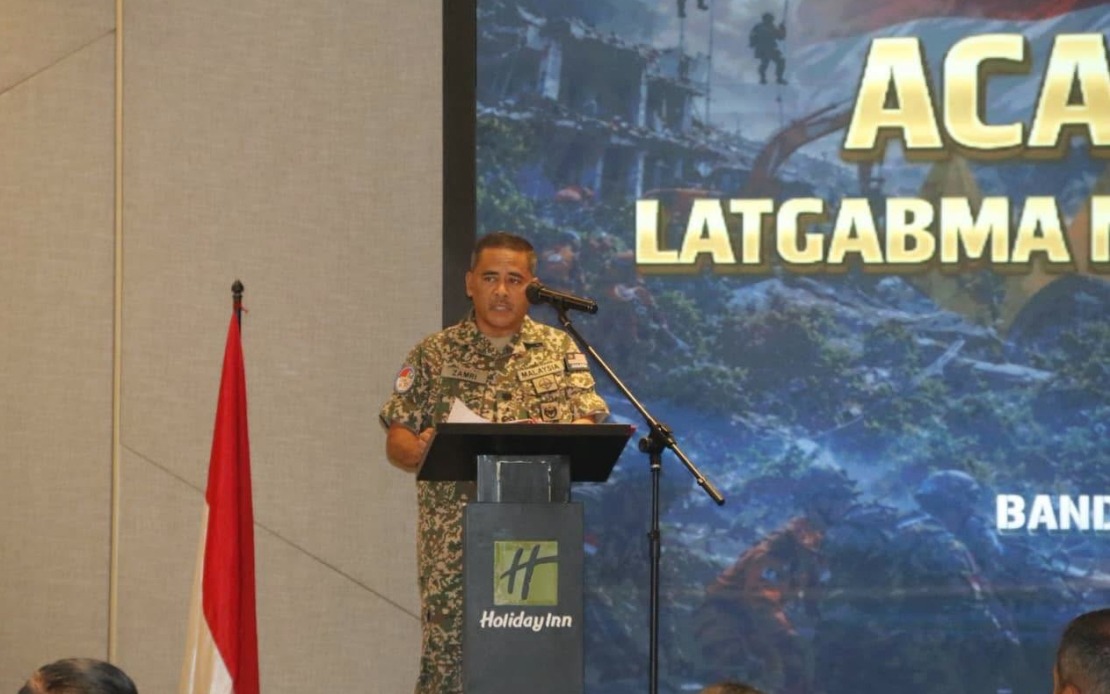
The Malaysian Armed Forces and Indonesia's National Armed Forces have taken a significant step forward in their strategic partnership by conducting an extensive 13-day joint military exercise in Lampung, Sumatra. Known as LATGABMA MALINDO DARSASA 12AB/2026, the operation represents more than routine defence activity—it signals deepening institutional trust and coordinated capability-building between two major Southeast Asian defence establishments at a time of mounting transnational security challenges throughout the region.
The exercise, which brought together 719 military personnel and civilian responders from both nations, reflects a methodical approach to addressing the evolving threat landscape. Rather than focusing solely on traditional inter-military operations, the planning emphasises humanitarian assistance, disaster relief capabilities, search-and-rescue coordination and emerging cyber vulnerabilities. This multidimensional framework acknowledges that contemporary security in Southeast Asia extends far beyond conventional military concerns, encompassing natural disasters, organised criminal networks, terrorism and digital warfare.
Brigadier General Datuk Zamri Othman, Commander of the 1st Infantry Brigade and chief of the MAF's exercise planning group, emphasised that the operation serves dual purposes. Beyond testing integrated operational procedures across land, maritime and air domains, it provides military personnel from both countries with direct exposure to shared procedural standards and confidence-building interactions. Such interpersonal familiarity among officers and enlisted ranks proves invaluable when rapid coordination becomes necessary during genuine crises, whether military confrontations or humanitarian catastrophes.
The choice of Lampung Province carries particular strategic logic. The region sits at the intersection of three active tectonic plate boundaries, creating an environment where earthquake and tsunami scenarios remain perpetually relevant training concerns. Rather than conducting abstract exercises, planners deliberately crafted scenarios rooted in Indonesia's actual disaster experiences, particularly catastrophic events that have devastated southern Sumatra. This grounding in lived experience produces more realistic preparation and equips participants with knowledge transferable to actual emergency situations affecting civilian populations.
The exercise curriculum divides into complementary academic and practical components. Through staff exercises, participants studied ten critical disaster scenarios ranging from initial emergency response through long-term stabilisation and transition phases. These structured sessions, involving officers from Malaysian and Indonesian defence ministries, fostered shared understanding of decision-making frameworks and response protocols. Participants then transitioned to field exercises where they applied classroom learning to simulated conditions, conducting practical activities such as establishing field hospitals, executing rope-rescue operations and coordinating medical interventions.
Civilian agency participation expanded the exercise's relevance considerably. Indonesian organisations including the National Search and Rescue Agency, Disaster Preparedness Cadets, Red Cross and Regional Disaster Management Agency worked alongside military contingents. This integration mirrors real-world emergency response, where effective management requires seamless coordination between armed forces and civilian emergency services. Malaysian participation included representatives from the National Disaster Management Agency, demonstrating institutional commitment to cross-border cooperation frameworks.
The exercise incorporated substantial community engagement components that extended benefits beyond military training objectives. Engineering teams conducted repairs on uninhabitable residential structures in participating villages and constructed concrete road infrastructure in rural communities. Medical teams operated health screening programmes at community clinics, distributed free spectacles and organised blood donation initiatives. Such civic action programming simultaneously strengthens host-nation relationships with military forces and demonstrates the practical value of defence cooperation to civilian populations who otherwise experience armed forces primarily through taxation.
Cyberspace received focused attention throughout the exercise, reflecting recognition that modern conflicts increasingly occur in digital domains. Training encompassed reconnaissance techniques, credential compromise methods, man-in-the-middle interception and information manipulation tactics. This segment proved particularly timely given regional tensions involving state-sponsored cyber activities, information warfare and infrastructure vulnerability. Building shared understanding of cyber threats and defence protocols between Malaysian and Indonesian forces enhances regional resilience against external actors seeking to exploit divided responses.
The LATGABMA MALINDO DARSASA exercise traces its lineage to 1984, operating through bilateral frameworks including the General Border Committee and the Malaysia-Indonesia Joint Training Committee, rotating between nations every three years. The previous iteration occurred in Pekan, Pahah in 2023, employing anti-terrorism scenarios. This consistency across decades demonstrates institutional stability and mutual commitment despite periodic diplomatic tensions or changes in political leadership. The exercise mechanism provides continuity in military-to-military relationships that sometimes transcends fluctuating diplomatic relations.
Regional security dynamics increasingly favour deepening Malaysia-Indonesia defence cooperation. Non-traditional threats—maritime piracy, human trafficking, drug smuggling, terrorism financing and environmental degradation—respect neither border nor sovereign jurisdiction. The shared waters between Peninsular Malaysia, Sabah, Sarawak and Indonesian territories require coordinated surveillance and intervention capabilities. Cyber threats similarly ignore geographical boundaries, with malicious actors operating across jurisdictions and targeting critical infrastructure throughout Southeast Asia. Joint training builds mutual understanding of threat patterns and compatible response mechanisms.
For Malaysian defence planners, the exercise demonstrates commitment to regional integration while maintaining institutional competence in complex operations. As Southeast Asia gravitates toward multipolarity with great power competition intensifying, smaller nations benefit from developing robust bilateral relationships that enhance collective capability. The exercise format—emphasising disaster response and humanitarian assistance rather than military dominance—projects Malaysia as a cooperative regional actor aligned with broader ASEAN principles of non-interference and peaceful dispute resolution.
The participation structure reveals institutional depth within both militaries. The Malaysian contingent of 150 personnel, alongside 463 Indonesian military members and dozens of civilian responders, demonstrates sustained resource commitment. Such scale indicates that defence cooperation constitutes genuine strategic priority rather than ceremonial gesture. Repeated exercises at this scale build institutional muscle memory—officers and non-commissioned officers gain experience with actual procedures they might execute during future crises, whether military or humanitarian.
Looking forward, the exercise framework appears adaptable to emerging challenges. Climate change will intensify tropical storms, flooding and humanitarian crises requiring rapid cross-border coordination. Maritime security threats will likely escalate as resource competition intensifies and non-state actors gain capabilities. Cybersecurity challenges will multiply as critical infrastructure becomes increasingly digitised. The exercise model—combining traditional military training with disaster response and cyber components—provides a flexible platform for building resilience against diverse threats. Consistent execution every three years ensures that new generations of officers benefit from exposure to these operational frameworks, sustaining institutional relationships across personnel rotations.

