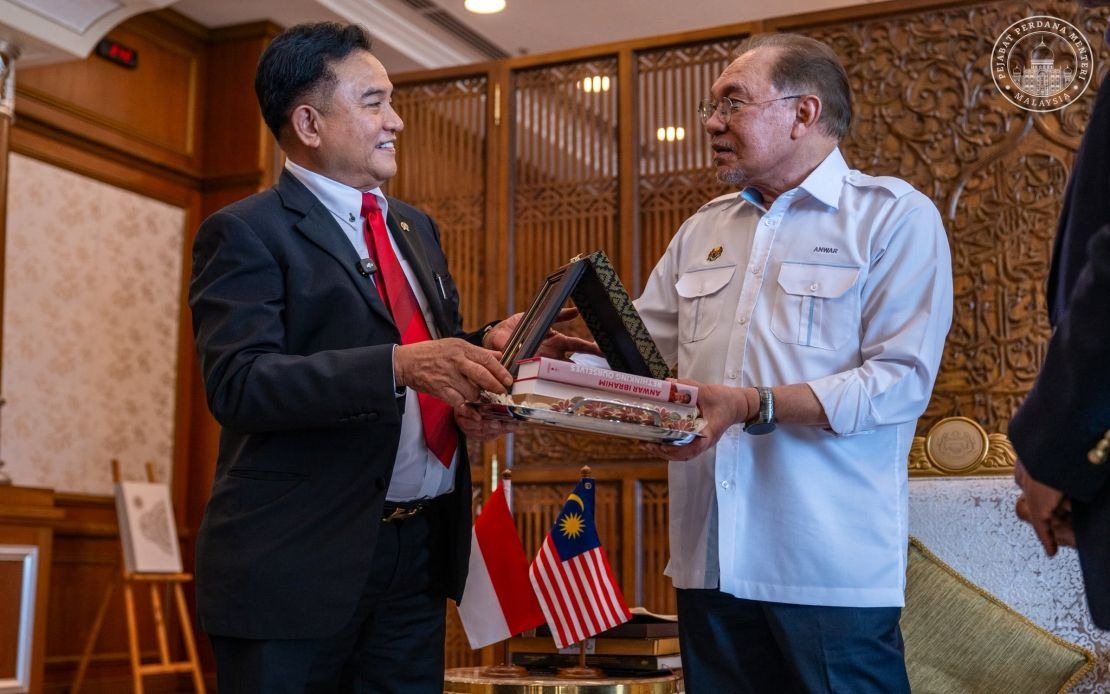
Prime Minister Datuk Seri Anwar Ibrahim has reaffirmed Malaysia's determination to deepen partnership with Indonesia across legislative frameworks, institutional governance structures, and areas of shared strategic concern. The commitment emerged from discussions with Indonesia's Coordinating Minister for Legal, Human Rights, Immigration and Correction, Prof Dr Yusril Ihza Mahendra, who visited Putrajaya for a courtesy meeting at the Prime Minister's Office on June 29.
The bilateral engagement highlights the contemporary importance of legislative and governance alignment between two of Southeast Asia's largest democracies. Both nations, as founding members of the Association of Southeast Asian Nations and regional anchors in their respective right, have long recognised that harmonising legal frameworks and administrative practices can facilitate smoother cooperation on transnational challenges ranging from human trafficking to maritime security and judicial processes affecting citizens on both sides of the border.
Anwar, who holds the concurrent portfolio of Finance Minister, emphasised during the meeting that strengthening institutional cooperation serves broader objectives beyond technical legal matters. The exchange of views between the two leaders reflected an understanding that modern governance challenges—including digital transformation, anti-corruption efforts, and human rights protection—benefit from shared learning and coordinated approaches. Indonesia's focus on legal affairs, human rights, immigration and correctional systems aligns with Malaysia's own priorities in these domains, creating natural platforms for substantive dialogue.
The emphasis on "fraternal relations" carries particular weight in the Malaysian-Indonesian context, where cultural and linguistic affinities coexist with periodic tensions over maritime boundaries, labour migration, and resource management. Regular high-level engagement on governance matters helps institutionalise cooperation beyond personality-driven relationships, embedding bilateral ties within formal structures less vulnerable to political fluctuations. Such meetings establish channels for addressing grievances and preventing misunderstandings before they escalate into diplomatic friction.
For Malaysia specifically, deepening ties with Indonesia offers several practical advantages. Indonesia's experience managing a vast archipelago with diverse regional governments informs approaches to federalism and decentralisation that Malaysian policymakers monitor closely. Similarly, cooperation on immigration and labour policies carries direct relevance to Malaysia's reliance on Indonesian migrant workers across multiple sectors, where clearer legal frameworks and coordinated enforcement reduce irregular migration and trafficking risks affecting both nations.
The legislative cooperation agenda likely encompasses harmonisation efforts in areas where inconsistencies create complications for businesses and citizens operating across borders. Financial services regulation, corporate governance standards, and intellectual property protection frameworks increasingly require regional coordination as economic integration advances. A shared commitment to upgrading these systems strengthens the investment environment for companies operating throughout Southeast Asia.
Human rights and correctional reform represent another substantive dimension of the proposed cooperation. Both countries have committed to international human rights treaties and face similar pressures regarding prison conditions, death penalty practices, and fair trial guarantees. Institutional exchange programmes, training initiatives, and policy consultation on these sensitive matters can demonstrate mutual commitment to upholding shared values while respecting national sovereignty and constitutional frameworks.
The timing of this engagement reflects Indonesia's broader diplomatic priorities under President Joko Widodo's administration, particularly through coordinating ministry structures designed to ensure whole-of-government approaches to complex policy challenges. For Malaysia under Anwar's leadership, the emphasis on institutional cooperation aligns with his administration's focus on reform, transparency, and rule of law as foundations for national development and regional stability.
Beyond the bilateral dimension, stronger Malaysia-Indonesia coordination on governance matters carries implications for ASEAN's collective capacity to address transnational issues. When the region's two largest Muslim-majority democracies demonstrate alignment on legal and human rights standards, they establish benchmarks influencing broader regional norms. This becomes particularly significant in an era where authoritarian trends in some countries have prompted concern among international observers about democratic backsliding across Southeast Asia.
The commitment to sustained cooperation also reflects recognition that legislative and governance challenges increasingly cross traditional boundaries. Cybercrime, environmental degradation, pandemic preparedness, and financial crime require legal frameworks and institutional capabilities that transcend national borders. Malaysia and Indonesia, with their respective strengths and experiences, stand to benefit from structured collaboration that pools expertise and accelerates policy innovation.
Moving forward, the practical manifestation of these commitments will become evident through specific initiatives such as joint working groups, legislative exchange programmes, and capacity-building projects. The success of bilateral governance cooperation ultimately depends on translating high-level political commitment into sustained institutional engagement, adequate resource allocation, and measurable outcomes that demonstrate tangible benefits to both populations. The meeting between Anwar and Prof Dr Yusril Ihza Mahendra thus represents not merely diplomatic courtesy but the initiation of a potentially consequential deepening of Southeast Asia's two largest economies' institutional relationship.

