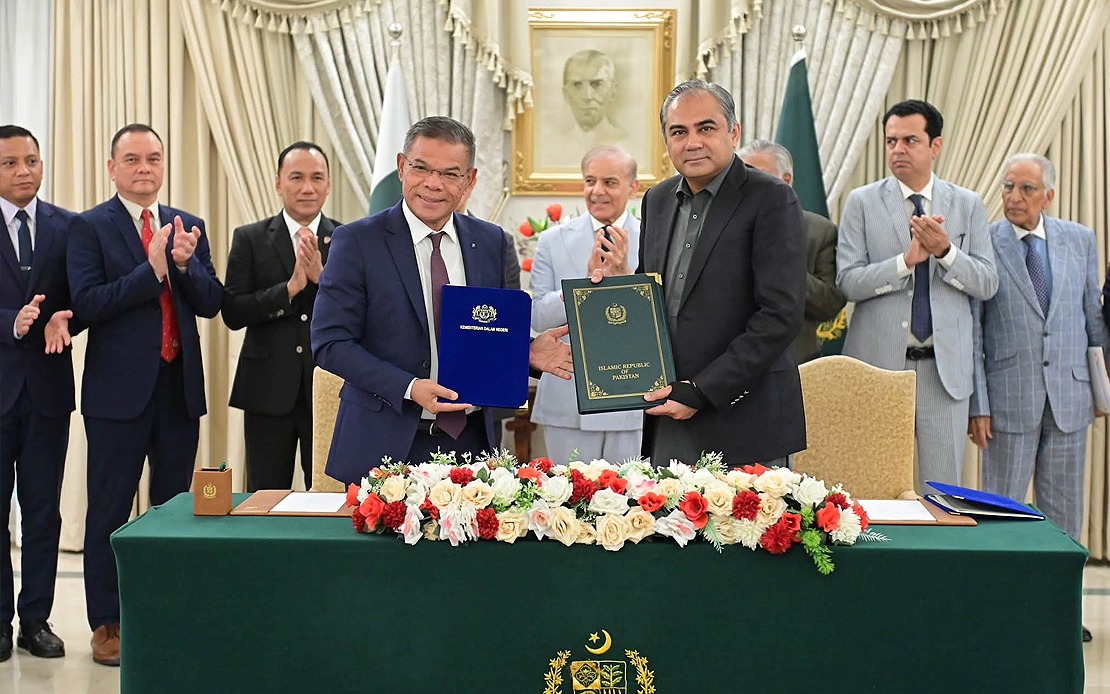
Malaysia and Pakistan have formalised a significant accord on prisoner transfers, with Home Minister Datuk Seri Saifuddin Nasution Ismail and Pakistan's Interior and Narcotics Control Minister Syed Mohsin Raza Naqvi affixing their signatures to the International Transfer of Prisoners (ITOP) Treaty during ceremonies held at Pakistan's Prime Minister's Office. Prime Minister Muhammad Shehbaz Sharif witnessed the historic signing, underscoring the diplomatic importance both governments attach to this arrangement. The development comes after five intensive rounds of negotiation spanning from September 2025, drawing participation from Malaysia's Home Ministry, Foreign Ministry, Attorney General's Chambers, Malaysian Prisons Department and Royal Malaysia Police—a comprehensive whole-of-government approach reflecting the complexity of international prisoner management.
The treaty represents a natural evolution in Malaysia-Pakistan relations, two Muslim-majority nations with historical ties and shared interests in regional stability. Saifuddin Nasution characterised the agreement as marking another milestone in bilateral cooperation, particularly in the security and legal domains where coordination remains essential in an era of transnational crime and terrorism concerns. The Malaysian Cabinet had previously approved the treaty on May 13, clearing the administrative pathway for the signing ceremony. This sequencing demonstrates that both governments had carefully vetted the arrangement through their respective institutional frameworks before proceeding to the formal conclusion.
Operationally, the ITOP Treaty creates a reciprocal mechanism whereby Malaysian nationals incarcerated in Pakistani facilities may petition for transfer home to complete their remaining sentences within the Malaysian correctional system. Simultaneously, Pakistani citizens imprisoned in Malaysia become eligible for repatriation to Pakistan to serve out their sentences there. This bilateral arrangement addresses a persistent challenge in international criminal justice: the plight of foreign nationals separated from their families, communities and cultural contexts while serving lengthy sentences abroad. The emotional and social toll on such prisoners—and the administrative burden on host nation prison systems—has motivated many countries to negotiate similar instruments.
Beyond the mechanical transfer of custody, the treaty embeds a rehabilitation philosophy grounded in cultural and environmental appropriateness. Both governments acknowledge that prisoners undergoing behavioural reform and skill development programmes respond more positively within settings aligned with their own cultural norms, family support systems and linguistic comfort. A Malaysian prisoner in a Pakistani facility, for instance, may struggle with language barriers, dietary practices and social alienation that impede genuine rehabilitation. By enabling transfer to Malaysian prisons operated under familiar legal and cultural frameworks, the treaty presumes higher success rates in reintegration—a philosophy increasingly endorsed by criminology professionals across the region.
The signing ceremony carried particular symbolic weight given the geopolitical context. Malaysia and Pakistan maintain warm diplomatic relations anchored in shared Islamic heritage, military cooperation dating back decades, and economic ties encompassing defence procurement and investment flows. Pakistan, as the first Muslim-majority nation to recognise Malaysia's independence in 1957, represents a partner of historical significance. The prisoner transfer agreement thus functions not merely as a technical legal instrument but as another thread binding the two nations, demonstrating mutual willingness to address complex cross-border issues through institutionalised frameworks rather than ad-hoc arrangements.
Since the dawn of the 21st century, international prisoner transfer treaties have proliferated among Commonwealth nations and beyond, reflecting a maturing consensus around humanitarian and pragmatic grounds for such cooperation. The United Nations has long encouraged member states to negotiate bilateral or multilateral arrangements enabling the repatriation of nationals convicted abroad. Malaysia's previous signature of similar treaties with other jurisdictions—though the ITOP with Pakistan represents one of the most recent and significant—indicates a policy commitment to normalising such mechanisms within the broader criminal justice architecture. The Pakistani signature similarly demonstrates Islamabad's engagement with international legal frameworks, particularly in areas addressing human rights and prisoner welfare.
For Malaysian families with relatives imprisoned in Pakistan, the treaty offers concrete relief. Such cases, while not numerically dominant in either nation's incarcerated population, nonetheless generate acute hardship given the distance, visa complications and financial burden involved in maintaining family contact across South and Southeast Asia. Similarly, Pakistani nationals serving time in Malaysian facilities—a population that includes individuals convicted of transnational drug trafficking, immigration violations and other federal offences—may now anticipate eventual repatriation rather than indefinite separation from their homeland. The treaty thus carries humanitarian dimensions that extend beyond policy abstraction into lived experience.
The legal and administrative machinery supporting the ITOP reflects sophisticated coordination between Malaysia's various institutional actors. The Attorney General's Chambers brings constitutional expertise and ensures alignment with federal criminal law frameworks. The Royal Malaysia Police and Malaysian Prisons Department contribute operational perspectives grounded in decades of experience managing foreign nationals within the criminal justice system. The Foreign Ministry ensures diplomatic protocols are observed and that Pakistani counterparts are engaged through appropriate channels. This multilateral governmental engagement suggests the treaty has been thoroughly stress-tested against potential implementation scenarios and edge cases before finalisation.
Regionally, the Malaysia-Pakistan prisoner transfer treaty may catalyse similar initiatives within ASEAN or between Southeast Asian nations and South Asian partners. Thailand, Indonesia, and the Philippines each host significant populations of foreign nationals in their correctional systems, creating similar humanitarian and administrative pressures. If the Malaysia-Pakistan arrangement functions smoothly in practice—facilitating transfers without security incidents or diplomatic friction—it may serve as a template encouraging Singapore, Brunei and Vietnam to pursue comparable agreements with key source nations. Such proliferation would represent a gradual but meaningful shift toward more humane and efficient management of transnational criminal justice outcomes.
Looking forward, the treaty's success will depend substantially on implementation rigour. Both governments must establish administrative protocols for vetting transfer applications, ensuring security clearances are properly conducted and that prisoners selected for repatriation do not pose unacceptable risk upon return to their home communities. Information-sharing between Malaysian and Pakistani prison authorities, judicial systems and law enforcement agencies will prove crucial in this regard. Any mismanagement—such as transferring an individual who subsequently commits serious crimes in their home nation—could rapidly undermine confidence in the arrangement and complicate bilateral relations.
The timing of the treaty's conclusion also reflects broader momentum in Malaysia-Pakistan relations during a period of relative political stability in both nations. Shehbaz Sharif's government has sought to diversify Pakistan's international partnerships and strengthen cooperation with key Islamic nations, particularly those in Southeast Asia representing significant economic and strategic weight. Malaysia similarly has prioritised deepening its South Asian partnerships beyond traditional linkages with India, recognising Pakistan's importance as an Islamic power, a nuclear state and a nation of geopolitical significance in stabilising the region. The prisoner transfer treaty thus nestles within this larger strategic landscape, functioning simultaneously as practical penal administration reform and as a diplomatic gesture affirming bilateral commitment.
From a Malaysian perspective, the ITOP ratification signals the government's readiness to modernise its approach to foreign nationals engaged with the criminal justice system. Rather than viewing imprisoned foreign nationals primarily through a security or incapacitation lens, the treaty implies recognition that rehabilitation within culturally appropriate environments, combined with family reconnection and eventual reintegration, serves long-term national interests. This philosophical shift—gradual but discernible across Malaysian criminal justice discourse in recent years—positions the nation as a responsible international actor invested in humane yet security-conscious approaches to transnational penology. As the treaty moves into operational phase, both Malaysia and Pakistan will be watched closely by neighbouring nations assessing whether international prisoner transfer arrangements can function effectively in the Asian context.

